. 2023 Oct;23(5):1267-1280.
doi: 10.3758/s13415-023-01108-1. Epub 2023 May 17.

Hierarchical status is rapidly assessed from behaviourally dominant faces

Affiliations

Hierarchical status is rapidly assessed from behaviourally dominant faces

Alan J Pegna et al. Cogn Affect Behav Neurosci. 2023 Oct.

Abstract

Recognition of social hierarchy is a key feature that helps us navigate through our complex social environment. Neuroimaging studies have identified brain structures involved in the processing of hierarchical stimuli, but the precise temporal dynamics of brain activity associated with such processing remains largely unknown. In this investigation, we used event-related potentials (ERPs) to examine the effect of social hierarchy on the neural responses elicited by dominant and nondominant faces. Participants played a game where they were led to believe that they were middle-rank players, responding alongside other alleged players, whom they perceived as higher or lower-ranking. ERPs were examined in response to dominant and nondominant faces, and low-resolution electromagnetic tomography (LORETA) was used to identify the implicated brain areas. The results revealed that the amplitude of the N170 component was enhanced for faces of dominant individuals, showing that hierarchy influences the early stages of face processing. A later component, the late positive potential (LPP) appearing between 350-700 ms, also was enhanced for faces of higher-ranking players. Source localisation suggested that the early modulation was due to an enhanced response in limbic regions. These findings provide electrophysiological evidence for enhanced early visual processing of socially dominant faces.

Keywords: Dominance; Emotion; Face; LPP; N170; P2; Social interaction; VPP.


Figures

Fig. 1
Fig. 1
(A) Examples of a typical trial (stimuli are not shown to scale). (B) After 10 trials with the same player, feedback was provided regarding said player and the participant with indications of hierarchical status (inferior = 1 star; superior = 3 stars). All players received 1 star for the first two blocks. Later, players were updated with participants always receiving an intermediate (2-star) rating. (C) After the first two blocks, a global ranking was provided that was then used throughout the subsequent blocks
Fig. 2
Fig. 2
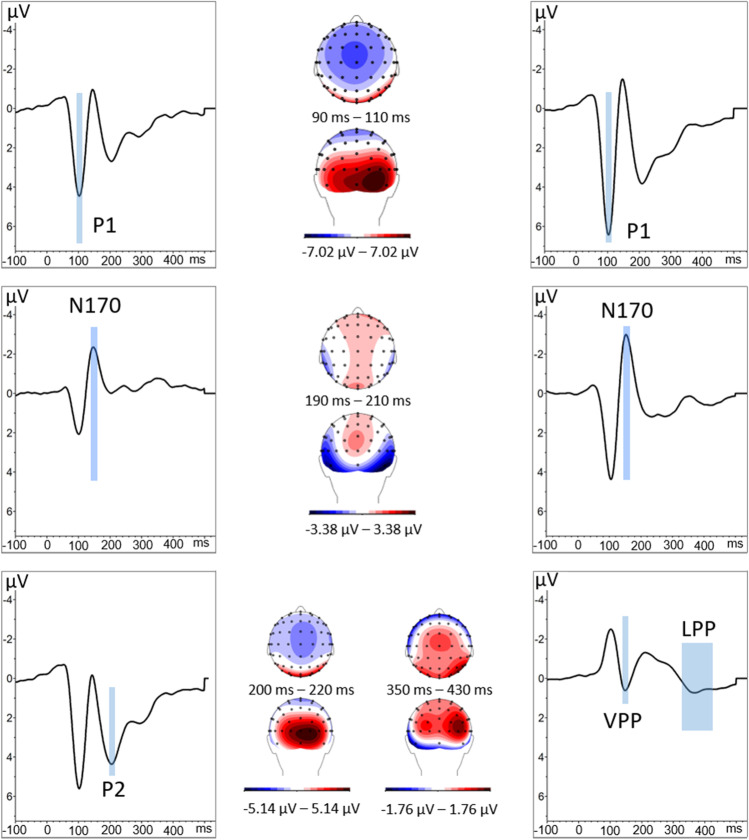
Grand-average waveform for the P1 (O1/O2, PO7/PO8, P9/P10), N170 (P7/P8, P9/P10 and TP9/TP10), P2 (Iz/O1/O2/Oz/PO7/PO8), and VPP and LPP (C1, C2, Cz, CP1, CP2, CPz, FC1, FC2, FCz) averaged over the electrodes of interest. Traces are expressed as mV over time (in ms). Centre: Scalp topographies viewed from above and behind for the mean during the respective time periods with corresponding color code below. The time window and scalp topography for the VPP is the same as for the N170 (central insert)
Fig. 3
Fig. 3
ERPs for control condition (black), dominant (red), and nondominant faces (blue) averaged over the electrodes of interest for the N170 and VPP. The blue boxes highlight the period corresponding to the N170/VPP situated between 145-165 ms. Centre: Scalp topography during the 145- to 165-ms time period viewed from above (top image) and from behind (bottom image) for the mean of the three conditions
Fig. 4
Fig. 4
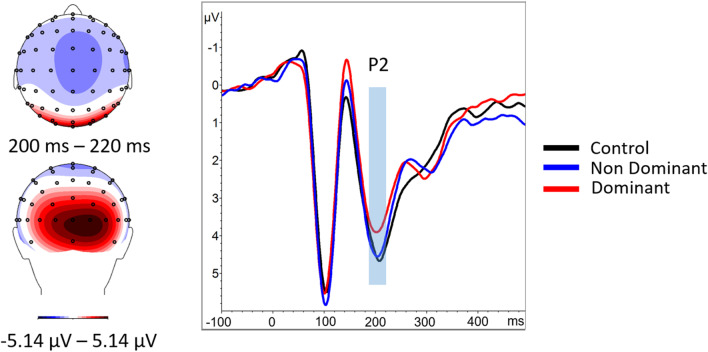
Right: ERPs for control condition (black), dominant (red), and nondominant faces (blue) averaged over the electrodes of interest for the P2 (electrodes Iz, O1, O2, Oz, PO7, and PO8). The period for the P2 is highlighted with the red box. Left: Mean P2 scalp topography viewed from above (top left) and behind (bottom left) for the three conditions averaged during the P2 time window
Fig. 5
Fig. 5
Right: ERPs for control condition (black), dominant (red) and nondominant faces (blue) averaged over the electrodes of interest for the LPP (electrodes C1, C2, Cz, CP1, CP2, CPz, FC1, FC2, FCz ). The LPP is highlighted in red. Left: Mean scalp topographies viewed from above (top left) and behind (bottom left) for the three conditions averaged during the 350 to 430 ms time window
Fig. 6
Fig. 6
Left panel: mean current density (y-axis in uV/mm2) over time (x-axis in ms) for dominant (red line) and nondominant faces (blue line) in the Limbic ROI. Blue boxes indicate the time periods corresponding to the N170, P2, and LPP periods identified in the ERP analyses. Right panel: Overlay of the ROI (highlighted in red), superimposed on a horizontal (top), sagittal (bottom left) and coronal (bottom right) sections of the MNI average brain. Mean activity in this ROI was significantly greater for dominant faces during the N170 time window (yellow pointers indicate location of maximum activity in this ROI during this window, and correspond to MNI coordinates: X = 39, Y = −7, Z = −24)
Fig. 7
Fig. 7
Mean current density during the LPP time period (350-430 ms) for faces averaged across all conditions. The scalp topography of the LPP was best explained by activity in the extrastriate visual cortices (BA 19), as well as anterior temporal (BA 20, BA 37, BA38) and prefrontal areas (BA 10, BA 11)

References

    1. Batty M, Taylor MJ. Early processing of the six basic facial emotional expressions. Cognitive Brain Research. 2003;17(3):613–62. doi: 10.1016/S0926-6410(03)00174-5. - DOI - PubMed
    1. Bauman MD, Toscano JE, Mason WA, Lavenex P, Amaral DG. The expression of social dominance following neonatal lesions of the amygdala or hippocampus in rhesus monkeys (Macaca mulatta) Behavioral Neuroscience. 2006;120(4):749. doi: 10.1037/0735-7044.120.4.749. - DOI - PubMed
    1. Bentin S, Allison T, Puce A, Perez E, McCarthy G. Electrophysiological studies of face perception in humans. Journal of Cognitive Neuroscience. 1996;8(6):551–565. doi: 10.1162/jocn.1996.8.6.551. - DOI - PMC - PubMed
    1. Bradley MM, Hamby S, Löw A, Lang PJ. Brain potentials in perception: Picture complexity and emotional arousal. Psychophysiology. 2007;44(3):364–373. doi: 10.1111/j.1469-8986.2007.00520.x. - DOI - PubMed
    1. Breton A, Jerbi K, Henaff M-A, Cheylus A, Baudouin J-Y, Schmitz C, Krolak-Salmon P, Van der Henst J-B. Face the hierarchy: ERP and oscillatory brain responses in social rank processing. PloS One. 2014;9:e91451. doi: 10.1371/journal.pone.0091451. - DOI - PMC - PubMed

Publication types

MeSH terms

LinkOut - more resources