


Primary SARS-CoV-2 infection in patients with immune-mediated inflammatory diseases: long-term humoral immune responses and effects on disease activity
- PMID: 37198536
- PMCID: PMC10189216
- DOI: 10.1186/s12879-023-08298-6
Primary SARS-CoV-2 infection in patients with immune-mediated inflammatory diseases: long-term humoral immune responses and effects on disease activity
Abstract
Background: Patients with immune-mediated inflammatory diseases (IMIDs) on immunosuppressants (ISPs) may have impaired long-term humoral immune responses and increased disease activity after SARS-CoV-2 infection. We aimed to investigate long-term humoral immune responses against SARS-CoV-2 and increased disease activity after a primary SARS-CoV-2 infection in unvaccinated IMID patients on ISPs.
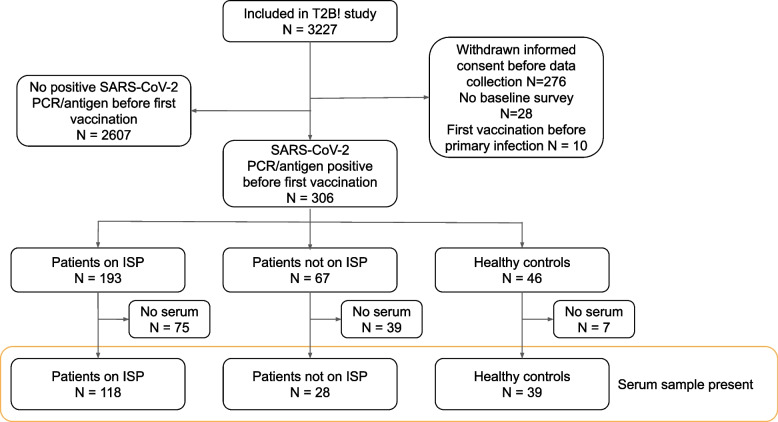
Methods: IMID patients on active treatment with ISPs and controls (i.e. IMID patients not on ISP and healthy controls) with a confirmed SARS-CoV-2 infection before first vaccination were included from an ongoing prospective cohort study (T2B! study). Clinical data on infections and increased disease activity were registered using electronic surveys and health records. A serum sample was collected before first vaccination to measure SARS-CoV-2 anti-receptor-binding domain (RBD) antibodies.
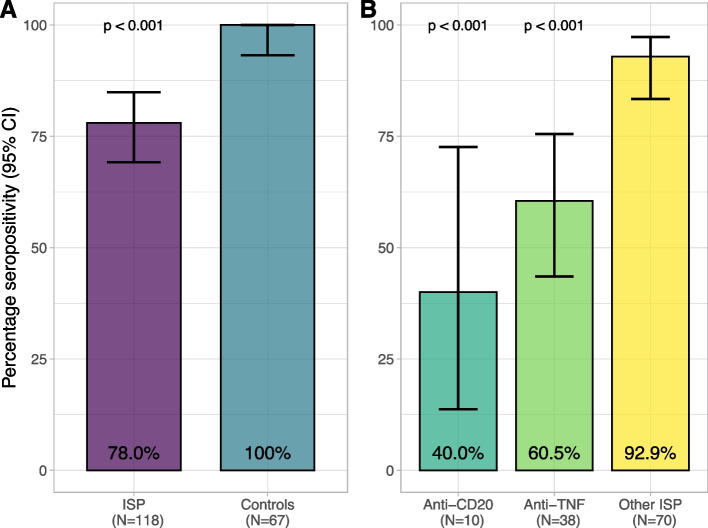
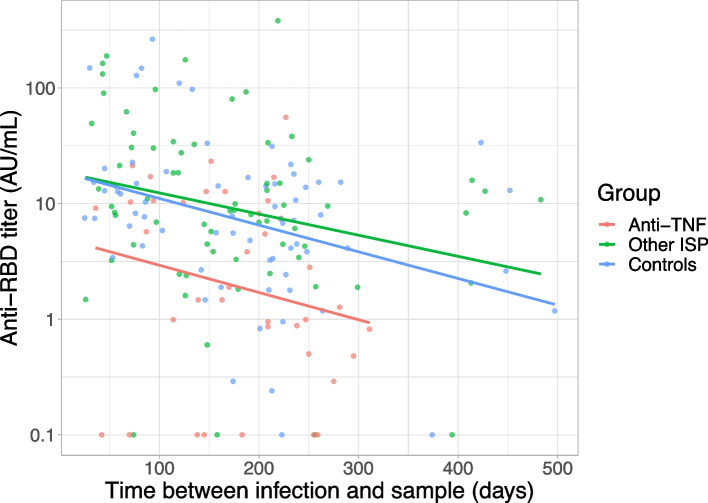
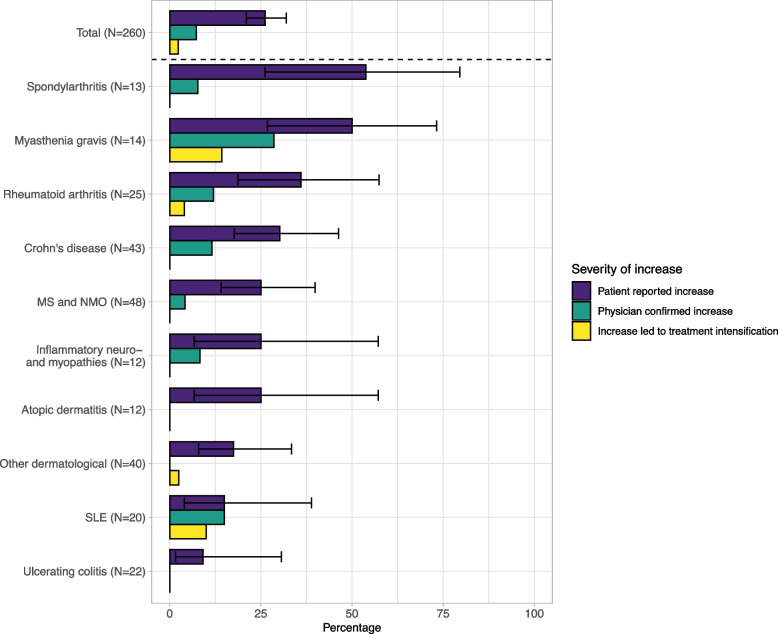
Results: In total, 193 IMID patients on ISP and 113 controls were included. Serum samples from 185 participants were available, with a median time of 173 days between infection and sample collection. The rate of seropositive IMID patients on ISPs was 78% compared to 100% in controls (p < 0.001). Seropositivity rates were lowest in patients on anti-CD20 (40.0%) and anti-tumor necrosis factor (TNF) agents (60.5%), as compared to other ISPs (p < 0.001 and p < 0.001, respectively). Increased disease activity after infection was reported by 68 of 260 patients (26.2%; 95% CI 21.2-31.8%), leading to ISP intensification in 6 out of these 68 patients (8.8%).
Conclusion: IMID patients using ISPs showed reduced long-term humoral immune responses after primary SARS-CoV-2 infection, which was mainly attributed to treatment with anti-CD20 and anti-TNF agents. Increased disease activity after SARS-CoV-2 infection was reported commonly, but was mostly mild.
Trial registration: NL74974.018.20, Trial ID: NL8900. Registered on 9 September 2020.
Keywords: Antibodies; Autoimmune disease; Covid-19; Disease activity; Flare; Immune-mediated inflammatory diseases; Immunity; Immunosuppression; SARS-CoV-2; TNF.
© 2023. The Author(s).
Conflict of interest statement
Joep Killestein, has speaking relationships with Merck, Biogen, TEVA, Sanofi, Genzyme, Roche and Novartis. AmsterdamUMC, location VUmc, MS Center Amsterdam has received financial support for research activities from Merck, Celgene, Biogen, GlaxoSmithKline, Immunic, Roche, Teva, Sanofi, Genzyme, and Novartis. Geert D’Haens has been a consultant for AbbVie, Agomab, AstraZeneca, AM Pharma, AMT, Arena Pharmaceuticals, Bristol Meiers Squibb, Boehringer Ingelheim, Celltrion, Eli Lilly, Exeliom Biosciences, Exo Biologics, Galapagos, Index Pharmaceuticals, Kaleido, Roche, Gilead, GlaxoSmithKline, Gossamerbio, Pfizer, Immunic, Johnson & Johnson, Origo, Polpharma, Procise Diagnostics, Prometheus Laboratories, Prometheus Biosciences, Progenity, and Protagonist; and has received speaker’s bureau fees from AbbVie, Arena Pharmaceuticals, Galapagos, Gilead, Pfizer, BMS, and Takeda. Phyllis Spuls is involved in performing clinical trials with many pharmaceutical industries that manufacture drugs used for the treatment of e.g. psoriasis and atopic dermatitis, for which financial compensation is paid to the department/hospital and is one of the main investigator of the TREAT registry taskforce and SECURE-AD registry. Barbara Horváth reports fees from Janssen-Cilag (Advisory Boards, Educational grants, Consultations, Investigator Initiative Studies), AbbVie (Advisory Boards, Educational grants, Consultations, Investigator Initiative Studies), Novartis Pharma (Advisory Boards, Consultations, Investigator Initiative Studies), UCB Pharma (Advisory Boards, Consultations), Leo Pharma (Consultations), Solenne B.V. (Investigator Initiative Studies), Celgene (Consultations, Investigator Initiative Studies), Akari therapeutics (Consultations, Investigator Initiative Studies), Philips (Consultation), Roche (Consultation), Regeneron (Consultation) and Sanofi (Consultation), Argenx (Advisory Boards, Consultations) which fees were paid to the institution. Jan Verschuuren receives financial support from Target to B consortium, Prinses Beatrix Spierfonds, and has been involved in trials or consultancies for Argenx, Alexion, Rapharma. He is coinventor on patent applications based on MuSK-related research. The LUMC received royalties from IBL and Argenx for MG research. All reimbursements were received by the LUMC. The authors are members of the European Reference Network for Rare Neuromuscular Diseases [ERN EURO-NMD]. DirkJan Hijnen is investigator for AbbVie, LEO pharma, MedImmune/AstraZeneca, Novartis, Sanofi/Regeneron; consultancies for Regeneron/Sanofi, LEO pharma, MedImmune/AstraZeneca, Novartis, Incyte, Janssen, Pfizer. Mark Löwenberg has served as speaker and/or principal investigator for: Abbvie, Alimentiv, Bristol Myers Squibb, Celgene, Covidien, Dr. Falk, Ferring Pharmaceuticals, Galapagos, Gilead, GlaxoSmithKline, Janssen-Cilag, Merck Sharp & Dohme, Pfizer, Protagonist therapeutics, Receptos, Takeda, Tillotts, Tramedico. He has received research grants from AbbVie, Merck Sharp & Dohme, Dr Falk, Achmea healthcare, Galapagos and ZonMW. Filip Eftimov reports (governmental) grants from ZonMw (the Netherlands Organization for Health Research and Development) to study immune responses after SARS-CoV-2 vaccination in autoimmune diseases. He also received grants from Prinses Beatrix Spierfonds, CSL Behring, Kedrion, Terumo BCT, Grifols, Takeda Pharmaceutical Company, and Guillain-Barré Syndrome-Chronic Inflammatory Demyelinating Polyneuropathy (GBS-CIDP) Foundation; consulting fees from UCB Pharma and CSl Behring; and honoraria from Grifols. Diane van der Woude has received research grants from Inova diagnostics, FOREUM (Foundation for Research in Rheumatology) and ZonMw (the Netherlands Organization for Health Research and Development), as well as consulting fees from Galapagos. All other authors had no conflicts of interest. The authors/Several authors of this publication are members of the Netherlands Neuromuscular Center (NL-NMD) and the European Reference Network for rare neuromuscular diseases EURO-NMD.
Figures
References
-
- Wieske L, van Dam KPJ, Steenhuis M, et al. Humoral responses after second and third SARS-CoV-2 vaccination in patients with immune-mediated inflammatory disorders on immunosuppressants: a cohort study. The Lancet Rheumatology. 2022;4(5):e338–e350. doi: 10.1016/S2665-9913(22)00034-0. - DOI - PMC - PubMed
MeSH terms
Substances
Grants and funding
LinkOut - more resources
Full Text Sources
Medical
Miscellaneous
