An official website of the United States government
The .gov means it’s official.
Federal government websites often end in .gov or .mil. Before
sharing sensitive information, make sure you’re on a federal
government site.
The site is secure.
The https:// ensures that you are connecting to the
official website and that any information you provide is encrypted
and transmitted securely.
Plasmids are the primary vector for horizontal transfer of antimicrobial resistance (AMR) within bacterial populations. We applied the MOB-suite, a toolset for reconstructing and typing plasmids, to 150 767 publicly available Salmonella whole-genome sequencing samples covering 1204 distinct serovars to produce a large-scale population survey of plasmids based on the MOB-suite plasmid nomenclature. Reconstruction yielded 183 017 plasmids representing 1044 primary MOB-clusters and 830 potentially novel MOB-clusters. Replicon and relaxase typing were able to type 83.4 and 58 % of plasmids, respectively, compared to 99.9 % for MOB-clusters. Within this work, we developed an approach to characterize the horizonal transfer of MOB-clusters and AMR genes across different serotypes, as well as the diversity of MOB-cluster associations with AMR genes. Aggregating conjugative mobility predictions provided by the MOB-suite and their corresponding serovar entropy demonstrated that non-mobilizable plasmids were associated with fewer serotypes compared to mobilizable or conjugative MOB-clusters. The host-range predictions for MOB-clusters also showed differences between the mobility classes, with mobilizable MOB-clusters accounting for 88.3 % of the multi-phyla (broad-host-range) predictions compared to 3 and 8.6 % for conjugative and non-mobilizable, respectively. A total of 296 (22 %) of identified MOB-clusters were associated with at least one resistance gene, indicating that the majority of Salmonella plasmids are not involved in AMR dissemination. Shannon entropy analysis of horizontal transfer of AMR genes across serovars and MOB-clusters demonstrated that horizonal transfer of genes is higher between serovars compared to transfer between different MOB-clusters. In addition to the population structure characterization based on primary MOB-clusters, we characterized a multi-plasmid outbreak responsible for the global dissemination of blaCMY-2 across different serotypes using higher resolution MOB-suite secondary cluster codes. The plasmid characterization approach developed here can be applied to different organisms to identify plasmids and genes which pose high risks for horizontal transfer.
Keywords:
Salmonella; antimicrobial resistance; horizontal transfer; mobile genetic elements; plasmids.
The authors declare that there are no conflicts of interest.
Figures
Fig. 1.
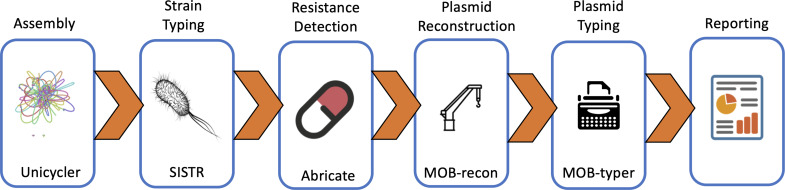
Overall plasmid analytical workflow.
Fig. 1.
Overall plasmid analytical workflow.
Fig. 1.
Overall plasmid analytical workflow.
Fig. 2.
Scatter plot of individual MOB-clusters…
Fig. 2.
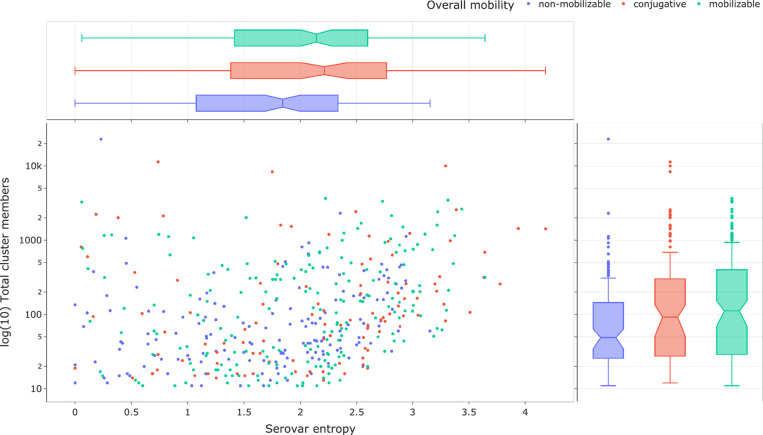
Scatter plot of individual MOB-clusters coloured based on their overall mobility class prediction.…
Fig. 2.
Scatter plot of individual MOB-clusters coloured based on their overall mobility class prediction. The y-axis is the log-scale number of occurrences of a MOB-cluster in the dataset and the x-axis is the serovar entropy (nats) based on sistr predictions. Box plots are presented for the marginal distributions for each axis.
Fig. 3.
Sunburst plot of individual NCBI…
Fig. 3.
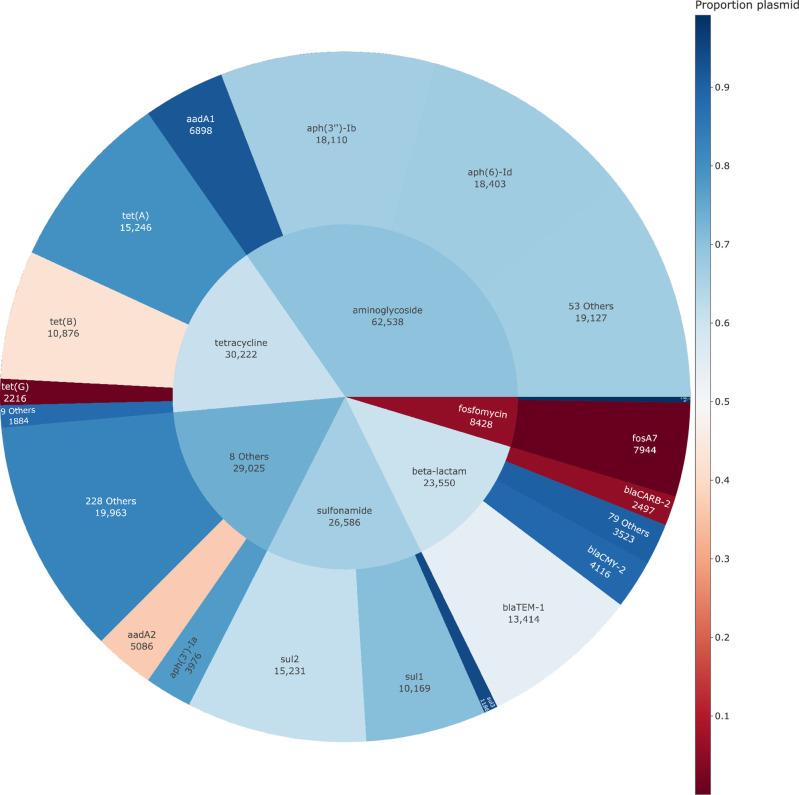
Sunburst plot of individual NCBI resistance genes grouped by drug class and coloured…
Fig. 3.
Sunburst plot of individual NCBI resistance genes grouped by drug class and coloured based on the proportion of occurrences of the gene associated with the chromosome or a plasmid.
Fig. 4.
Relationship between serovar and MOB-cluster…
Fig. 4.
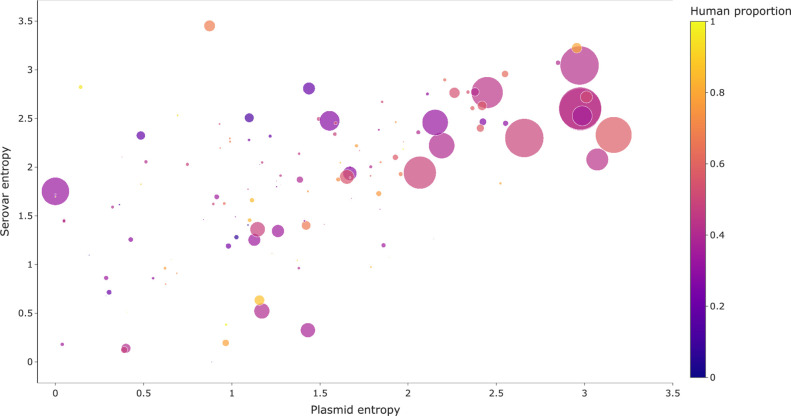
Relationship between serovar and MOB-cluster entropy (nats) for individual NCBI-curated resistance genes. The…
Fig. 4.
Relationship between serovar and MOB-cluster entropy (nats) for individual NCBI-curated resistance genes. The size of each circle represents the abundance of the gene in the dataset and colours indicate the percentage of samples associated with human sources.
Fig. 5.
Sunburst plot of the bla …
Fig. 5.
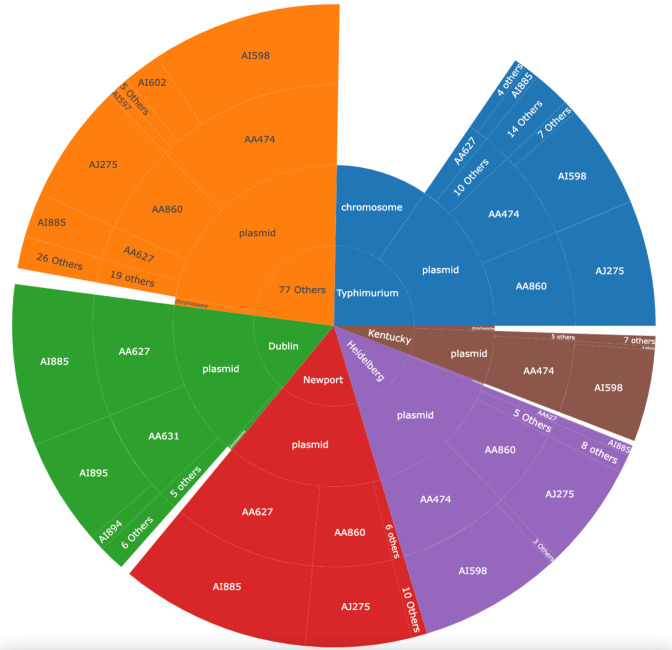
Sunburst plot of the bla CMY-2 ( n =4116) multi-plasmid outbreak with…
Fig. 5.
Sunburst plot of the blaCMY-2 (n=4116) multi-plasmid outbreak with the inner ring showing association between chromosome or plasmid contig sequences. The middle ring shows the primary MOB-cluster and outer ring shows the secondary MOB-cluster associated with the gene.
Fig. 6.
Relationship between serovar entropy (nats)…
Fig. 6.
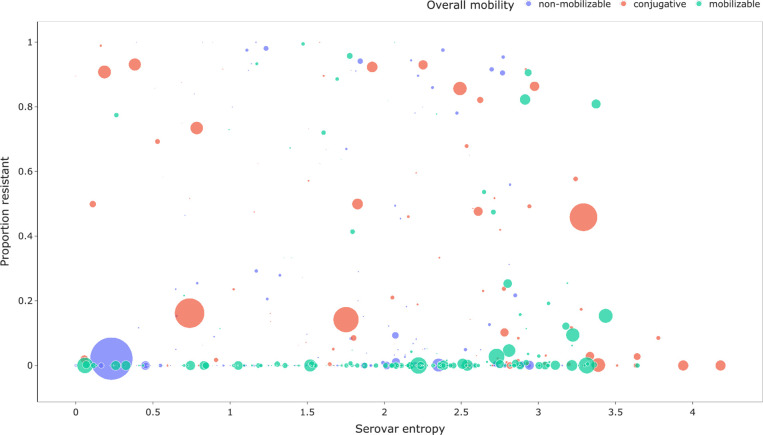
Relationship between serovar entropy (nats) and proportion of members containing at least one…
Fig. 6.
Relationship between serovar entropy (nats) and proportion of members containing at least one NCBI resistance gene for individual MOB-clusters. The size of the circles represents the abundance of the MOB-cluster and overall mobility prediction is used to colour the circles.
Robertson J, Schonfeld J, Bessonov K, Bastedo P, Nash JHE. 2023. A global survey of Salmonella Plasmids and their associations with antimicrobial resistance. Microbiology Society. Dataset.
-
DOI
-
PMC
-
PubMed
Balasubramanian R, Im J, Lee J-S, Jeon HJ, Mogeni OD, et al. The global burden and epidemiology of invasive non-typhoidal Salmonella infections. Hum Vaccin Immunother. 2019;15:1421–1426. doi: 10.1080/21645515.2018.1504717.
-
DOI
-
PMC
-
PubMed
Majowicz SE, Musto J, Scallan E, Angulo FJ, Kirk M, et al. The global burden of nontyphoidal Salmonella gastroenteritis . Clin Infect Dis. 2010;50:882–889. doi: 10.1086/650733.
-
DOI
-
PubMed
Pires SM, Desta BN, Mughini-Gras L, Mmbaga BT, Fayemi OE, et al. Burden of foodborne diseases: think global, act local. Curr Opin Food Sci. 2021;39:152–159. doi: 10.1016/j.cofs.2021.01.006.
-
DOI
-
PMC
-
PubMed
WHO Antimicrobial Resistance: Global Report on Surveillance 2014. Geneva: World Health Organization; 2014.