Review
. 2023 May 2:10:1116861.
doi: 10.3389/fcvm.2023.1116861. eCollection 2023.

The interplay between nonalcoholic fatty liver disease and atherosclerotic cardiovascular disease

Affiliations
Review

The interplay between nonalcoholic fatty liver disease and atherosclerotic cardiovascular disease

Alexandra C Finney et al. Front Cardiovasc Med. .

Abstract

Therapeutic approaches that lower circulating low-density lipoprotein (LDL)-cholesterol significantly reduced the burden of cardiovascular disease over the last decades. However, the persistent rise in the obesity epidemic is beginning to reverse this decline. Alongside obesity, the incidence of nonalcoholic fatty liver disease (NAFLD) has substantially increased in the last three decades. Currently, approximately one third of world population is affected by NAFLD. Notably, the presence of NAFLD and particularly its more severe form, nonalcoholic steatohepatitis (NASH), serves as an independent risk factor for atherosclerotic cardiovascular disease (ASCVD), thus, raising interest in the relationship between these two diseases. Importantly, ASCVD is the major cause of death in patients with NASH independent of traditional risk factors. Nevertheless, the pathophysiology linking NAFLD/NASH with ASCVD remains poorly understood. While dyslipidemia is a common risk factor underlying both diseases, therapies that lower circulating LDL-cholesterol are largely ineffective against NASH. While there are no approved pharmacological therapies for NASH, some of the most advanced drug candidates exacerbate atherogenic dyslipidemia, raising concerns regarding their adverse cardiovascular consequences. In this review, we address current gaps in our understanding of the mechanisms linking NAFLD/NASH and ASCVD, explore strategies to simultaneously model these diseases, evaluate emerging biomarkers that may be useful to diagnose the presence of both diseases, and discuss investigational approaches and ongoing clinical trials that potentially target both diseases.

Keywords: animal models; atherosclerosis; biomarkers; nonalcoholic fatty liver disease; nonalcoholic steatohepatitis; pathophysiology; therapeutics.


Conflict of interest statement

The authors declare that the research was conducted in the absence of any commercial or financial relationships that could be construed as a potential conflict of interest.

Figures
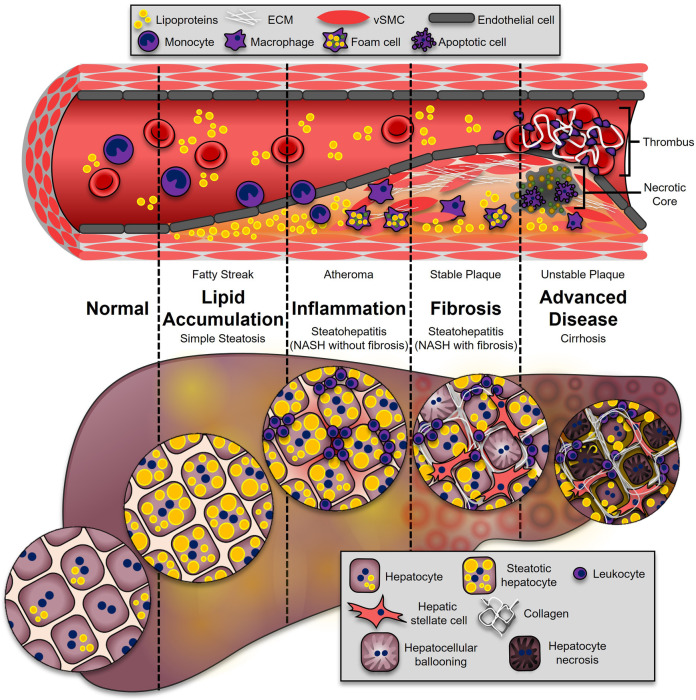
Figure 1
Figure 1
Progression of ASCVD and NASH. The onset of both ASCVD and NASH begins with dysregulated lipid metabolism, leading to their accumulation in the neointimal region of the artery (fatty streak), or the hepatocytes (simple hepatic steatosis). This process enhances inflammatory pathways in both diseases. During atherosclerosis, leukocytes adhere and transmigrate into the developing plaque, where they secrete additional cytokines and chemokines (atheroma). In the liver, leukocytes from the circulation accumulate, leading to NASH (NASH without fibrosis). These immune cells secrete soluble factors to activate collagen-producing cells: synthetic vascular smooth muscle cells (vSMCs) in atherosclerosis (stable plaque), and hepatic stellate cells in the liver (NASH with fibrosis). The most advanced stages of disease are associated with higher mortality. In atherosclerosis, advanced plaques with a large necrotic core and thin fibrous caps are prone to rupture (unstable plaque), which is highly thrombogenic. In the liver, excessive fibrosis and cell death leads to irreversible damage and loss of liver function (cirrhosis).
Figure 2
Figure 2
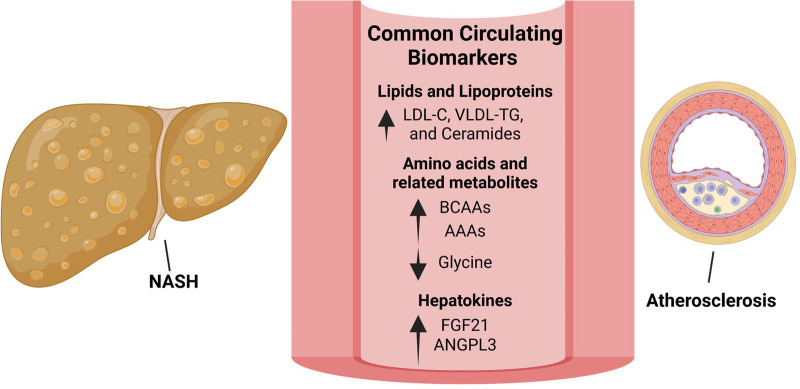
Biomarkers linking NAFLD/NASH and ASCVD offer potential therapeutic strategies. Lipid species that are increased in both NAFLD/NASH and ASCVD include low-density lipoprotein-cholesterol (LDL-C), very low-density lipoprotein (VLDL) and triglycerides (TG) as well as ceramides. Although significantly lowering ASCVD, LDL-C reduction using statins has shown inconsistent results with regards to NASH treatment. Targeting ceramide synthesis have shown promising results in rodent models of NAFLD/NASH and ASCVD and warrants clinical evaluation. Amino acid metabolism is commonly dysregulated in NAFLD/NASH and ASCVD with circulating branched-chain amino acids (BCAAs) and aromatic amino acids (AAAs) increased and glycine decreased in both diseases. In rodent models and small-scale clinical studies, glycine-based treatments reduced steatohepatitis and atherosclerosis warranting clinical evaluation in larger cohorts. The hepatokines, fibroblast growth factor-21 (FGF-21) and angiopoietin like 3 (ANGPTL3), are increased in both NAFLD/NASH and ASCVD. Interestingly, approaches to inhibit hepatic ANGPTL3 have shown promise in treating dyslipidemia but were associated with increased hepatic steatosis and markers of liver injury. Despite being increased in both diseases, FGF21 analogues are protective in rodent models of NASH and atherosclerosis as well as in patients with NASH.

References

    1. Tsao CW, Aday AW, Almarzooq ZI, Anderson CAM, Arora P, Avery CL, et al. Heart disease and stroke statistics-2023 update: a report from the American heart association. Circulation. (2023) 147(8):e93–621. 10.1161/CIR.0000000000001123 - DOI - PubMed
    1. Loos RJF, Yeo GSH. The genetics of obesity: from discovery to biology. Nat Rev Genet. (2022) 23(2):120–33. 10.1038/s41576-021-00414-z - DOI - PMC - PubMed
    1. Marchesini G, Marzocchi R. Metabolic syndrome and NASH. Clin Liver Dis. (2007) 11(1):105–17; ix. 10.1016/j.cld.2007.02.013 - DOI - PubMed
    1. Younossi ZM, Koenig AB, Abdelatif D, Fazel Y, Henry L, Wymer M. Global epidemiology of nonalcoholic fatty liver disease-meta-analytic assessment of prevalence, incidence, and outcomes. Hepatology. (2016) 64(1):73–84. 10.1002/hep.28431 - DOI - PubMed
    1. Younossi ZM, Golabi P, de Avila L, Paik JM, Srishord M, Fukui N, et al. The global epidemiology of NAFLD and NASH in patients with type 2 diabetes: a systematic review and meta-analysis. J Hepatol. (2019) 71(4):793–801. 10.1016/j.jhep.2019.06.021 - DOI - PubMed

LinkOut - more resources