


Pre-COVID-19 cognitive social capital and peri-COVID-19 depression: A prospective cohort study on the contextual moderating effect of the COVID-19 pandemic in China, 2016-2020
- PMID: 37201370
- PMCID: PMC10073591
- DOI: 10.1016/j.healthplace.2023.103022
Pre-COVID-19 cognitive social capital and peri-COVID-19 depression: A prospective cohort study on the contextual moderating effect of the COVID-19 pandemic in China, 2016-2020
Abstract
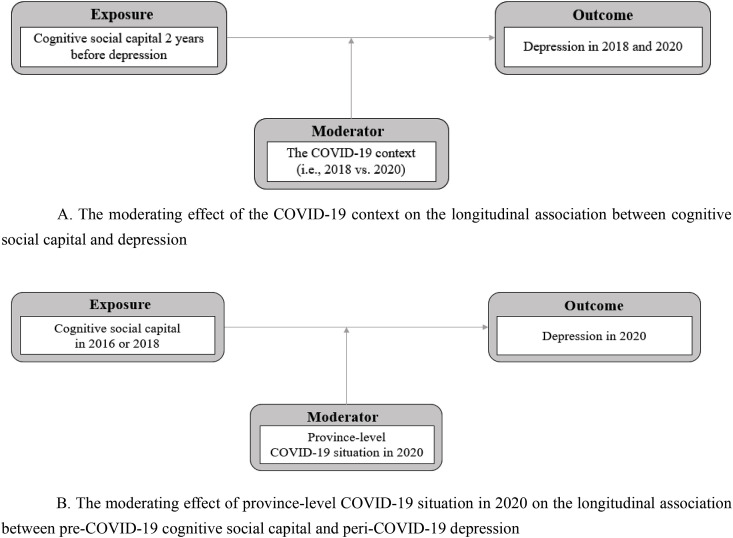
Social capital could protect mental health. We examined whether the COVID-19 context and province-level COVID-19 situation altered the longitudinal association between cognitive social capital (generalized trust, trust in neighbors, trust in local government officials, and reciprocity) and depression. Results from multilevel mixed-effects linear regression models showed that trust in neighbors, trust in local government officials, and reciprocity were more crucial in longitudinally reducing depression in 2020 than in 2018. Also, as compared with provinces where the COVID-19 situation was less poor, trust in local government officials in 2018 was more crucial in reducing depression in 2020 in provinces with a worse COVID-19 situation. Therefore, cognitive social capital should be taken into account for pandemic preparedness and mental health resilience.
Keywords: COVID-19; China; Cognitive social capital; Depression; Longitudinal association; Pandemic preparedness.
Copyright © 2023. Published by Elsevier Ltd.
Figures
References
-
- Aldrich D.P. University of Chicago Press; 2012. Building Resilience: Social Capital in Post-Disaster Recovery.
-
- Chan S.-M., Chung G.K.-K., Chan Y.-H., Woo J., Yeoh E.K., Chung R.Y.-N., Wong S.Y.-S., Marmot M., Lee R.W.-T., Wong H. The mediating role of individual-level social capital among worries, mental health and subjective well-being among adults in Hong Kong during the COVID-19 pandemic. Curr. Psychol. 2021 doi: 10.1007/s12144-021-02316-z. - DOI - PMC - PubMed
MeSH terms
LinkOut - more resources
Full Text Sources
Medical
