


Canine leproid granuloma caused by a member of the Mycobacterium tuberculosis complex
- PMID: 37204061
- PMCID: PMC10331390
- DOI: 10.1177/10406387231176816
Canine leproid granuloma caused by a member of the Mycobacterium tuberculosis complex
Abstract
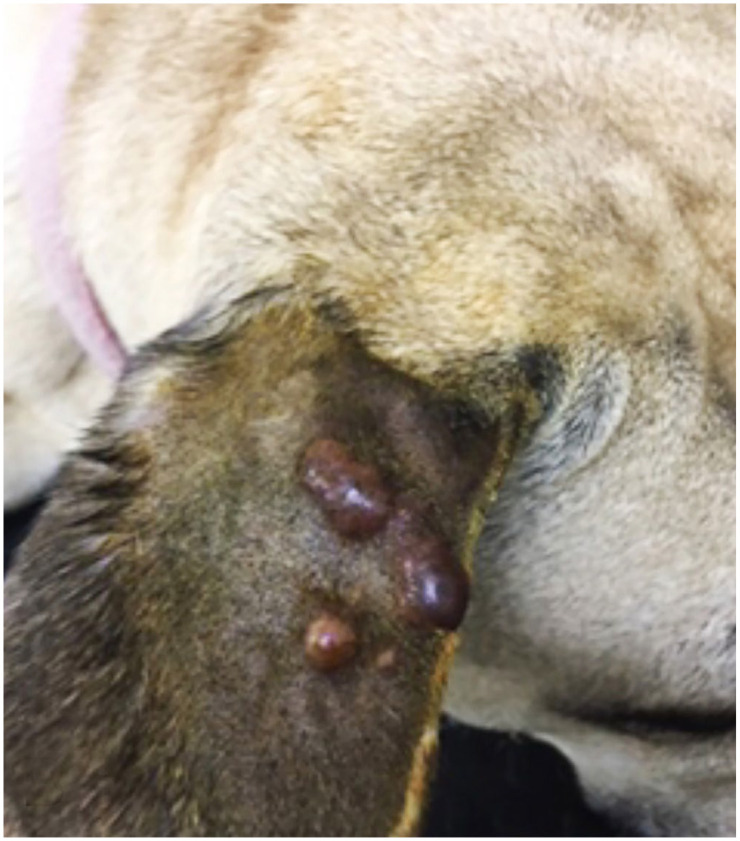
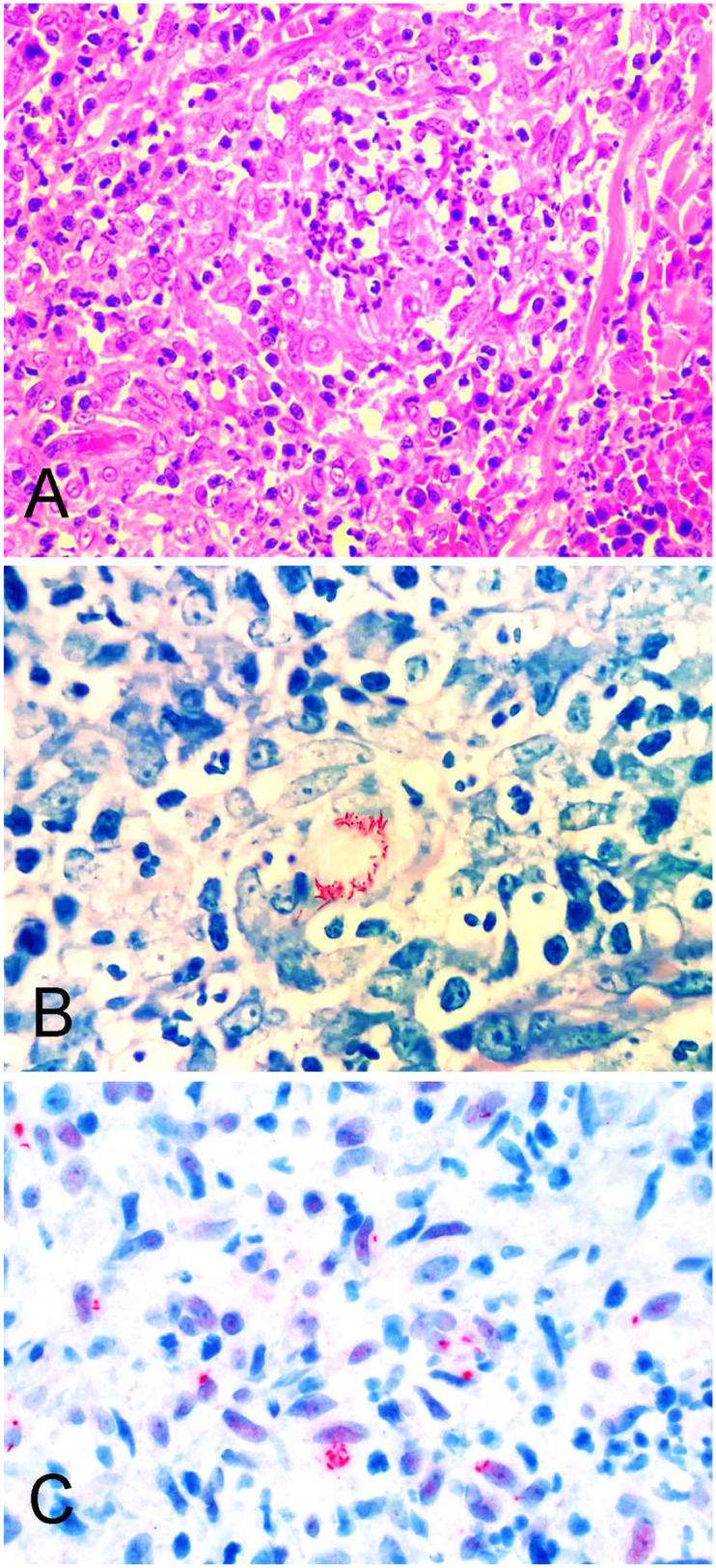
Canine leproid granuloma (CLG) is a chronic form of dermatitis that has been associated with nontuberculous mycobacterial infections in Africa, Oceania, the Americas, and Europe. We report here a case of CLG associated with a member of the Mycobacterium tuberculosis complex (MTBC), which could be of public health concern. An 8-y-old pet dog developed 0.5-1-cm diameter, raised, firm, nonpruritic, alopecic, painless skin nodules on the external aspects of both pinnae. Histologic examination revealed severe pyogranulomatous dermatitis with intracellular Ziehl-Neelsen-positive bacilli that were immunoreactive by immunohistochemistry using a polyclonal primary antibody that recognizes tuberculous and nontuberculous Mycobacterium species. DNA extracted from formalin-fixed, paraffin-embedded skin sections was tested by a Mycobacterium genus-specific nested PCR assay targeting the 16S rRNA gene. BLAST sequence analysis of 214-bp and 178-bp amplicons showed 99.5% identity with members of the MTBC; however, the agent could not be identified at the species level. Although CLG has been associated traditionally with nontuberculous mycobacterial infections, the role of Mycobacterium spp. within the MTBC as a cause of this condition, and the role of dogs with CLG as possible sources of MTBC to other animals and humans, should not be disregarded given its zoonotic potential.
Keywords: Mycobacterium tuberculosis complex; canine leproid granuloma; dermatitis; dogs; pathology; pyogranuloma.
Conflict of interest statement
The authors declared no potential conflicts of interest with respect to the research, authorship, and/or publication of this article.
Figures
References
-
- Bhatnagar J, et al.. Improved detection and accuracy of Mycobacterium species identification from paraffin embedded tissues of patients by using multigene targeted PCR and sequencing. Open Forum Infect Dis 2017;4(Suppl 1):S620–S621.
-
- Charles J, et al.. Cytology and histopathology of canine leproid granuloma syndrome. Aust Vet J 1999;77:799–803. - PubMed
-
- Dedola C, et al.. First report of canine leprosy in Europe: molecular and clinical traits. Vet Rec 2014;174:120. - PubMed
-
- Foley JE, et al.. Clinical, microscopic, and molecular aspects of canine leproid granuloma in the United States. Vet Pathol 2002;39:234–239. - PubMed
-
- Frothingham R, Meeker-O’Connell WA.Genetic diversity in the Mycobacterium tuberculosis complex based on variable numbers of tandem DNA repeats. Microbiology (Reading) 1998;144:1189–1196. - PubMed
MeSH terms
Substances
LinkOut - more resources
Full Text Sources
Medical
Research Materials
Miscellaneous
