


Physical Versus Virtual Reality-Based Calm Rooms for Psychiatric Inpatients: Quasi-Randomized Trial
- PMID: 37204858
- PMCID: PMC10238960
- DOI: 10.2196/42365
Physical Versus Virtual Reality-Based Calm Rooms for Psychiatric Inpatients: Quasi-Randomized Trial
Abstract
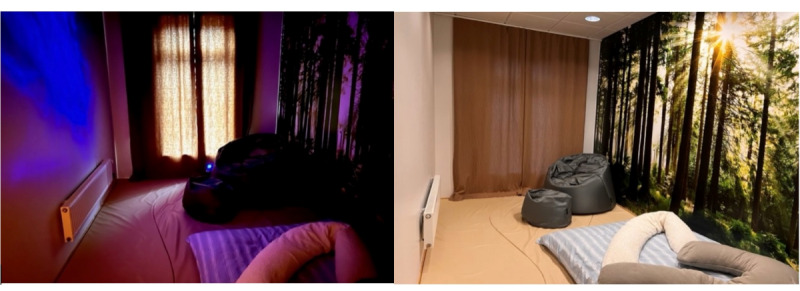
Background: Interest in sensory rooms or so-called "calm rooms" in psychiatric inpatient care has increased significantly. In a hospital setting, their purpose is to introduce a relaxing environment to increase well-being as well as to decrease anxiety and aggressive behaviors. Calm rooms can also be used as a tool to provide self-help through a convenient environment for the patients and, at the same time, strengthen the therapeutic relationship between the patient and the professional. Recent developments in virtual reality (VR) have made virtual calm rooms possible, but these have not yet been evaluated in psychiatric inpatient care.
Objective: This study aimed to compare the effects of VR and physical calm rooms on self-reported well-being and physiological markers of arousal.
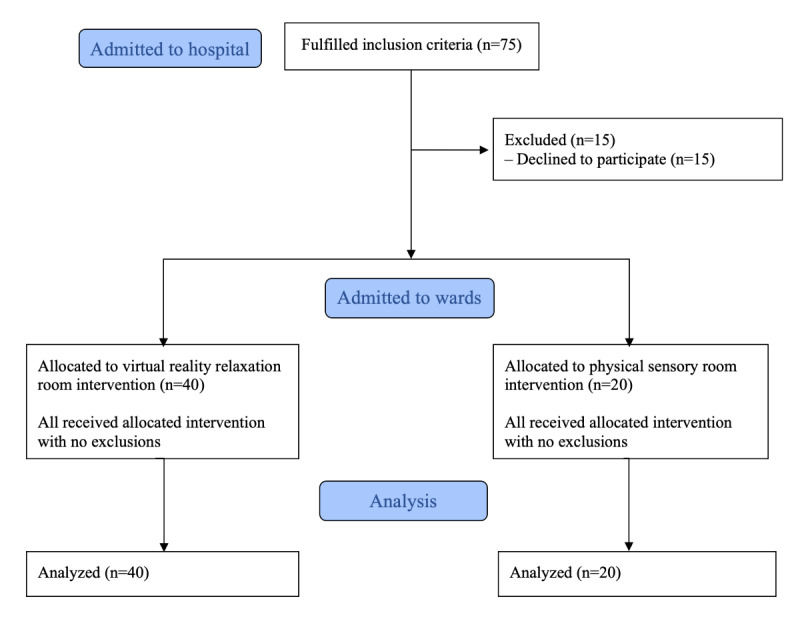
Methods: The study was conducted in 2 inpatient psychiatric wards specializing in bipolar disorder from March 2019 to February 2021. Patients who were already admitted were asked if they were interested in using a calm room and willing to provide ratings. This study relied on the quasi-randomized allocation of patients to the wards, which either had a physical or VR calm room. Self-assessment scales (Montgomery-Åsberg Depression Rating Scale-Self Assessment [MADRS-S], Beck Anxiety Scale, and Clinical Global Impression) were used to determine the participants' baseline level of depressive and anxiety symptoms before their use of the physical or VR calm room. The study determined the state of well-being measured using an 11-point visual analog scale (VAS) as well as arousal measured by blood pressure (systolic and diastolic) and heart rate before and after the use of the calm rooms. The primary end point was self-reported well-being using the VAS.
Results: A total of 60 participants were included-40 used the VR calm room and 20 used the physical calm room. The mean age of participants was 39 years and the majority were women (35/60, 58%). Analysis of VAS measurement showed improved well-being at the group level from before to after the intervention (P<.05), with no statistically significant difference in effects between the 2 different interventions. Effects were not moderated by baseline depression levels (dichotomized as MADRS-S >20 or ≤20) despite an overall difference in reported well-being between subgroups.
Conclusions: Although the power in this study was low, the findings of this first study indicate comparable effects with respect to well-being and arousal of a VR calm room and a physical calm room. This suggests that a VR calm room can be a viable alternative when the use of a physical calm room is not an option for logistic or other reasons.
Trial registration: ClinicalTrials.gov NCT03918954; https://clinicaltrials.gov/ct2/show/NCT03918954.
Keywords: psychiatric inpatient care; psychiatry; relaxation; sensory room; virtual reality.
©Maria Ilioudi, Philip Lindner, Lilas Ali, Sara Wallström, Almira Osmanovic Thunström, Michael Ioannou, Nicole Anving, Viktor Johansson, William Hamilton, Örjan Falk, Steinn Steingrimsson. Originally published in the Journal of Medical Internet Research (https://www.jmir.org), 19.05.2023.
Conflict of interest statement
Conflicts of Interest: WH founded and served as CTO of Mimerse, the company that developed the Calm Place app. Mimerse is no longer an active company and had no role in collecting or analyzing data. PL reports having consulted for Mimerse. All other authors declare no conflict of interest.
Figures

References
Publication types
MeSH terms
Associated data
LinkOut - more resources
Full Text Sources
Medical
