. 2023 Apr 1;4(2):339-349.
doi: 10.1002/jha2.683. eCollection 2023 May.

Clinical and laboratory characteristics of patients with symptomatic secondary immunodeficiency following the treatment of haematological malignancies

Affiliations

Clinical and laboratory characteristics of patients with symptomatic secondary immunodeficiency following the treatment of haematological malignancies

Adrian M Shields et al. EJHaem. .

Abstract

Secondary immunodeficiency (SID), manifesting as increased susceptibility to infection, is an emergent clinical problem in haematoncology. Management of SID includes vaccination, prophylactic antibiotics (pAbx) and immunoglobulin replacement therapy (IgRT). We report clinical and laboratory parameters of 75 individuals, treated for haematological malignancy, who were referred for immunological assessment due to recurrent infections. Forty-five were managed with pAbx while thirty required IgRT after failing to improve on pAbx. Individuals requiring IgRT had significantly more bacterial, viral and fungal infections resulting in hospitalization at least 5 years after their original haemato-oncological diagnosis. Following immunological assessment and intervention, a 4.39-fold reduction in the frequency of hospital admissions to treat infection was observed in the IgRT cohort and a 2.30-fold reduction in the pAbx cohort. Significant reductions in outpatient antibiotic use were also observed in both cohorts following immunology input. Patients requiring IgRT were more hypogammaglobulinaemic and had lower titres of pathogen-specific antibodies and smaller memory B cell populations than those requiring pAbx. Test vaccination with pneumococcal conjugate vaccine discriminated poorly between the two groups. Patients requiring IgRT could be distinguished by combining wider pathogen-specific serology with a frequency of hospital admissions for infection. If validated in larger cohorts, this approach may circumvent the need for test vaccination and enhance patient selection for IgRT.

Keywords: haematological malignancy; immunoglobulin replacement; secondary immunodeficiency; vaccination.


Conflict of interest statement

Mark T. Drayson reports personal fees from Abingdon Health, outside the submitted work. All other authors declare no competing interests.

Figures
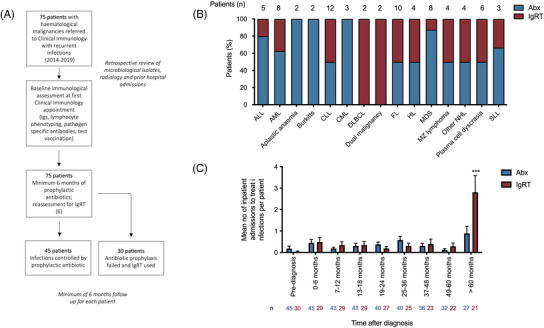
FIGURE 1
FIGURE 1
(A) Flow diagram of the assessment and management of patients in this study. (B) Underlying haematological diagnoses in 75 patients referred for investigation of recurrent infections between 2014–2019 and their immunological treatment prophylactic antibiotics (Abx) or immunoglobulin replacement therapy (IgRT). The number of patients with each diagnosis is provided above the individual columns. (C) The timing of hospital admissions to treat infections following the diagnosis of haematological malignancy. In each treatment group, the number of hospital admissions to treat infections occurring during each time period was documented. The number of individuals at risk is provided for each group provided below the bars. Data are expressed as the mean number of hospital admissions per patient per time period (e.g. between 49–60 months post‐diagnosis, individuals whose infections could be controlled using Abx alone suffered 0.12 infections requiring hospitalisation compared to 0.29 in the IgRT group). ***p < 0.0001 by two‐way analysis of variance (ANOVA).
FIGURE 2
FIGURE 2
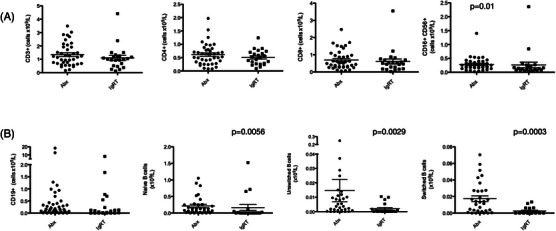
(A) Lymphocyte subset analysis in patients with symptomatic secondary immunodeficiency requiring treatment with prophylactic antibiotics (Abx) or immunoglobulin replacement therapy (IgRT). (B) CD19+ B cell phenotyping in patients with symptomatic secondary immunodeficiency. p‐Values are shown where statistical significance between the two groups was demonstrated using a two‐tailed Mann‐Whitney U‐test.
FIGURE 3
FIGURE 3
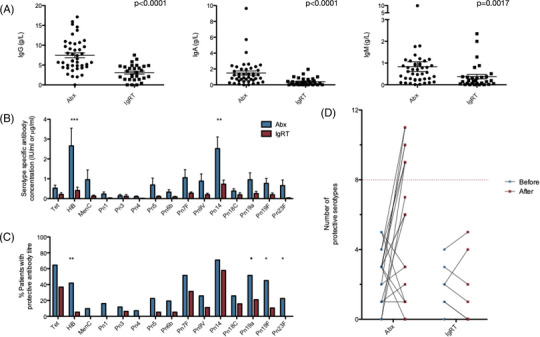
(A) Serum immunoglobulin G, A and M levels in patients with symptomatic secondary immunodeficiency requiring treatment with prophylactic antibiotics (Abx) or immunoglobulin replacement therapy (IgRT). p‐Values shown where statistical significance between the two groups was demonstrated using a two‐tailed Mann‐Whitney U‐test. (B) Baseline titres of pathogen‐specific antibodies amongst the cohort. (C) Percentage of patients demonstrating seroprotective titres of pathogen‐specific antibodies at baseline. (D) Response to vaccination with a 13‐valent pneumococcal conjugate vaccine in patients requiring Abx or IgRT. A normal response to vaccination is defined as achieving seroprotection in greater than 70% of measured serotypes (dotted red line). *p < 0.05, **p < 0.01, ***p < 0.001 by two‐way ANOVA.
FIGURE 4
FIGURE 4
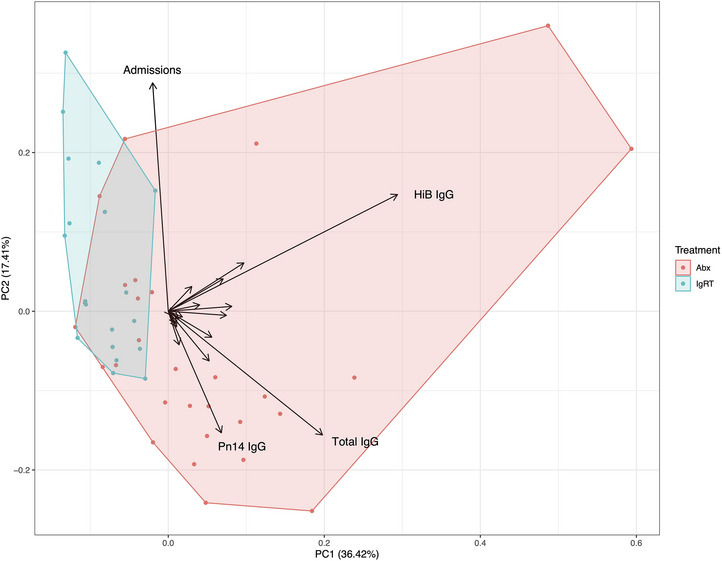
Unsupervised clustering (principal component analysis) of the two treatment groups based on baseline immunoglobulin G, A and M levels, hospital admissions to treat infections and functional IgG antibody titres directed against Tetanus toxoid, Haemophilus influenzae B, meningococcus serogroup C and pneumococcal serotypes. Eigenvectors for selected variables are labelled.
FIGURE 5
FIGURE 5
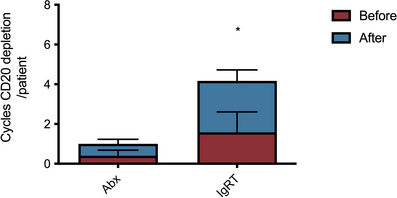
Mean number of cycles of B cell depleting agents before and after transplantation in patients who had received bone marrow transplantation. *p = 0.001, Mann‐Whitney's two‐tailed test.

References

    1. Patel SY, Carbone J, Jolles S. The expanding field of secondary antibody deficiency: causes, diagnosis, and management. Front Immunol. 2019;10:33. - PMC - PubMed
    1. Shillitoe B, Hollingsworth R, Foster M, Garcez T, Guzman D, Edgar JD, et al. Immunoglobulin use in immune deficiency in the UK: a report of the UKPID and National Immunoglobulin Databases. Clin Med (Lond). 2018;18(5):364–70. - PMC - PubMed
    1. Foster M. NHS Immunoglobulin Database Annual Report 2019/20. MD/DAS. 2021:1–30.
    1. Kumar SK, Dispenzieri A, Lacy MQ, Gertz MA, Buadi FK, Pandey S, et al. Continued improvement in survival in multiple myeloma: changes in early mortality and outcomes in older patients. Leukemia 2014;28(5):1122–8. - PMC - PubMed
    1. Weide R, Feiten S, Chakupurakal G, Friesenhahn V, Kleboth K, Köppler H, et al. Survival improvement of patients with chronic lymphocytic leukemia (CLL) in routine care 1995–2017. Leuk Lymphoma. 2020;61(3):557–66. - PubMed