. 2023 May 3:17:1143109.
doi: 10.3389/fnins.2023.1143109. eCollection 2023.

Anesthesia and analgesia for experimental craniotomy in mice and rats: a systematic scoping review comparing the years 2009 and 2019

Affiliations

Anesthesia and analgesia for experimental craniotomy in mice and rats: a systematic scoping review comparing the years 2009 and 2019

Hannah King et al. Front Neurosci. .

Abstract

Experimental craniotomies are a common surgical procedure in neuroscience. Because inadequate analgesia appears to be a problem in animal-based research, we conducted this review and collected information on management of craniotomy-associated pain in laboratory mice and rats. A comprehensive search and screening resulted in the identification of 2235 studies, published in 2009 and 2019, describing craniotomy in mice and/or rats. While key features were extracted from all studies, detailed information was extracted from a random subset of 100 studies/year. Reporting of perioperative analgesia increased from 2009 to 2019. However, the majority of studies from both years did not report pharmacologic pain management. Moreover, reporting of multimodal treatments remained at a low level, and monotherapeutic approaches were more common. Among drug groups, reporting of pre- and postoperative administration of non-steroidal anti-inflammatory drugs, opioids, and local anesthetics in 2019 exceeded that of 2009. In summary, these results suggest that inadequate analgesia and oligoanalgesia are persistent issues associated with experimental intracranial surgery. This underscores the need for intensified training of those working with laboratory rodents subjected to craniotomies.

Systematic review registration: https://osf.io/7d4qe.

Keywords: animal welfare; multimodal analgesia; neuroscience; neurosurgery; pain; postoperative pain; refinement; surgery.


Conflict of interest statement

The authors declare that the research was conducted in the absence of any commercial or financial relationships that could be construed as a potential conflict of interest.

Figures
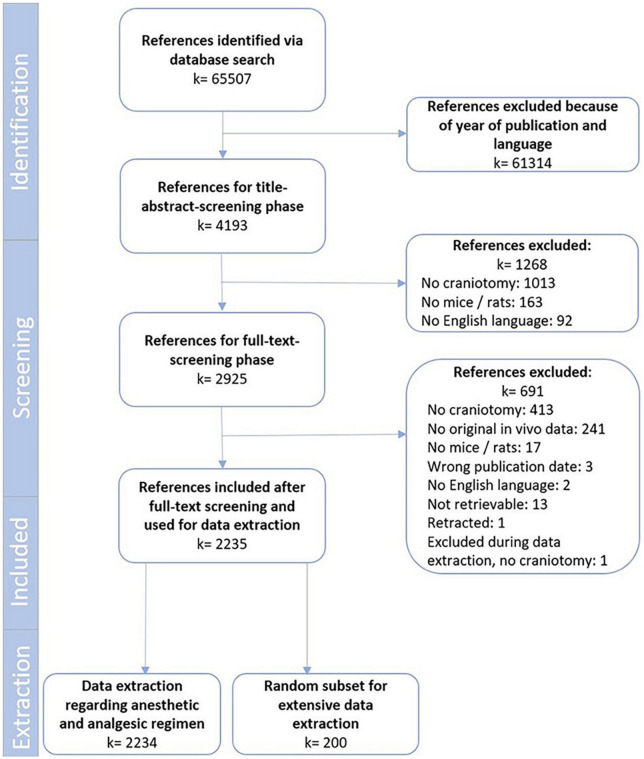
FIGURE 1
FIGURE 1
Study flow chart.
FIGURE 2
FIGURE 2
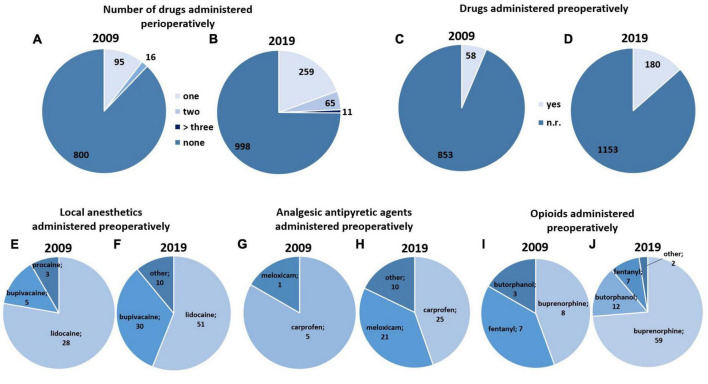
Analgesics and local anesthetics administered perioperatively and preoperatively (k = 2244 studies). (A,B) Number of drugs (analgesics and local anesthetics) administered perioperatively in 2009 (A) and 2019 (B). (C,D) Drugs (analgesics and local anesthetics) administered preoperatively in 2009 (C) and 2019 (D). (E,F) Local anesthetics administered preoperatively in 2009 (E) and 2019 (F). Other = drugs used in up to four studies. (G,H) Analgesic antipyretic agents administered preoperatively in 2009 (G) and 2019 (H). Other = drugs used in up to seven studies. (I,J) Opioids administered preoperatively in 2009 (I) and 2019 (J). Other = drugs used in up to two studies. “Preoperatively” was defined as all timepoints before skin incision.
FIGURE 3
FIGURE 3
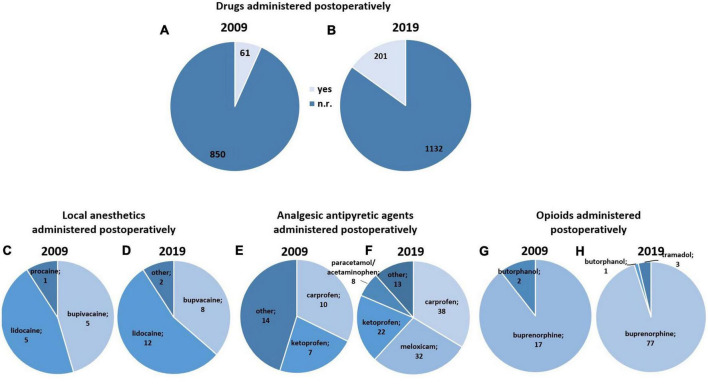
Analgesics and local anesthetics administered postoperatively (k = 2244 studies). (A,B) Drugs (analgesics and local anesthetics) administered postoperatively in 2009 (A) and 2019 (B). (C,D) Local anesthetics administered postoperatively in 2009 (C) and 2019 (D). Other = drugs used in up to two studies. (E,F) Analgesic antipyretic agents administered postoperatively in 2009 (E) and 2019 (F). Other = drugs used in up to five studies. (G,H) Opioids administered postoperatively in 2009 (G) and 2019 (H). “Postoperatively” was defined as all timepoints after finishing surgery and closing of incision.
FIGURE 4
FIGURE 4
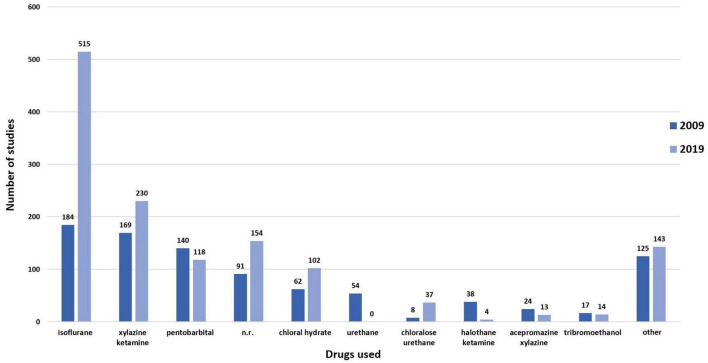
Anesthetics drugs (k = 2241 studies). Administration of anesthetic drugs in 2009 (k = 911) and 2019 (k = 1330). N.r., not reported. Note that one of the included papers from 2019 did not use anesthesia; the surgeries were performed on conscious animals.
FIGURE 5
FIGURE 5
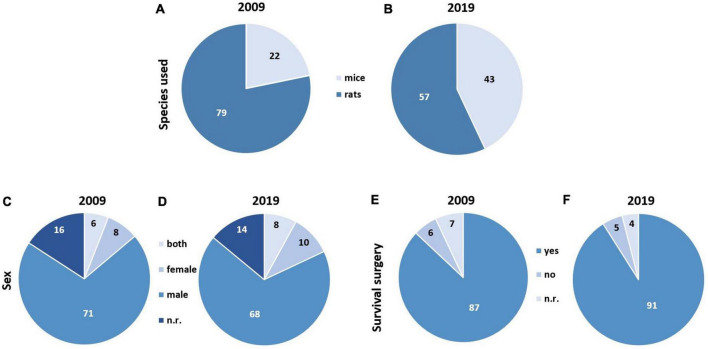
Animal model characteristics: species and sex and intervention characteristic survival surgery in the subset of 200 studies. (A) Studies using mice and rats in 2009 (k = 101 studies). (B) Studies using mice and rats in 2019 (k = 100 studies). (C,D) Studies reporting sex in 2009 (C; k = 101 studies) and 2019 (D; k = 100 studies). (E,F) Studies reporting if animals survived surgery in 2009 (E; k = 100 studies) and 2019 (F; k = 100 studies). n.r., not reported.

References

    1. Aldehri M., Temel Y., Jahanshahi A., Hescham S. (2019). Fornix deep brain stimulation induces reduction of hippocampal synaptophysin levels. J. Chem. Neuroanat. 96 34–40. 10.1016/j.jchemneu.2018.12.001 - DOI - PubMed
    1. Arfè A., Scotti L., Varas-Lorenzo C., Nicotra F., Zambon A., Kollhorst B., et al. (2016). Non-steroidal anti-inflammatory drugs and risk of heart failure in four European countries: Nested case-control study. BMJ 354:i4857. 10.1136/bmj.i4857 - DOI - PubMed
    1. Arras M., Rettich A., Cinelli P., Kasermann H. P., Burki K. (2007). Assessment of post-laparotomy pain in laboratory mice by telemetric recording of heart rate and heart rate variability. BMC Vet. Res. 3:16. 10.1186/1746-6148-3-16 - DOI - PMC - PubMed
    1. Asan A. S., Sahin M. (2019). Modulation of multiunit spike activity by transcranial AC stimulation (tACS) in the rat cerebellar cortex. Annu. Int. Conf. IEEE Eng. Med. Biol. Soc. 2019 5192–5195. 10.1109/EMBC.2019.8856830 - DOI - PMC - PubMed
    1. Ban V. S., Bhoja R., McDonagh D. L. (2019). Multimodal analgesia for craniotomy. Curr. Opin. Anaesthesiol. 32 592–599. 10.1097/ACO.0000000000000766 - DOI - PubMed

Publication types

LinkOut - more resources