


Investigating One Health risks for human colonisation with extended spectrum β-lactamase-producing Escherichia coli and Klebsiella pneumoniae in Malawian households: a longitudinal cohort study
- PMID: 37207684
- PMCID: PMC10319635
- DOI: 10.1016/S2666-5247(23)00062-9
Investigating One Health risks for human colonisation with extended spectrum β-lactamase-producing Escherichia coli and Klebsiella pneumoniae in Malawian households: a longitudinal cohort study
Abstract
Background: Low-income countries have high morbidity and mortality from drug-resistant infections, especially from enteric bacteria such as Escherichia coli. In these settings, sanitation infrastructure is of variable and often inadequate quality, creating risks of extended-spectrum β-lactamase (ESBL)-producing Enterobacterales transmission. We aimed to describe the prevalence, distribution, and risks of ESBL-producing Enterobacterales colonisation in sub-Saharan Africa using a One Health approach.
Methods: Between April 29, 2019, and Dec 3, 2020, we recruited 300 households in Malawi for this longitudinal cohort study: 100 each in urban, peri-urban, and rural settings. All households underwent a baseline visit and 195 were selected for longitudinal follow-up, comprising up to three additional visits over a 6 month period. Data on human health, antibiotic usage, health-seeking behaviours, structural and behavioural environmental health practices, and animal husbandry were captured alongside human, animal, and environmental samples. Microbiological processing determined the presence of ESBL-producing E coli and Klebsiella pneumoniae, and hierarchical logistic regression was performed to evaluate the risks of human ESBL-producing Enterobacterales colonisation.
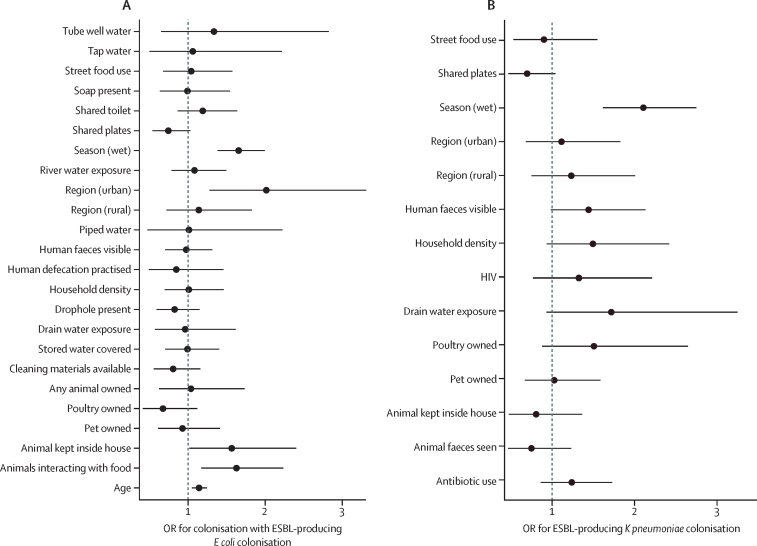
Findings: A paucity of environmental health infrastructure and materials for safe sanitation was identified across all sites. A total of 11 975 samples were cultured, and ESBL-producing Enterobacterales were isolated from 1190 (41·8%) of 2845 samples of human stool, 290 (29·8%) of 973 samples of animal stool, 339 (66·2%) of 512 samples of river water, and 138 (46·0%) of 300 samples of drain water. Multivariable models illustrated that human ESBL-producing E coli colonisation was associated with the wet season (adjusted odds ratio 1·66, 95% credible interval 1·38-2·00), living in urban areas (2·01, 1·26-3·24), advanced age (1·14, 1·05-1·25), and living in households where animals were observed interacting with food (1·62, 1·17-2·28) or kept inside (1·58, 1·00-2·43). Human ESBL-producing K pneumoniae colonisation was associated with the wet season (2·12, 1·63-2·76).
Interpretation: There are extremely high levels of ESBL-producing Enterobacterales colonisation in humans and animals and extensive contamination of the wider environment in southern Malawi. Urbanisation and seasonality are key risks for ESBL-producing Enterobacterales colonisation, probably reflecting environmental drivers. Without adequate efforts to improve environmental health, ESBL-producing Enterobacterales transmission is likely to persist in this setting.
Funding: Medical Research Council, National Institute for Health and Care Research, and Wellcome Trust.
Translation: For the Chichewa translation of the abstract see Supplementary Materials section.
Copyright © 2023 The Author(s). Published by Elsevier Ltd. This is an Open Access article under the CC BY 4.0 license. Published by Elsevier Ltd.. All rights reserved.
Conflict of interest statement
Declaration of interests We declare no competing interests.
Figures


References
-
- Tacconelli E, Carrara E, Savoldi A, et al. Discovery, research, and development of new antibiotics: the WHO priority list of antibiotic-resistant bacteria and tuberculosis. Lancet Infect Dis. 2018;18:318–327. - PubMed
-
- Mughini-Gras L, Dorado-García A, van Duijkeren E, et al. Attributable sources of community-acquired carriage of Escherichia coli containing β-lactam antibiotic resistance genes: a population-based modelling study. Lancet Planet Health. 2019;3:e357–e369. - PubMed
Publication types
MeSH terms
Substances
Grants and funding
LinkOut - more resources
Full Text Sources
Medical
Research Materials
Miscellaneous
