


Concerns about stone free rate and procedure events of percutaneous nephrolithotripsy (PCNL) for 2-4 cm kidney stones by standard-PCNL vs mini-PCNL- comparative randomised study
- PMID: 37208652
- PMCID: PMC10199612
- DOI: 10.1186/s12894-023-01270-1
Concerns about stone free rate and procedure events of percutaneous nephrolithotripsy (PCNL) for 2-4 cm kidney stones by standard-PCNL vs mini-PCNL- comparative randomised study
Abstract
Background: To compare the efficacy and safety of standard percutaneous nephrolithotomy (PCNL) with mini- PCNL for kidney stones 2-4 cm.
Methods: Eighty patients were enrolled in a comparative study, they were randomly divided into mini-PCNL group (n = 40) and standard-PCNL (n = 40). Demographic characteristics, perioperative events, complications, stone free rate (SFR) were reported.
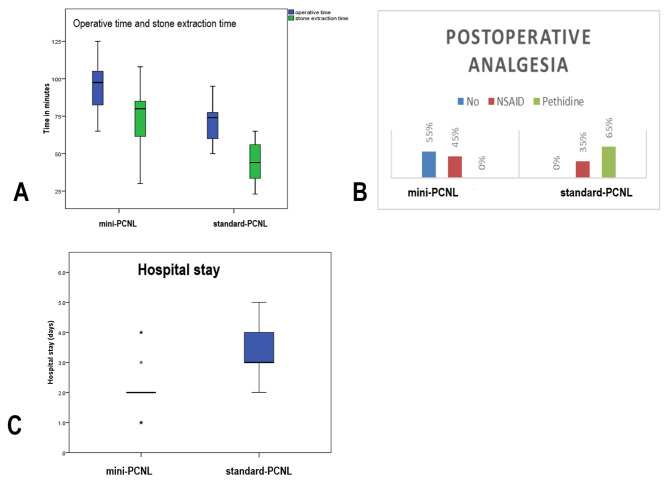
Results: Both groups showed no significant difference in clinical data about age, stone location, back pressure changes, and body mass index. The mean operative time was (95 ± 17.9 min) in mini-PCNL, and (72.1 ± 14.9 min). Stone free rate were 80% and 85% in mini-PCNL and standard-PCNL respectively. Intra-operative complications, post-operative need for analgesia, hospital stay were significantly higher in standard-PCNL compared to mini-PCNL (85% vs. 80%). The study followed CONSORT 2010 guidelines for reporting parallel group randomization.
Conclusion: Mini-PCNL is an effective and safe treatment of kidney stones 2-4 cm, it has the advantage over standard-PCNL being has less intra-operative events, less post-operative analgesia, shorter hospital stay, while operative time and stone free rate are comparable when considering multiplicity, hardness, and site of stones.
Keywords: Kidney stones; Mini percutaneous nephrolithotomy; Percutaneous nephrolithotomy; Renal stones; Stone free rate.
© 2023. The Author(s).
Conflict of interest statement
The authors have no competing interests to declare that are relevant to the content of this article.
Figures
References
-
- Wright A, Rukin N, Smith D, De la Rosette J, Somani BK. (2016) 'Mini, ultra, micro’ - nomenclature and cost of these new minimally invasive percutaneous nephrolithotomy (PCNL) techniques Ther Adv Urol. 8(2):142–6. doi: 10.1177/1756287215617674. Epub 2015 Nov 26. PMID: 27034726; PMCID: PMC4772355. - PMC - PubMed
-
- Mishra S, Sharma R, Garg C, Kurien A, Sabnis R, Desai M. (2011). Prospective comparative study of miniperc and standard PNL for treatment of 1 to 2 cm size renal stone. BJU Int. 108(6):896-9; discussion 899–900. doi: 10.1111/j.1464-410X.2010.09936.x. Epub 2011 Apr 8. PMID: 21477212. - PubMed
Publication types
MeSH terms
LinkOut - more resources
Full Text Sources
