Comparison of residual monomer amounts released from indirect bonding adhesives
- PMID: 37212680
- PMCID: PMC10575638
- DOI: 10.2319/122322-864.1
Comparison of residual monomer amounts released from indirect bonding adhesives
Abstract
Objectives: To quantify the amount of residual monomer released from orthodontic adhesives used in the indirect bonding technique and compare it to a direct bonding composite resin.
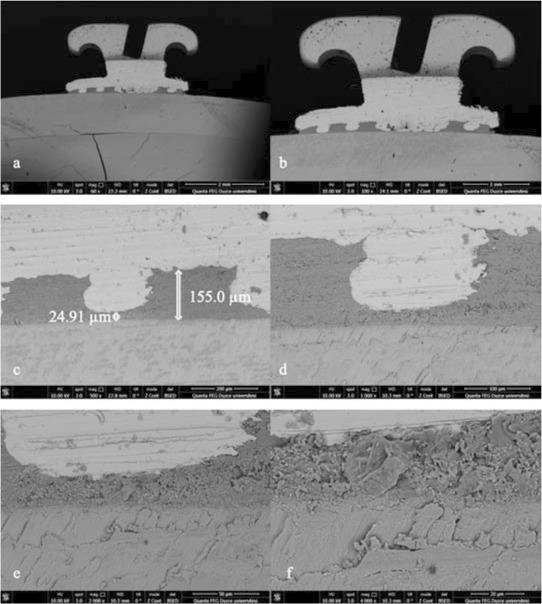
Materials and methods: Five hundred stainless steel orthodontic brackets were bonded on bovine incisors using five groups of bonding resins: Transbond XT (TXT), Transbond Supreme LV (SLV), Sondhi Rapid-Set (SRS), Transbond IDB (IDB), and Custom I.Q. (CIQ). Liquid samples were gathered on the first, seventh, 21st, and 35th days. Residual monomer release was measured from the liquid samples with a liquid chromatography device. In addition, the amount and shape of the adhesive between the tooth surface and the bracket base was evaluated using obtained electron microscopy images. The data were analyzed using analysis of variance, and a Tukey post-hoc test was applied.
Results: Hydroxyethylmethacrylate and bisphenol A-glycidyl methacrylate monomers were released by all study groups. Urethane-dimethacrylate was released from the TXT, SLV, IDB, and CIQ groups. Triethylene glycol dimethacrylate was released from TXT, SLV, IDB, and SRS groups. The amount of total monomer release was higher in chemically cured adhesives than in light-cured adhesives. Among the chemically cured adhesives, premix adhesives had the highest amount of total monomer release. The light-cured adhesives had less thickness.
Conclusions: Light-curing adhesives have significantly less monomer release than chemically polymerized adhesives.
Keywords: Adhesive; Indirect bonding; Residual monomer.
© 2023 by the EH Angle Education and Research Foundation, Inc.
Figures




References
-
- Silverman E, Cohen M, Gianelly AA, Dietz VS. A universal direct bonding system for both metal and plastic brackets. Am J Orthod. 1972;62((3)):236–244. - PubMed
-
- Yagci A, Uysal T, Ulker M, Ramoglu SI. Microleakage under orthodontic brackets bonded with the custom base indirect bonding technique. Eur J Orthod. 2010;32((3)):259–263. - PubMed
-
- Xue C, Xu H, Guo Y, et al. Accurate bracket placement using a computer-aided design and computer-aided manufacturing–guided bonding device: an in vivo study. Am J Orthod Dentofacial Orthop. 2020;157((2)):269–277. - PubMed
-
- Sondhi A. Efficient and effective indirect bonding. Am J Orthod Dentofacial Orthop. 1999;115((4)):352–359. - PubMed
-
- Van Landuyt KL, Snauwaert J, De Munck J, et al. Systematic review of the chemical composition of contemporary dental adhesives. Biomaterials. 2007;28((26)):3757–3785. - PubMed
MeSH terms
Substances
LinkOut - more resources
Full Text Sources