


Phoenix dactylifera (date palm; Arecaceae) putative lectin homologs: Genome-wide search, architecture analysis, and evolutionary relationship
- PMID: 37213699
- PMCID: PMC10197109
- DOI: 10.1016/j.sjbs.2023.103676
Phoenix dactylifera (date palm; Arecaceae) putative lectin homologs: Genome-wide search, architecture analysis, and evolutionary relationship
Abstract
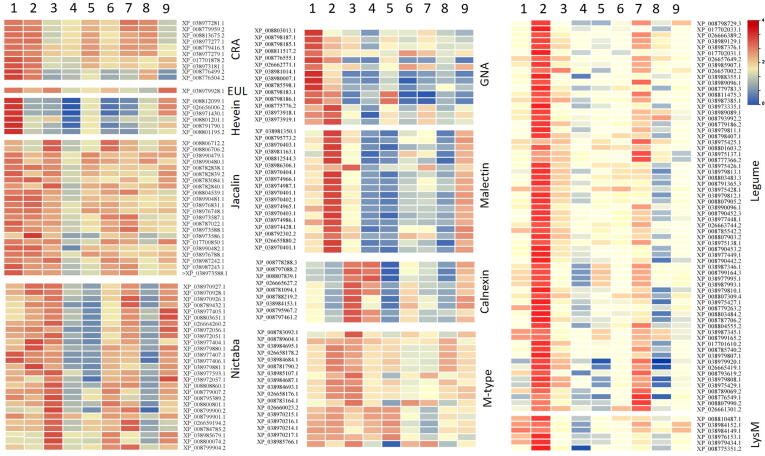
The date palm, Phoenix dactylifera, is a vital crop in nations in the Middle East and North Africa. The date palm was thought to have outstanding traditional medicinal value because it was abundant in phytochemicals with diverse chemical structures. The date palm's ability to withstand harsh environments could be partly attributed to a class of proteins known as lectins, which are carbohydrate-binding proteins that can bind sugar moieties reversibly and without changing their chemical structures. After scanning the genome of P. dactylifera (GCF 009389715.1), this in silico study discovered 196 possible lectin homologs from 11 different families, some specific to plants. At the same time, others could also be found in other kingdoms of life. Their domain architectures and functional amino acid residues were investigated, and they yielded a 40% true-lectin with known conserved carbohydrate-binding residues. Further, their probable subcellular localization, physiochemical and phylogenetic analyses were also performed. Scanning all putative lectin homologs against the anticancer peptide (ACP) dataset found in the AntiCP2.0 webpage identified 26 genes with protein kinase receptors (Lec-KRs) belonging to 5 lectin families, which are reported to have at least one ACP motif. Our study offers the first account of Phoenix-lectins and their organization that can be used for further structural and functional analysis and investigating their potential as anticancer proteins.
Keywords: ACP; Domain rearrangements; Localization; Phoenix dactylifera; Ture lectins.
© 2023 The Author(s).
Conflict of interest statement
The authors declare that they have no known competing financial interests or personal relationships that could have appeared to influence the work reported in this paper.
Figures



References
-
- Agostino M., Velkov T., Dingjan T., Williams S.J., Yuriev E., Ramsland P.A. The carbohydrate-binding promiscuity of euonymus europaeus lectin is predicted to involve a single binding site. Glycobiology. 2015;25(1):101–114. - PubMed
-
- Al-Alawi, R.A., Al-Mashiqri, J.H., Al-Nadabi, J.S.M., Al-Shihi, B.I., Baqi, Y., 2017. Date palm tree (phoenix dactylifera l.): Natural products and therapeutic options. Front Plant Sci. 8:845 https://doi.org/10.3389/fpls.2017.00845. - PMC - PubMed
-
- Almagro Armenteros J.J., Tsirigos K.D., Sønderby C.K., Petersen T.N., Winther O., Brunak S., von Heijne G., Nielsen H. Signalp 5.0 improves signal peptide predictions using deep neural networks. Nat. Biotechnol. 2019;37(4):420–423. - PubMed
LinkOut - more resources
Full Text Sources
