


Pyrroloquinoline-quinone to reduce fat accumulation and ameliorate obesity progression
- PMID: 37214340
- PMCID: PMC10196175
- DOI: 10.3389/fmolb.2023.1200025
Pyrroloquinoline-quinone to reduce fat accumulation and ameliorate obesity progression
Abstract
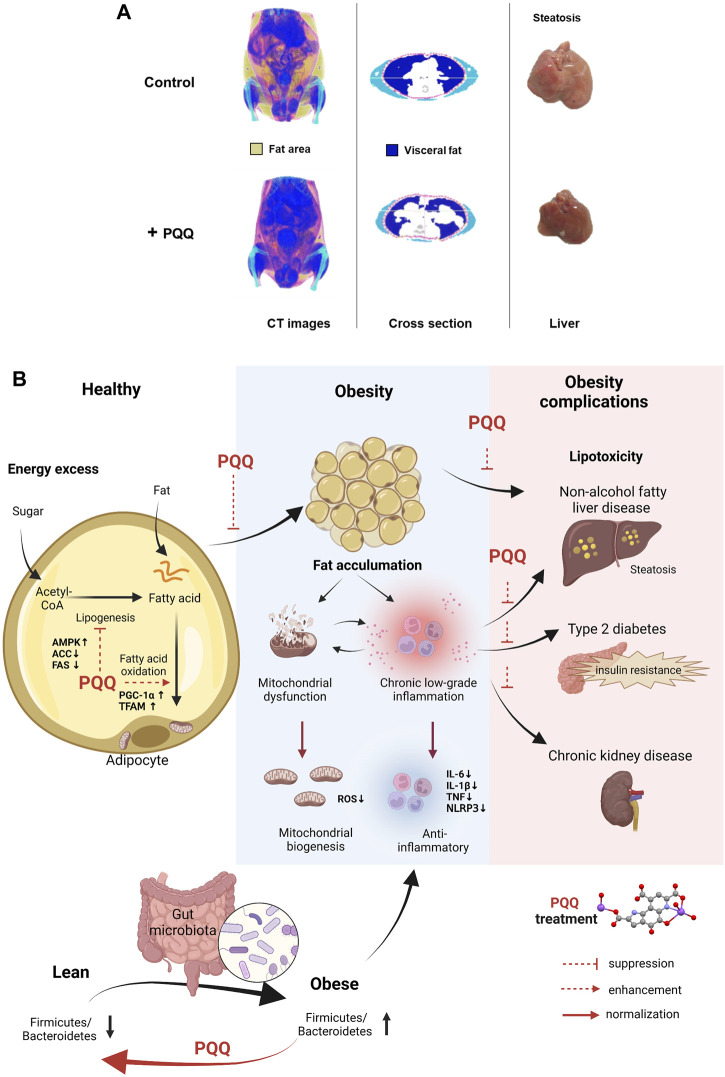
Obesity is a major health concern worldwide, and its prevalence continues to increase in several countries. Pyrroloquinoline quinone (PQQ) is naturally found in some foods and is available as a dietary supplement in its disodium crystal form. The potential health benefits of PQQ have been studied, considering its antioxidant and anti-inflammatory properties. Furthermore, PQQ has been demonstrated to significantly influence the functions of mitochondria, the organelles responsible for energy production within cells, and their dysfunction is associated with various health conditions, including obesity complications. Here, we explore PQQ properties that can be exploited in obesity treatment and highlight the underlying molecular mechanisms. We review animal and cell culture studies demonstrating that PQQ is beneficial for reducing the accumulation of visceral and hepatic fat. In addition to inhibiting lipogenesis, PQQ can increase mitochondria number and function, leading to improved lipid metabolism. Besides diet-induced obesity, PQQ ameliorates programing obesity of the offspring through maternal supplementation and alters gut microbiota, which reduces obesity risk. In obesity progression, PQQ mitigates mitochondrial dysfunction and obesity-associated inflammation, resulting in the amelioration of the progression of obesity co-morbidities, including non-alcoholic fatty liver disease, chronic kidney disease, and Type 2 diabetes. Overall, PQQ has great potential as an anti-obesity and preventive agent for obesity-related complications. Although human studies are still lacking, further investigations to address obesity and associated disorders are still warranted.
Keywords: PQQ; fat; inflammation; lipogenesis; metabolic syndrome; mitochondria; obesity; pyrroloquinoline quinone.
Copyright © 2023 Mohamad Ishak and Ikemoto.
Conflict of interest statement
NI and KI were employed the Niigata Research Laboratory, Mitsubishi Gas Chemical Company, Inc.
Figures
References
-
- Castro A. M., Macedo-de la Concha L. E., Pantoja-Meléndez C. A. (2017). Low-grade inflammation and its relation to obesity and chronic degenerative diseases. Rev. Medica del Hosp. Gen. Mex. 80, 101–105. 10.1016/j.hgmx.2016.06.011 - DOI
-
- Chowanadisai W., Bauerly K. A., Tchaparian E., Wong A., Cortopassi G. A., Rucker R. B. (2010). Pyrroloquinoline quinone stimulates mitochondrial biogenesis through cAMP response element-binding protein phosphorylation and increased PGC-1alpha expression. J. Biol. Chem. 285, 142–152. 10.1074/jbc.M109.030130 - DOI - PMC - PubMed
Publication types
LinkOut - more resources
Full Text Sources
