


Performance evaluation of mesoscopic photoacoustic imaging
- PMID: 37214427
- PMCID: PMC10199419
- DOI: 10.1016/j.pacs.2023.100505
Performance evaluation of mesoscopic photoacoustic imaging
Abstract
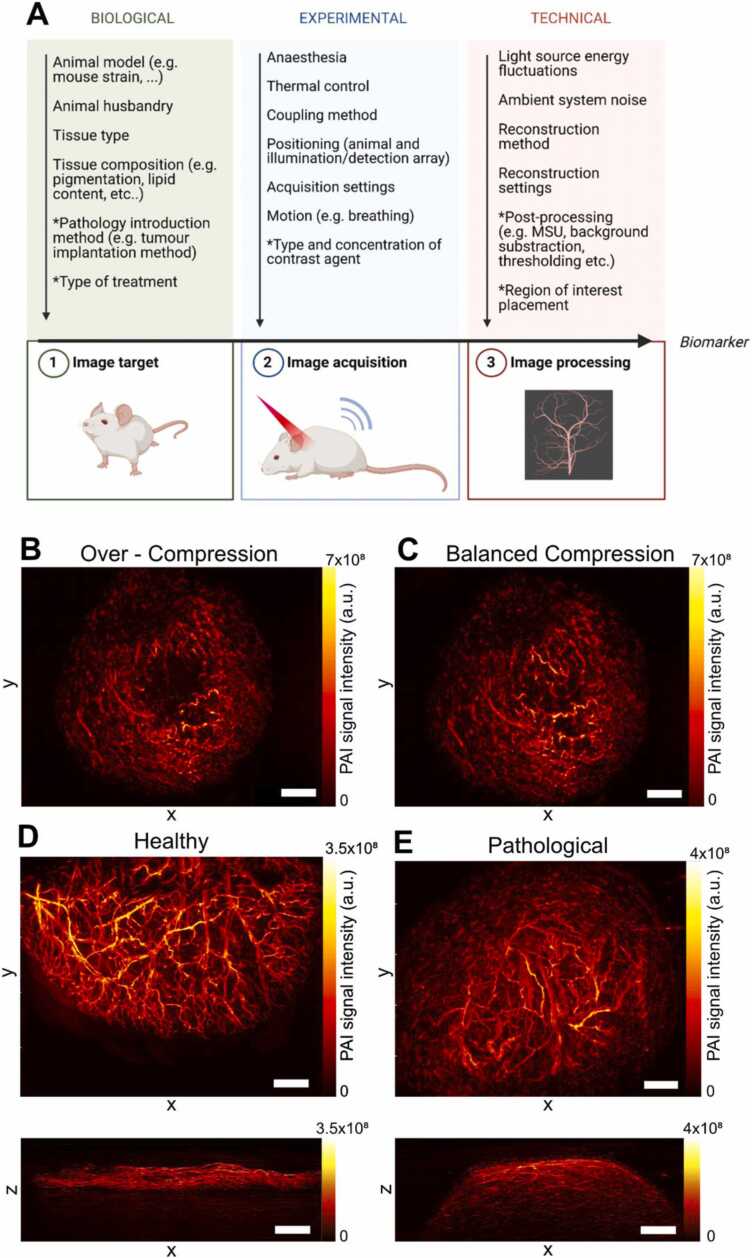
Photoacoustic mesoscopy visualises vascular architecture at high-resolution up to ~3 mm depth. Despite promise in preclinical and clinical imaging studies, with applications in oncology and dermatology, the accuracy and precision of photoacoustic mesoscopy is not well established. Here, we evaluate a commercial photoacoustic mesoscopy system for imaging vascular structures. Typical artefact types are first highlighted and limitations due to non-isotropic illumination and detection are evaluated with respect to rotation, angularity, and depth of the target. Then, using tailored phantoms and mouse models, we investigate system precision, showing coefficients of variation (COV) between repeated scans [short term (1 h): COV= 1.2%; long term (25 days): COV= 9.6%], from target repositioning (without: COV=1.2%, with: COV=4.1%), or from varying in vivo user experience (experienced: COV=15.9%, unexperienced: COV=20.2%). Our findings show robustness of the technique, but also underscore general challenges of limited-view photoacoustic systems in accurately imaging vessel-like structures, thereby guiding users when interpreting biologically-relevant information.
Keywords: Phantom; Photoacoustic mesoscopy; Precision; Raster-Scanning Optoacoustic Mesoscopy (RSOM); Repeatability; Reproducibility.
© 2023 The Authors. Published by Elsevier GmbH.
Conflict of interest statement
The authors declare the following financial interests/personal relationships which may be considered as potential competing interests Sarah Bohndiek reports a relationship with EPFL Center for Biomedical Imaging that includes: speaking and lecture fees. Sarah Bohndiek reports a relationship with PreXion Inc that includes: funding grants. Sarah Bohndiek reports a relationship with iThera Medical GmbH that includes: non-financial support.The authors declare the following financial interests / personal relationships, which may be considered as potential competing interests. Sarah Bohndiek reports a relationship with EPFL Center for Biomedical Imaging that includes: speaking and lecture fees. Sarah Bohndiek reports a relationship with PreXion Inc that includes: funding grants. Sarah Bohndiek reports a relationship with iThera Medical GmbH that includes: non-financial support. The other authors have no conflict of interest related to the present manuscript to disclose.
Figures



References
-
- Omar M., Aguirre J., Ntziachristos V. Optoacoustic mesoscopy for biomedicine. Nat. Biomed. Eng. 2019;3:354–370. - PubMed
-
- Aguirre J., et al. Precision assessment of label-free psoriasis biomarkers with ultra-broadband optoacoustic mesoscopy. Nat. Biomed. Eng. 2017;1:0068.
-
- Taruttis A., Ntziachristos V. Advances in real-time multispectral optoacoustic imaging and its applications. Nat. Photonics. 2015;9:219–227.
-
- Tanghetti MD E., Jennings J. A comparative study with a 755 nm picosecond Alexandrite laser with a diffractive lens array and a 532 nm/1064 nm Nd:YAG with a holographic optic. Lasers Surg. Med. 2018;50:37–44. - PubMed
-
- Schwarz M., Buehler A., Aguirre J., Ntziachristos V. Three-dimensional multispectral optoacoustic mesoscopy reveals melanin and blood oxygenation in human skin in vivo. J. Biophoton. 2016;9:55–60. - PubMed
Grants and funding
LinkOut - more resources
Full Text Sources
