Mechanistic and Kinetic Approach on the Propargyl Radical (C3H3) with the Criegee Intermediate (CH2OO)
- PMID: 37214685
- PMCID: PMC10193399
- DOI: 10.1021/acsomega.3c00491
Mechanistic and Kinetic Approach on the Propargyl Radical (C3H3) with the Criegee Intermediate (CH2OO)
Abstract
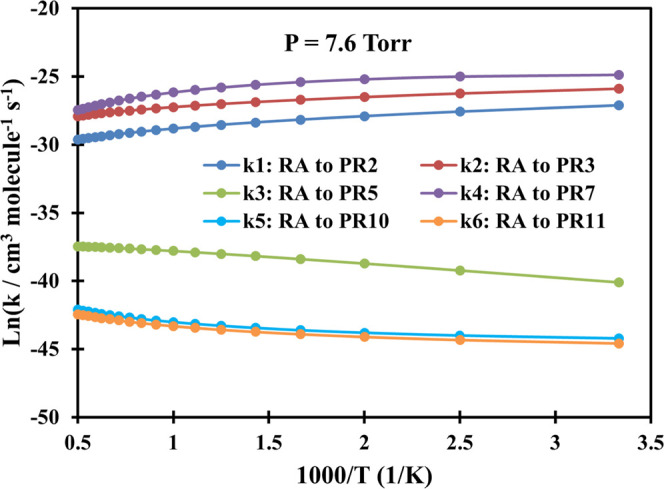
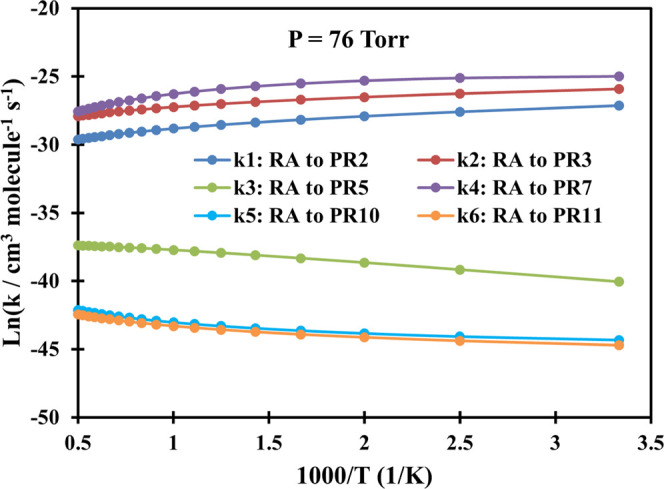
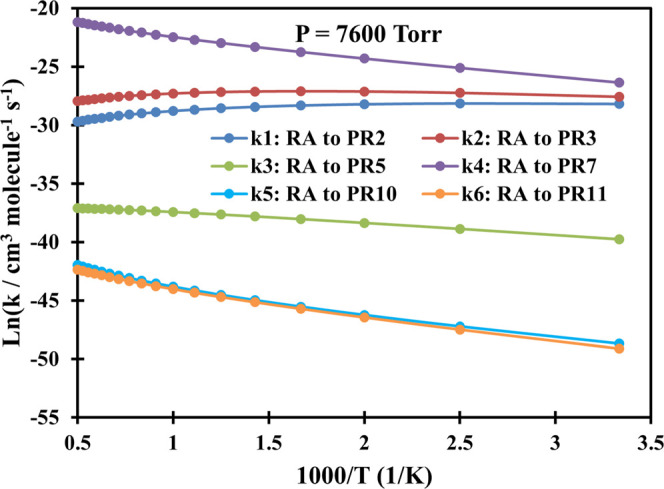
The detailed reaction mechanism and kinetics of the C3H3 + CH2OO system have been thoroughly investigated. The CBS-QB3 method in conjunction with the ME/vRRKM theory has been applied to figure out the potential energy surface and rate constants for the C3H3 + CH2OO system. The C3H3 + CH2OO reaction leading to the CH2-[cyc-CCHCHOO] + H product dominates compared to the others. Rate constants of the reaction are dependent on temperatures (300-2000 K) and pressures (1-76,000 Torr), for which the rate constant of the channel C3H3 + CH2OO → CH2-[cyc-CCHCHOO] + H decreases at low pressures (1-76 Torr), but it increases with rising temperature if the pressure P ≥ 760 Torr. Rate constants of the three reaction channels C3H3 + CH2OO → CHCCH2CHO + OH, C3H3 + CH2OO → OCHCHCHCHO + H, and C3H3 + CH2OO → CHCHCHO + CH2O fluctuate with temperatures. The branching ratio of the C3H3 + CH2OO → CH2-[cyc-CCHCHOO] + H channel is the highest, accounting for 51-98.7% in the temperature range of 300-2000 K and 760 Torr pressure, while those of the channels forming the products PR10 (OCHCHCHCHO + H) and PR11 (CHCHCHO + CH2O) are the lowest, less than 0.1%, indicating that the contribution of these two reaction paths to the title reaction is insignificant. The proposed temperature- and pressure-dependent rate constants, together with the thermodynamic data of the species involved, can be confidently used for modeling CH2OO-related systems under atmospheric and combustion conditions.
© 2023 The Authors. Published by American Chemical Society.
Conflict of interest statement
The authors declare no competing financial interest.
Figures





References
-
- Horie O.; Moortgat G. K. Decomposition pathways of the excited Criegee intermediates in the ozonolysis of simple alkenes. Atmos. Environ., Part A 1991, 25, 1881–1896. 10.1016/0960-1686(91)90271-8. - DOI
LinkOut - more resources
Full Text Sources