


Circulating eosinophils associated with responsiveness to COVID-19 vaccine and the disease severity in patients with SARS-CoV-2 omicron variant infection
- PMID: 37217986
- PMCID: PMC10202064
- DOI: 10.1186/s12890-023-02473-w
Circulating eosinophils associated with responsiveness to COVID-19 vaccine and the disease severity in patients with SARS-CoV-2 omicron variant infection
Abstract
Objective: This study aimed to investigate the longitudinal circulating eosinophil (EOS) data impacted by the COVID-19 vaccine, the predictive role of circulating EOS in the disease severity, and its association with T cell immunity in patients with SARS-CoV-2 Omicron BA.2 variant infection in Shanghai, China.
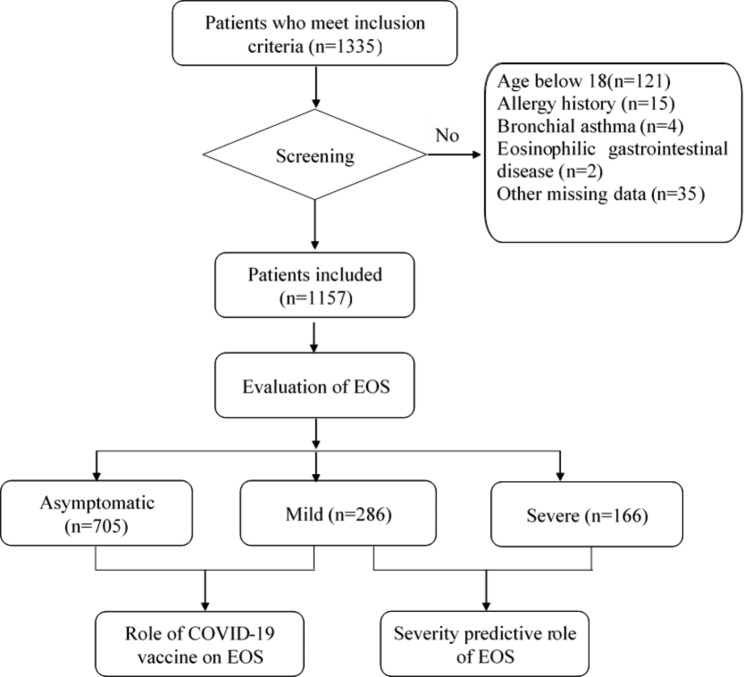
Methods: We collected a cohort of 1,157 patients infected with SARS-CoV-2 Omicron/BA.2 variant in Shanghai, China. These patients were diagnosed or admitted between Feb 20, 2022, and May 10, 2022, and were classified as asymptomatic (n = 705), mild (n = 286) and severe (n = 166) groups. We compiled and analyzed data of patients' clinical demographic characteristics, laboratory findings, and clinical outcomes.
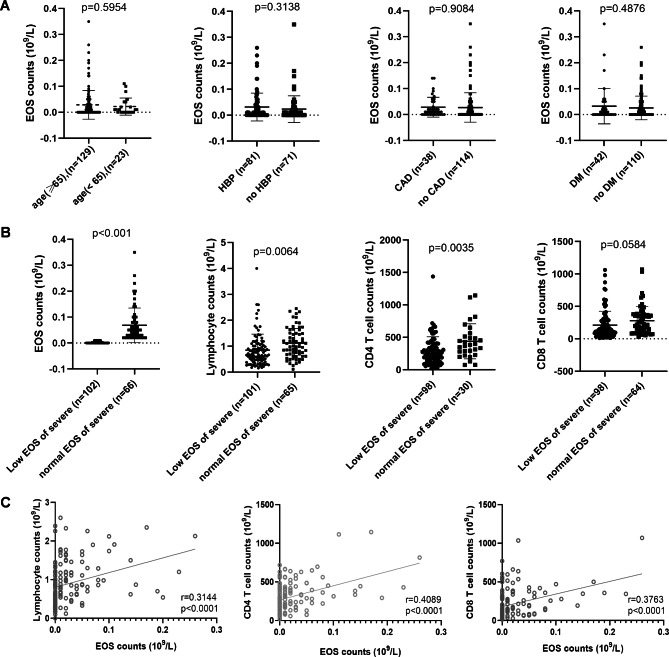
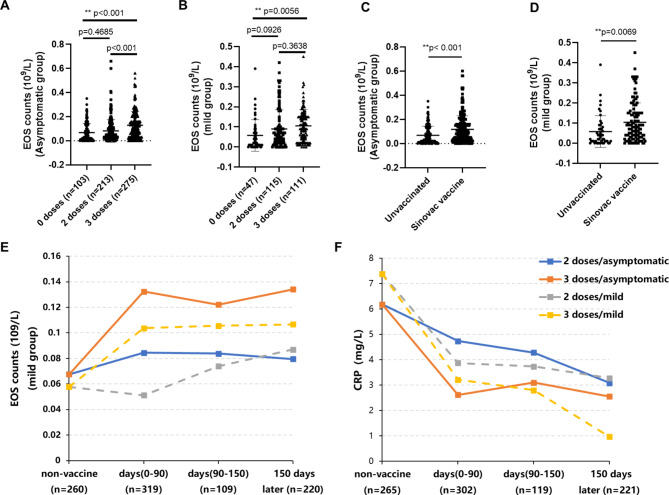
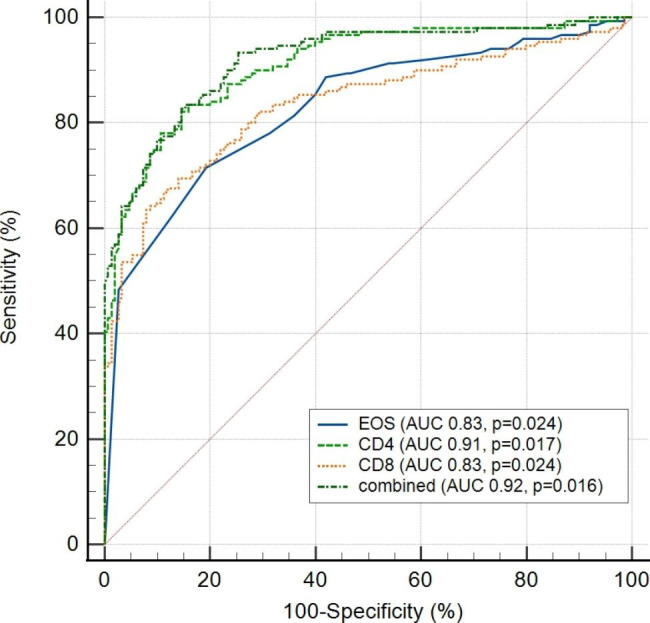
Results: COVID-19 vaccine reduced the incidence of severe cases. Severe patients were shown to have declined peripheral blood EOS. Both the 2 doses and 3 doses of inactivated COVID-19 vaccines promoted the circulating EOS levels. In particular, the 3rd booster shot of inactivated COVID-19 vaccine was shown to have a sustained promoting effect on circulating EOS. Univariate analysis showed that there was a significant difference in age, underlying comorbidities, EOS, lymphocytes, CRP, CD4, and CD8 T cell counts between the mild and the severe patients. Multivariate logistic regression analysis and ROC curve analysis indicate that circulating EOS (AUC = 0.828, p = 0.025), the combination of EOS and CD4 T cell (AUC = 0.920, p = 0.017) can predict the risk of disease severity in patients with SARS-CoV-2 Omicron BA.2 variant infection.
Conclusions: COVID-19 vaccine promotes circulating EOS and reduces the risk of severe illness, and particularly the 3rd booster dose of COVID-19 vaccine sustainedly promotes EOS. Circulating EOS, along with T cell immunity, may have a predictive value for the disease severity in SARS-CoV-2 Omicron infected patients.
Keywords: COVID-19 vaccine; Disease severity; Eosinophil (EOS); Omicron variant; SARS-CoV-2; T cell immunity.
© 2023. The Author(s).
Conflict of interest statement
The authors declare no competing interests.
Figures
References
-
- Chen N, Zhou M, Dong X, Qu J, Gong F, Han Y, Qiu Y, Wang J, Liu Y, Wei Y, et al. Epidemiological and clinical characteristics of 99 cases of 2019 novel coronavirus pneumonia in Wuhan, China: a descriptive study. Lancet. 2020;395(10223):507–13. doi: 10.1016/S0140-6736(20)30211-7. - DOI - PMC - PubMed
-
- Martin CA, Pan D, Melbourne C, Teece L, Aujayeb A, Baggaley RF, Bryant L, Carr S, Gregary B, Gupta A, et al. Risk factors associated with SARS-CoV-2 infection in a multiethnic cohort of United Kingdom healthcare workers (UK-REACH): a cross-sectional analysis. PLoS Med. 2022;19(5):e1004015. doi: 10.1371/journal.pmed.1004015. - DOI - PMC - PubMed
-
- Jian Wu YW, Cai Z, Lin Z, Huang H, Wang D, Yu J, Jiang B, Zhao X, Zhai G, Lin S, Li L. Hongcui Cao: Effects of Different Therapeutic Schedules on Patients with COVID-19: A Prospective Case–Control Study in China. Advanced Gut & Microbiome Research 2022, 2022:10.
MeSH terms
Substances
Supplementary concepts
LinkOut - more resources
Full Text Sources
Medical
Research Materials
Miscellaneous
