


The Impact of Introducing Midwives and also Mentoring on the Quality of Sexual, Reproductive, Maternal, Newborn, and Adolescent Health Services in Low- and Middle-Income Countries: An Integrative Review Protocol
- PMID: 37218908
- PMCID: PMC10204447
- DOI: 10.3390/mps6030048
The Impact of Introducing Midwives and also Mentoring on the Quality of Sexual, Reproductive, Maternal, Newborn, and Adolescent Health Services in Low- and Middle-Income Countries: An Integrative Review Protocol
Abstract
Introduction: Midwives have the potential to significantly contribute to health-delivery systems by providing sexual, reproductive, maternal, newborn, and adolescent health (SRMNAH) care. However, scant research finds barriers to understanding what midwives need to realize their full potential. There are gaps in the definition of a midwife and an understanding of effective means to support the implementation of midwifery care. Mentorship has been found to support systems and healthcare providers to improve care availability and quality.
Objectives: We describe the methodology of an integrative review that aims to generate evidence of the impact of introducing midwives and also on-site facility mentoring to better understand facilitators and barriers to implementation of the quality and availability of SRMNAH services in low- and middle-income countries (LMICs).
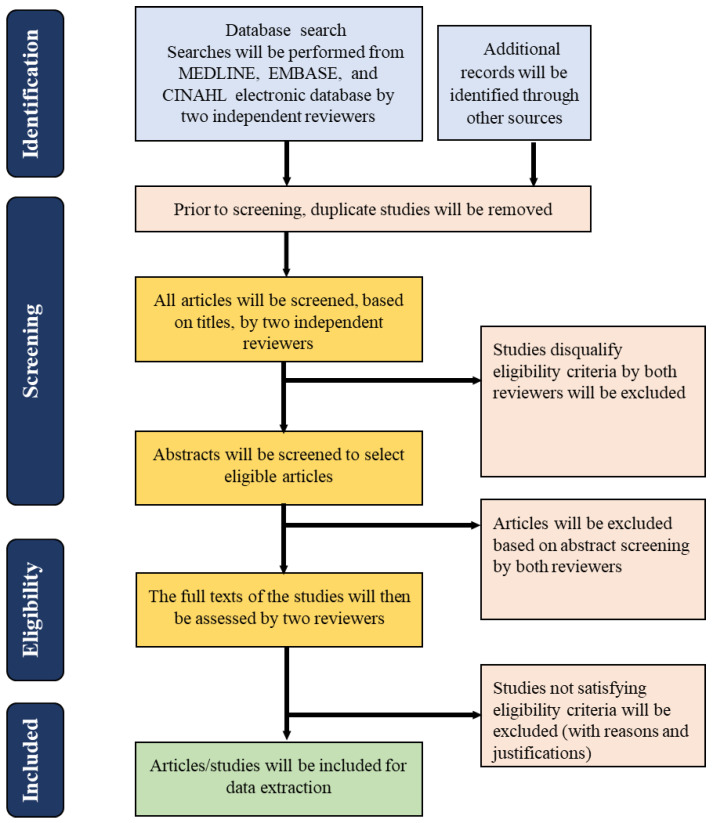
Methods: The Preferred Reporting Items for Systematic Reviews and Meta-Analyses (PRISMA) guidelines will be used to carry out the integrative review. Four electronic bibliographic databases, PubMed MEDLINE, EMBASE, Scopus, and CINAHL, will be used to identify eligible studies. All types of qualitative or quantitative studies will be considered. Eligible studies will be screened according to Population, Intervention, Comparison, and Outcome (PICO) inclusion criteria, and data will be extracted against a predetermined format. The aspects of health system strengthening in providing improved SRMNCH care will be examined in this review to generate evidence on how midwives and mentorship can improve routine care and health outcomes using the World Health Organization's Six Building Blocks approach. The quality of the articles will be thematically analyzed in four areas: coherence and integrity, appropriateness for answering the question, relevance and focus, and overall assessment using the Gough weight-of-evidence framework.
Expected results: The literature review will consider assessing both upstream health systems regulators and downstream effectors for implementing midwifery interventions. Within this building block framework, this research will report on the outcomes and experiences of introducing midwives and the effectiveness of mentoring midwives and other staff in midwives' roles in improving care quality and health outcomes.
Keywords: health systems strengthening; maternity care; mentoring; midwives; quality.
Conflict of interest statement
The authors declare no conflict of interest.
Figures
References
-
- Nove A., Friberg I.K., de Bernis L., McConville F., Moran A.C., Najjemba M., ten Hoope-Bender P., Tracy S., Homer C.S. Potential impact of midwives in preventing and reducing maternal and neonatal mortality and stillbirths: A Lives Saved Tool modelling study. Lancet Glob. Health. 2021;9:e24–e32. doi: 10.1016/S2214-109X(20)30397-1. - DOI - PMC - PubMed
-
- Renfrew M.J., McFadden A., Bastos M.H., Campbell J., Channon A.A., Cheung N.F., Silva D.R.A.D., Downe S., Kennedy H.P., Malata A., et al. Midwifery and quality care: Findings from a new evidence-informed framework for maternal and newborn care. Lancet. 2014;384:1129–1145. doi: 10.1016/S0140-6736(14)60789-3. - DOI - PubMed
LinkOut - more resources
Full Text Sources
