


Depression Severity Is Different in Dysosmic Patients Who Have Experienced Traumatic Brain Injury Compared with Those Who Have Not
- PMID: 37218979
- PMCID: PMC10204405
- DOI: 10.3390/neurolint15020040
Depression Severity Is Different in Dysosmic Patients Who Have Experienced Traumatic Brain Injury Compared with Those Who Have Not
Abstract
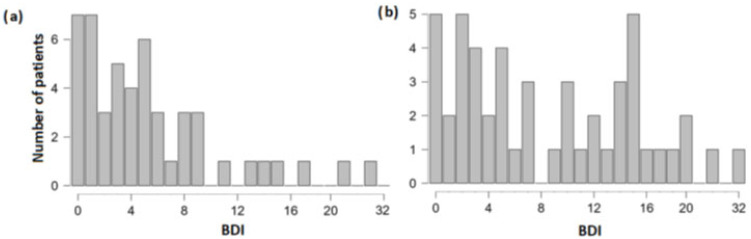
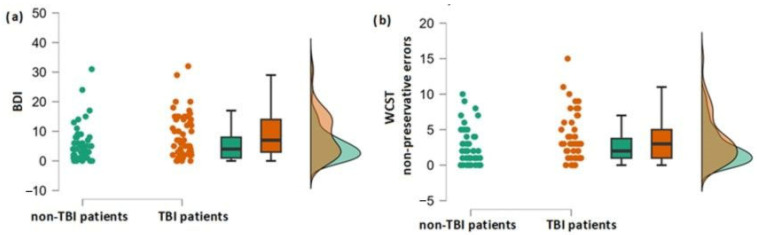
Traumatic brain injury (TBI) in humans can result in olfactory, cognitive, and affective changes. Surprisingly, research on the consequences of TBI often did not control for olfactory function in the investigated groups. Consequently, the affective or cognitive differences might be misleading as related rather to different olfactory performance than to a TBI experience. Hence, our study aimed to investigate whether TBI occurrence would lead to altered affective and cognitive functioning in two groups of dysosmic patients, one with TBI experience and one without. In total, 51 patients with TBI experience and 50 controls with varied causes of olfactory loss were thoroughly examined in terms of olfactory, cognitive, and affective performance. Student t-tests demonstrated that the only significant difference between the groups appeared in the depression severity, with TBI patients being more depressed (t = 2.3, p = 0.011, Cohen's d = -0.47). Regression analyses further showed that TBI experience was significantly associated with depression severity (R2 = 0.05, F [1, 96] = 5.5, p = 0.021, beta = 1.4). In conclusion, the present study showed that TBI experience is linked to depression, which is more pronounced compared to individuals with olfactory loss without TBI.
Keywords: depression; olfaction disorders; quality of life; traumatic brain injury.
Conflict of interest statement
The authors declare no conflict of interest.
Figures
References
-
- Feltrin F.S., Zaninotto A.L., Guirado V., Macruz F., Sakuno D., Dalaqua M., Magalhães L.G.A., Paiva W.S., De Andrade A.F., Otaduy M.C.G., et al. Longitudinal changes in brain volumetry and cognitive functions after moderate and severe diffuse axonal injury. Brain Inj. 2018;32:1413–1422. doi: 10.1080/02699052.2018.1494852. - DOI - PubMed
-
- Goleburn C.R., Golden C.J. Traumatic brain injury outcome in older adults: A critical review of the literature. J. Clin. Geropsychol. 2001;7:161–187. doi: 10.1023/A:1011335027445. - DOI
LinkOut - more resources
Full Text Sources
