


Editorial
doi: 10.1093/procel/pwad031.
Microbiome research outlook: past, present, and future
Affiliations
- PMID: 37219087
- PMCID: PMC10599639
- DOI: 10.1093/procel/pwad031
Item in Clipboard
Editorial
Microbiome research outlook: past, present, and future
Protein Cell.
.
No abstract available
Conflict of interest statement
The authors declare no competing interests related to the content of this paper.
Figures
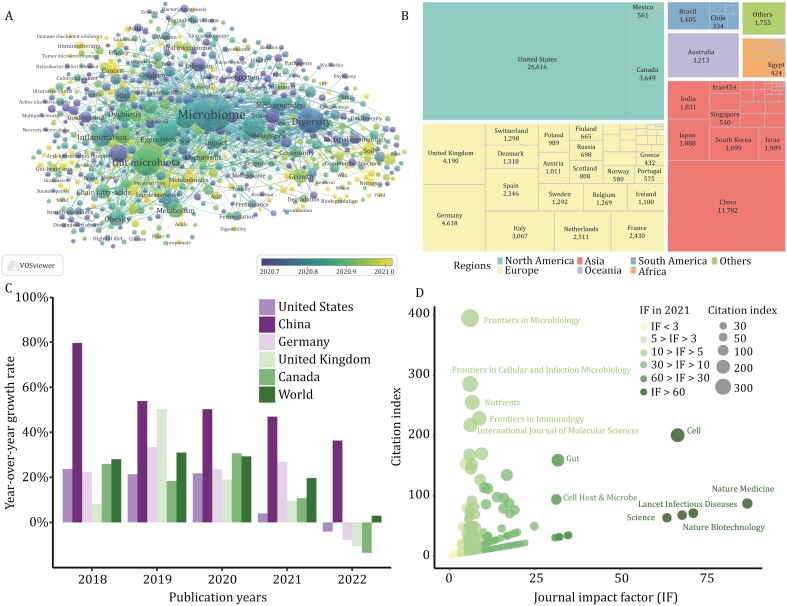
The trends and growth of microbiome research over the past years. Data were extracted from Web of Science Core Collection database on March 29th, 2023. (A) Keywords cluster map illustrating the hot spots in microbiome research, with 638 terms occurred at least 100 times since 1985. (B) Tree map indicating the geographical distribution of publications related to microbiome since 1985. (C) Bar graph displaying the year-over-year growth rate of the five countries with the most microbiome-related publications over the past 5 years. Year-over-year growth rate is calculated as follows: (the amount of the year’s publications—the amount of the last-year’s publications)/the amount of the last-year’s publications × 100%; (D) Bubble plot showing the citation indexes of journals citing publications from the first two special issues of Protein & Cell. Citation index is calculated as follows: the number of citations that a journal has made to the publications × the journal impact factor (IF) in 2021. (A) is drawn by VOSviewer.
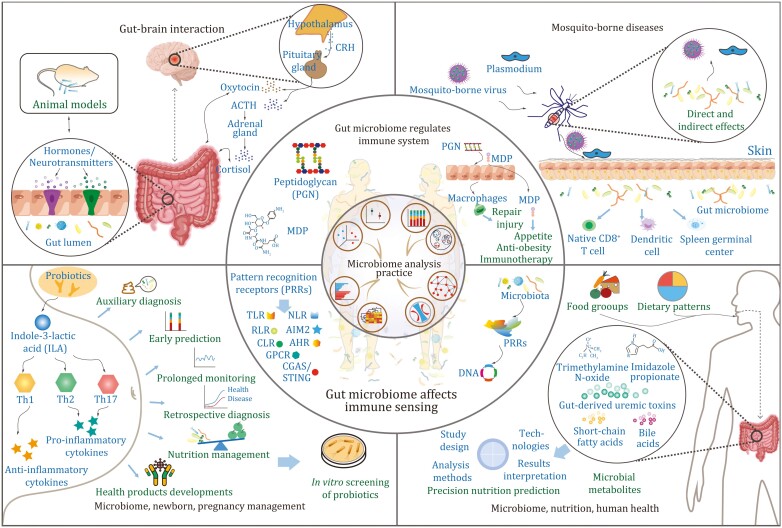
The framework of the current microbiome special issue. This framework covers seven important aspects of microbiome research, including best practices for analyzing microbiomes [inner circle, Wen et al. (2023)], the regulation of gut microbiomes on the human immune system [upper outer circle, Yin et al. (2023)], how gut microbiomes affect human immune sensing (lower outer circle, Wan et al. (2023)), the role of microbiomes in gut–brain interaction [upper left, Wang et al. (2023), Zheng et al. (2023)], how microbiomes can interfere with the spread of mosquito-borne diseases in both mosquitoes and humans (upper right, Shi et al. (2023)), the application of microbiomes in maternal and newborn health [lower left, Gao and Wang (2023)], and the study of nutri-microbiome epidemiology [lower right, Gou et al. (2023)]. The gut and brain of the figure are drawn with Figdraw.
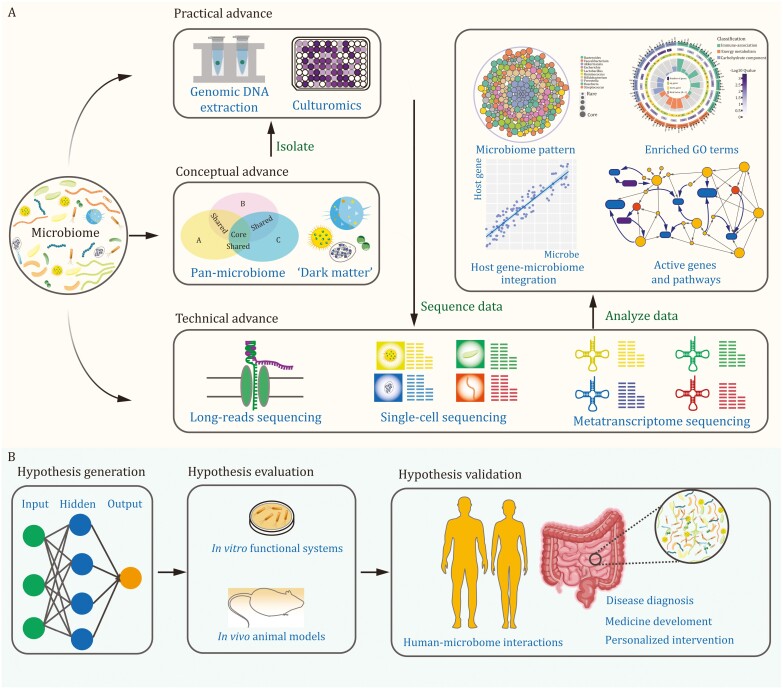
Future direction of microbiome research. (A) The flow chart presents an overview of the practical, conceptual, and technical advances in microbiome for studying its function and mechanisms. (B) The research data of microbiome is essential for hypothesis generation, evaluation, and validation.
References
-
- Chen T, Zhang H, Liu Yet al. EVenn: easy to create repeatable and editable Venn diagrams and Venn networks online. J Genet Genom 2021;48:863–866. - PubMed
Publication types
MeSH terms
Grants and funding
LinkOut - more resources
Full Text Sources
Miscellaneous
