Randomized Controlled Trial
. 2023 May 23;13(1):172.
doi: 10.1038/s41398-023-02477-4.

Acute effects of intravenous DMT in a randomized placebo-controlled study in healthy participants

Affiliations
Randomized Controlled Trial

Acute effects of intravenous DMT in a randomized placebo-controlled study in healthy participants

Severin B Vogt et al. Transl Psychiatry. .

Abstract

N,N-dimethyltryptamine (DMT) is distinct among classic serotonergic psychedelics because of its short-lasting effects when administered intravenously. Despite growing interest in the experimental and therapeutic use of intravenous DMT, data are lacking on its clinical pharmacology. We conducted a double-blind, randomized, placebo-controlled crossover trial in 27 healthy participants to test different intravenous DMT administration regimens: placebo, low infusion (0.6 mg/min), high infusion (1 mg/min), low bolus + low infusion (15 mg + 0.6 mg/min), and high bolus + high infusion (25 mg + 1 mg/min). Study sessions lasted for 5 h and were separated by at least 1 week. Participant's lifetime use of psychedelics was ≤20 times. Outcome measures included subjective, autonomic, and adverse effects, pharmacokinetics of DMT, and plasma levels of brain-derived neurotropic factor (BDNF) and oxytocin. Low (15 mg) and high (25 mg) DMT bolus doses rapidly induced very intense psychedelic effects that peaked within 2 min. DMT infusions (0.6 or 1 mg/min) without a bolus induced slowly increasing and dose-dependent psychedelic effects that reached plateaus after 30 min. Both bolus doses produced more negative subjective effects and anxiety than infusions. After stopping the infusion, all drug effects rapidly decreased and completely subsided within 15 min, consistent with a short early plasma elimination half-life (t1/2α) of 5.0-5.8 min, followed by longer late elimination (t1/2β = 14-16 min) after 15-20 min. Subjective effects of DMT were stable from 30 to 90 min, despite further increasing plasma concentrations, thus indicating acute tolerance to continuous DMT administration. Intravenous DMT, particularly when administered as an infusion, is a promising tool for the controlled induction of a psychedelic state that can be tailored to the specific needs of patients and therapeutic sessions.Trial registration: ClinicalTrials.gov identifier: NCT04353024.


Conflict of interest statement

The authors declare no competing interests.

Figures
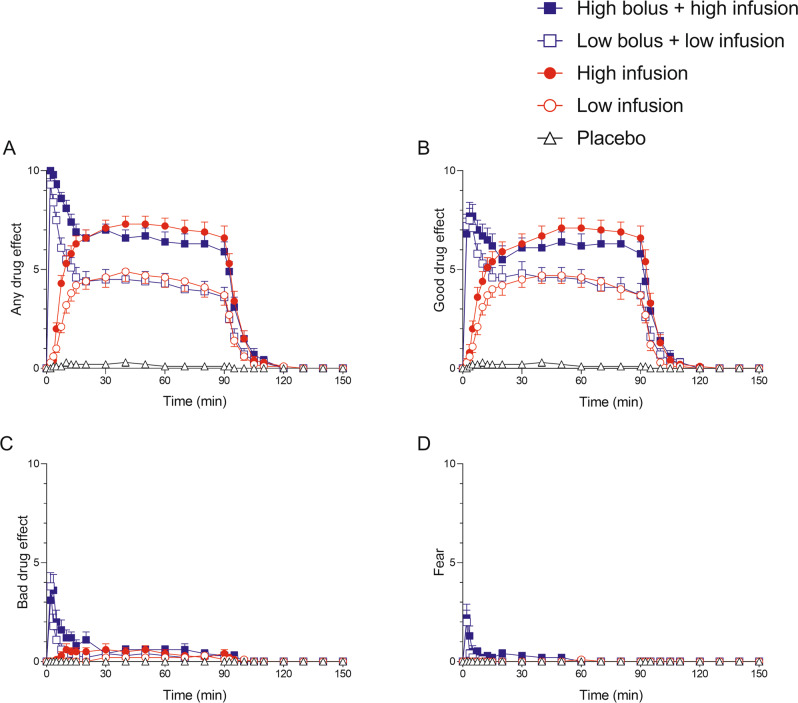
Fig. 1
Fig. 1. Acute subjective effects of N,N-dimethyltryptamine (DMT) over time.
The different intravenous dosing conditions of DMT were the following: Low infusion (0.6 mg/min), high infusion (1 mg/min), low bolus (15 mg) + low infusion (0.6 mg/min), and high bolus (25 mg) + high infusion (1 mg/min). The low and high bolus doses induced similar maximal drug effects on all four subjective effect scales, peaking within the first 2 min after intravenous bolus administration and decreasing relatively quickly within 10–15 min. The low and high infusions without a bolus dose induced “any drug effects” (A) and “good drug effects (B),” reaching a plateau after 30 min and remaining stable at the respective level until the end of the infusion at 90 min. After stopping the infusion, all drug effects rapidly and completely subsided within 15 min. Only minimal “bad drug effects (C)” and no “anxiety (D)” were induced by the infusions. Effects of the low and high bolus doses did not differ significantly, whereas the different infusion rates produced significantly different plateaus of “any drug effects” and “good drug effects.” Bolus doses were administered at t = 0. Infusions started at t = 1 min and lasted until t = 90 min. The data are expressed as the mean ± SEM in 27 participants. The corresponding maximal responses and statistics are shown in Table 1 and Supplementary Table S5.
Fig. 2
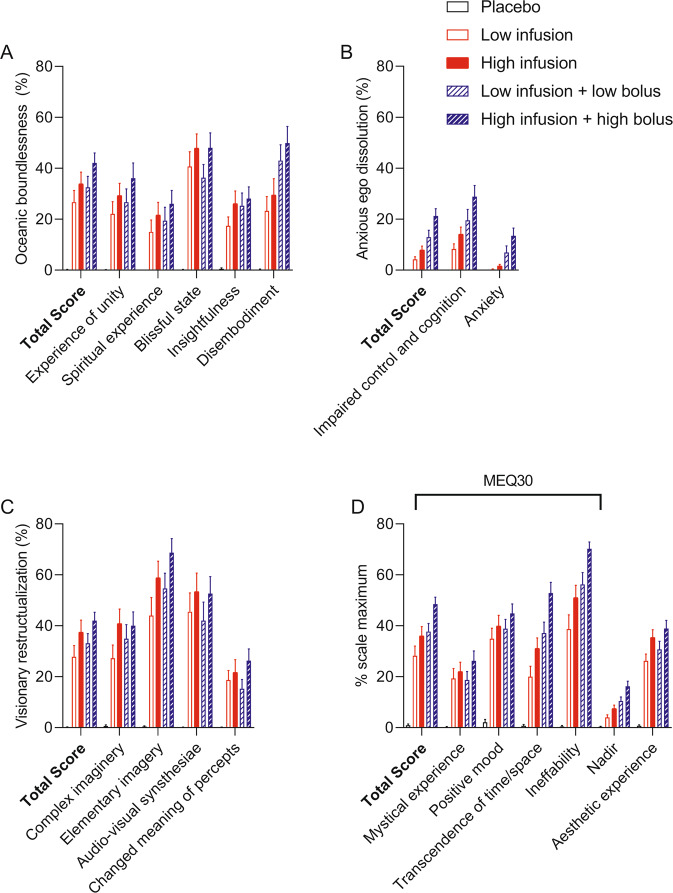
Fig. 2. Acute subjective effects of N,N-dimethyltryptamine (DMT) rated after the session.
Acute alterations of mind on the 5 Dimensions of Altered States of Consciousness (5D-ASC) scale (AC) and acute mystical-type experiences on the Mystical Experience Questionnaire 30 (MEQ30) induced by DMT (D). The high bolus + high infusion induced the highest scores on all subscales. The data are expressed as the mean ± SEM percentage of maximally possible scale scores in 27 participants. Statistics are shown in Supplementary Table S1.
Fig. 3
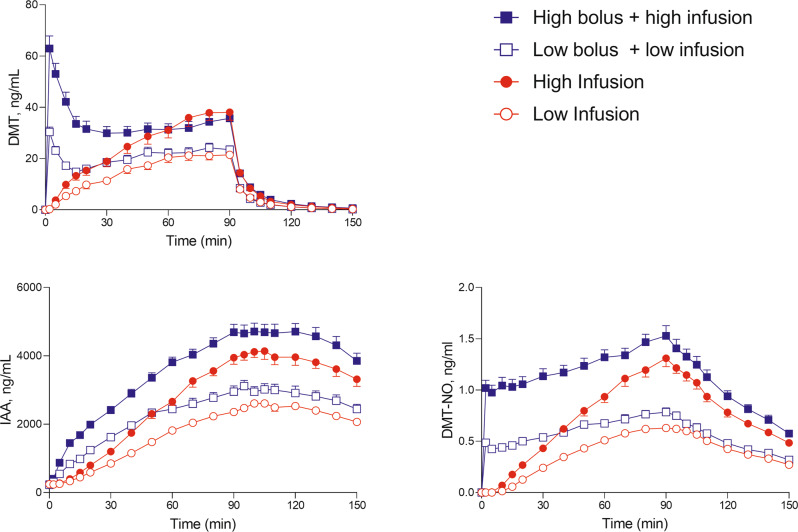
Fig. 3. Plasma concentrations of N,N-dimethyltryptamine (DMT), DMT-N-oxide (DMT-NO), and indole-3-acetic acid (IAA) over time.
Both bolus doses (15 and 25 mg) produced peak DMT levels 2 min after administration. Plasma DMT concentrations then rapidly decreased until reaching a plateau after 20 min. In the infusion-only conditions (0.6 and 1 mg/min), DMT concentrations increased until reaching a plateau at 70–80 min. After stopping the infusion at 90 min, DMT levels very rapidly decreased within 15–20 min in all conditions. The corresponding pharmacokinetic parameters are shown in Table 2 and Supplementary Table S4. Individual concentrations are shown in Supplementary Fig. S3–5.

References

    1. Dominguez-Clave E, Soler J, Elices M, Pascual JC, Alvarez E, de la Fuente Revenga M, et al. Ayahuasca: pharmacology, neuroscience and therapeutic potential. Brain Res Bull. 2016;126:89–101. doi: 10.1016/j.brainresbull.2016.03.002. - DOI - PubMed
    1. Riba J, McIlhenny EH, Bouso JC, Barker SA. Metabolism and urinary disposition of N,N-dimethyltryptamine after oral and smoked administration: a comparative study. Drug Test Anal. 2015;7:401–6. doi: 10.1002/dta.1685. - DOI - PubMed
    1. Gouzoulis-Mayfrank E, Heekeren K, Neukirch A, Stoll M, Stock C, Obradovic M, et al. Psychological effects of (S)-ketamine and N,N-dimethyltryptamine (DMT): a double-blind, cross-over study in healthy volunteers. Pharmacopsychiatry. 2005;38:301–11. doi: 10.1055/s-2005-916185. - DOI - PubMed
    1. Gallimore AR, Strassman RJ. A model for the application of target-controlled intravenous infusion for prolonged immersive DMT psychedelic experience. Front Pharmacol. 2016;7:211. doi: 10.3389/fphar.2016.00211. - DOI - PMC - PubMed
    1. Timmermann C, Roseman L, Williams L, Erritzoe D, Martial C, Cassol H, et al. DMT models the near-death experience. Front Psychol. 2018;9:1424. doi: 10.3389/fpsyg.2018.01424. - DOI - PMC - PubMed

Publication types

Associated data