


Maternal alcohol consumption and the risk of miscarriage in the first and second trimesters: A systematic review and dose-response meta-analysis
- PMID: 37221907
- PMCID: PMC10333669
- DOI: 10.1111/aogs.14566
Maternal alcohol consumption and the risk of miscarriage in the first and second trimesters: A systematic review and dose-response meta-analysis
Abstract
Introduction: According to a precautionary principle, it is recommended that pregnant women and women trying to conceive abstain from alcohol consumption. In this dose-response meta-analysis, we aimed to examine the association between alcohol consumption and binge drinking and the risk of miscarriage in the first and second trimesters.
Material and methods: The literature search was conducted in MEDLINE, Embase and the Cochrane Library in May 2022, without any language, geographic or time limitations. Cohort or case-control studies reporting dose-specific effects adjusting for maternal age and using separate risk assessments for first- and second-trimester miscarriages were included. Study quality was assessed using the Newcastle-Ottawa Scale. This study is registered with PROSPERO, registration number CRD42020221070.
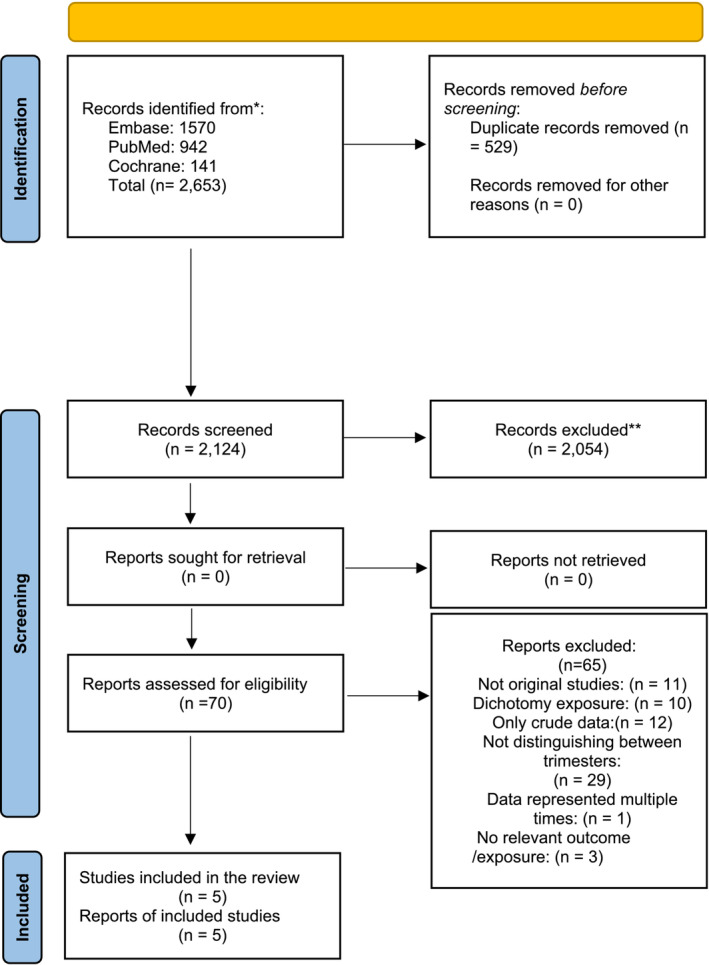
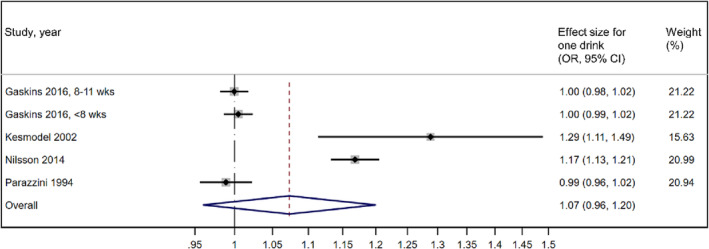
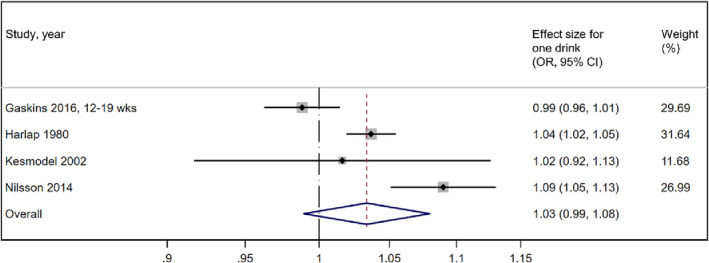
Results: A total of 2124 articles were identified. Five articles met the inclusion criteria. Adjusted data from 153 619 women were included in the first-trimester analysis and data from 458 154 women in the second-trimester analysis. In the first and second trimesters, the risk of miscarriage increased by 7% (odds ratio [OR] 1.07, 95% confidence interval [CI] 0.96-1.20) and 3% (OR 1.03, 95% CI 0.99-1.08) for each additional drink per week, respectively, but not to a statistically significant degree. One article regarding binge drinking and the risk of miscarriage was found, which revealed no association between the variables in either the first or second trimester (OR 0.84 [95% CI 0.62-1.14] and OR 1.04 [95% CI 0.78-1.38]).
Conclusions: This meta-analysis revealed no dose-dependent association between miscarriage risk and alcohol consumption, but further focused research is recommended. The research gap regarding miscarriage and binge drinking needs further investigation.
Keywords: alcohol consumption; binge drinking; miscarriage; pregnancy; spontaneous abortion.
© 2023 The Authors. Acta Obstetricia et Gynecologica Scandinavica published by John Wiley & Sons Ltd on behalf of Nordic Federation of Societies of Obstetrics and Gynecology (NFOG).
Conflict of interest statement
The authors have stated explicitly that there are no conflicts of interest in connection with this article.
Figures
References
-
- Kesmodel U. Alkohol og graviditet [alcohol and pregnancy]. Ugeskr Laeger. 1999;161:4989‐4994. - PubMed
-
- Popova S, Lange S, Probst C, Gmel G, Rehm J. Estimation of national, regional, and global prevalence of alcohol use during pregnancy and fetal alcohol syndrome: a systematic review and meta‐analysis. Lancet Glob Health. 2017;5:e290‐e299. - PubMed
-
- Strandberg‐Larsen K, Andersen A‐MN, Kesmodel US. Unreliable estimation of prevalence of fetal alcohol syndrome. Lancet Glob Health. 2017;5(6):e290‐e299. - PubMed
-
- Flak AL, Su S, Bertrand J, Denny CH, Kesmodel US, Cogswell ME. The association of mild, moderate, and binge prenatal alcohol exposure and child neuropsychological outcomes: a meta‐analysis. Alcohol Clin Exp Res. 2014;38:214‐226. - PubMed
Publication types
MeSH terms
LinkOut - more resources
Full Text Sources
Medical
Miscellaneous
