Review
. 2023 Nov;39(11):1703-1716.
doi: 10.1007/s12264-023-01065-2. Epub 2023 May 24.

Advances and Applications of Brain Organoids

Affiliations
Review

Advances and Applications of Brain Organoids

Yang Li et al. Neurosci Bull. 2023 Nov.

Abstract

Understanding the fundamental processes of human brain development and diseases is of great importance for our health. However, existing research models such as non-human primate and mouse models remain limited due to their developmental discrepancies compared with humans. Over the past years, an emerging model, the "brain organoid" integrated from human pluripotent stem cells, has been developed to mimic developmental processes of the human brain and disease-associated phenotypes to some extent, making it possible to better understand the complex structures and functions of the human brain. In this review, we summarize recent advances in brain organoid technologies and their applications in brain development and diseases, including neurodevelopmental, neurodegenerative, psychiatric diseases, and brain tumors. Finally, we also discuss current limitations and the potential of brain organoids.

Keywords: Brain development; Brain organoid; Human pluripotent stem cell; Neurological disease.


Conflict of interest statement

The authors declare that they have no conflict of interest.

Figures
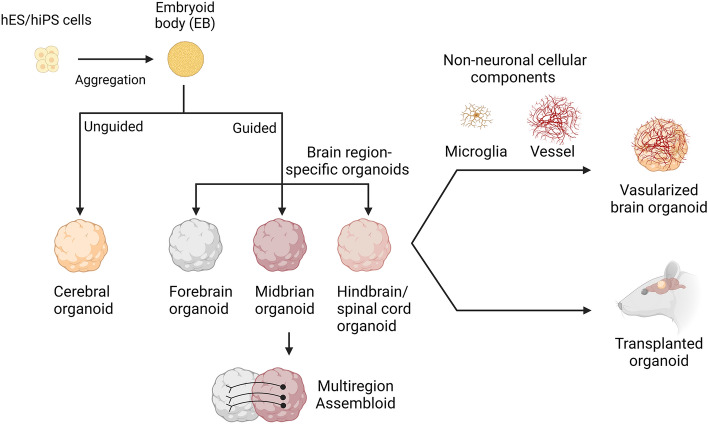
Fig. 1
Fig. 1
Advances in brain organoid methods. Human stem cell/pluripotent stem cells can be differentiated in self-organizing 3D cultures to derive unguided neural organoids (cerebral organoids) or brain region-specific organoids resembling various regions of the nervous system. Brain region-specific organoids can be combined to generate assemblies to model complex cell-cell interactions and neural circuit formation in the human nervous system. Brain organoids also can be fused with non-neuronal cellular components such as vessels and microglia or transplanted into animals to vascularize brain organoids. The figure was created with BioRender.com.
Fig. 2
Fig. 2
Applications of brain organoids. A Neurodevelopmental disorders. Brain organoids have been used to study neurodevelopmental disorders such as autism spectrum disorder, microcephaly, and Rett syndrome. B Neurodegenerative disorders. iPSC-induced or CRISPR-Cas9 gene-edited brain organoids have been successfully established for studying aging-dependent Alzheimer’s disease (AD), Parkinson’s disease (PD), and Huntington’s disease (HD). C Psychiatric disorders. Mental diseases mainly include depressive disorder, schizophrenia, and bipolar disorder. D Brain tumors. They also provide a unique opportunity to model brain tumors such as glioblastoma, medulloblastoma, and meningioma. The figure was created with BioRender.com.

References

    1. Rakic P. Evolution of the neocortex: A perspective from developmental biology. Nat Rev Neurosci. 2009;10:724–735. doi: 10.1038/nrn2719. - DOI - PMC - PubMed
    1. Giandomenico SL, Lancaster MA. Probing human brain evolution and development in organoids. Curr Opin Cell Biol. 2017;44:36–43. doi: 10.1016/j.ceb.2017.01.001. - DOI - PubMed
    1. Mertens J, Marchetto MC, Bardy C, Gage FH. Evaluating cell reprogramming, differentiation and conversion technologies in neuroscience. Nat Rev Neurosci. 2016;17:424–437. doi: 10.1038/nrn.2016.46. - DOI - PMC - PubMed
    1. Eiraku M, Watanabe K, Matsuo-Takasaki M, Kawada M, Yonemura S, Matsumura M, et al. Self-organized formation of polarized cortical tissues from ESCs and its active manipulation by extrinsic signals. Cell Stem Cell. 2008;3:519–532. doi: 10.1016/j.stem.2008.09.002. - DOI - PubMed
    1. Lancaster MA, Renner M, Martin CA, Wenzel D, Bicknell LS, Hurles ME, et al. Cerebral organoids model human brain development and microcephaly. Nature. 2013;501:373–379. doi: 10.1038/nature12517. - DOI - PMC - PubMed
