


Analysis of the 50 Most Cited Articles on Achilles Tendon Injury
- PMID: 37223076
- PMCID: PMC10201165
- DOI: 10.1177/23259671231170846
Analysis of the 50 Most Cited Articles on Achilles Tendon Injury
Abstract
Background: Achilles tendon injuries represent one of the most common reasons for referral to orthopaedic surgeons.
Purpose: To outline the characteristics, examine trends in publication, and evaluate the correlation between citations and study quality of the 50 most cited articles on Achilles tendon injury.
Study design: Cross-sectional study.
Methods: After searching the Web of Science for articles published in orthopaedic journals, we identified the 50 most cited articles on Achilles tendon injury and abstracted their characteristics. Risk of bias was assessed using the modified Coleman Methodology Score (mCMS). Multiple bivariate analyses (Pearson or Spearman correlation coefficient) were used to evaluate the association among number of citations, citation rate (citations/year), 2020 journal impact factor (JIF), year of publication, level of evidence (LoE), study type (tendon rupture or chronic tendinopathy), sample size, and mCMS.
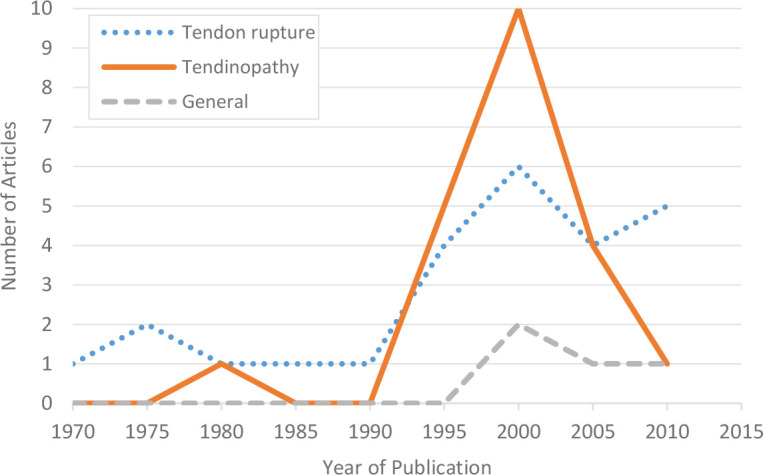
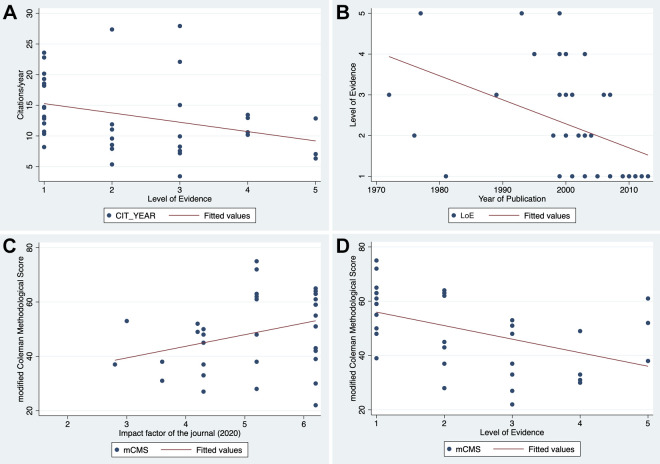
Results: The top 50 articles were cited 12,194 times. Each article had a mean ± SD 244 ± 88.8 citations (range, 157-657) and a citation rate of 12.6 ± 5.4 per year (range, 3-28). A total of 35 studies (70%) were published between 2000 and 2010. The citation rate of the 16 most recent studies was almost double that of the 16 oldest studies (17.5 vs 9.9; P < .001). Nineteen studies (49%) were classified as having poor quality (mCMS <50 points). The mean JIF of the 9 journals that published the studies was 5.1. The citation rate correlated with the number of citations (r = 0.56; P < .001), publication year (r = 0.60; P < .001), and LoE (r = -0.44; P = .005). The publication year correlated with the LoE (r = -0.40; P = .01). Study quality in terms of mCMS correlated with the JIF (r = 0.35; P = .03) and LoE (r = -0.48; P = .003) but not the citation rate (P = .15).
Conclusion: The mean LoE and the citation rate of the most cited articles on Achilles tendon injury both significantly increased over time. Although the JIF was positively correlated with study quality, almost half of the studies had poor-quality methodology.
Keywords: achilles; bibliometric; rupture; tendinopathy; top cited.
© The Author(s) 2023.
Conflict of interest statement
The authors declared that there are no conflicts of interest in the authorship and publication of this contribution. AOSSM checks author disclosures against the Open Payments Database (OPD). AOSSM has not conducted an independent investigation on the OPD and disclaims any liability or responsibility relating thereto.
Figures
References
-
- Abdelkader NA, Helmy MNK, Fayaz NA, Saweeres ESB. Short- and intermediate-term results of extracorporeal shockwave therapy for noninsertional Achilles tendinopathy. Foot Ankle Int. 2021;42(6):788–797. - PubMed
-
- Alfredson H, Öhberg L. Sclerosing injections to areas of neo-vascularisation reduce pain in chronic Achilles tendinopathy: a double-blind randomised controlled trial. Knee Surg Sports Traumatol Arthrosc. 2005;13(4):338–344. - PubMed
-
- Alfredson H, Öhberg L, Forsgren S. Is vasculo-neural ingrowth the cause of pain in chronic Achilles tendinosis? An investigation using ultrasonography and colour Doppler, immunohistochemistry, and diagnostic injections. Knee Surg Sports Traumatol Arthrosc. 2003;11(5):334–338. - PubMed
-
- Alfredson H, Pietilä T, Jonsson P, Lorentzon R. Heavy-load eccentric calf muscle training for the treatment of chronic Achilles tendinosis. Am J Sports Med. 1998;26(3):360–366. - PubMed
LinkOut - more resources
Full Text Sources
