


Prenatal exposures to per- and polyfluoroalkyl substances and epigenetic aging in umbilical cord blood: The Healthy Start study
- PMID: 37224946
- PMCID: PMC10330919
- DOI: 10.1016/j.envres.2023.116215
Prenatal exposures to per- and polyfluoroalkyl substances and epigenetic aging in umbilical cord blood: The Healthy Start study
Abstract
Background: Per- and polyfluoroalkyl substances (PFAS) are ubiquitous, environmentally persistent chemicals, and prenatal exposures have been associated with adverse child health outcomes. Prenatal PFAS exposure may lead to epigenetic age acceleration (EAA), defined as the discrepancy between an individual's chronologic and epigenetic or biological age.
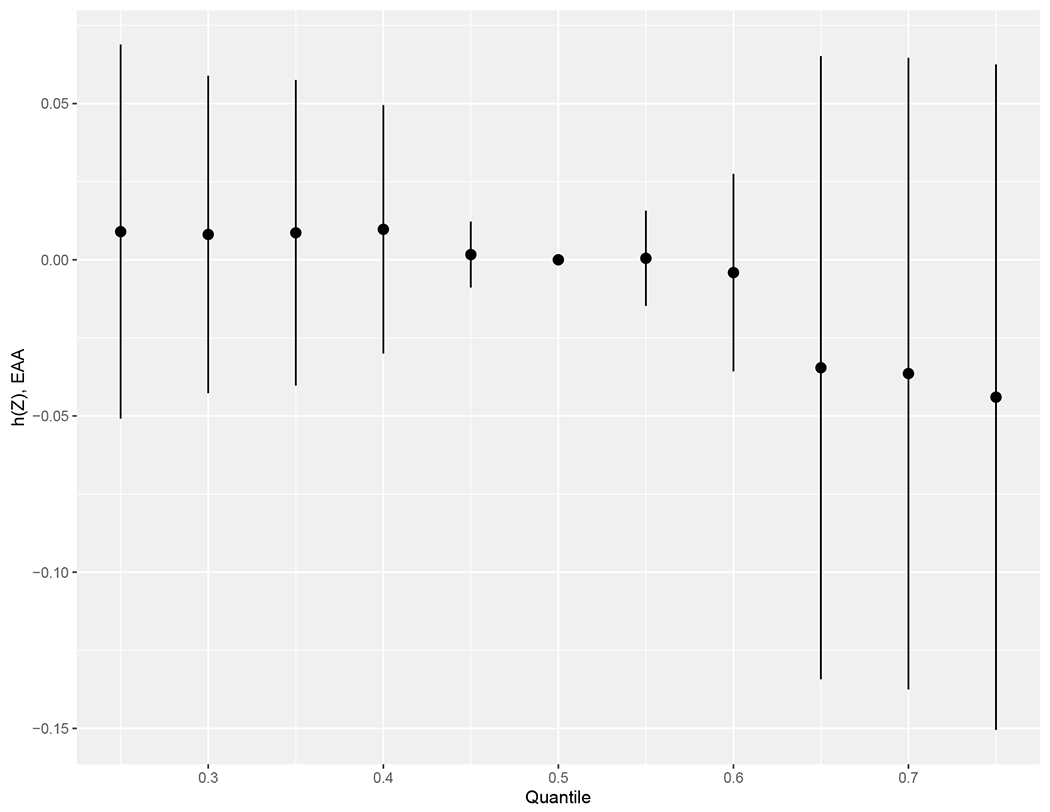
Objectives: We estimated associations of maternal serum PFAS concentrations with EAA in umbilical cord blood DNA methylation using linear regression, and a multivariable exposure-response function of the PFAS mixture using Bayesian kernel machine regression.
Methods: Five PFAS were quantified in maternal serum (median: 27 weeks of gestation) among 577 mother-infant dyads from a prospective cohort. Cord blood DNA methylation data were assessed with the Illumina HumanMethylation450 array. EAA was calculated as the residuals from regressing gestational age on epigenetic age, calculated using a cord-blood specific epigenetic clock. Linear regression tested for associations between each maternal PFAS concentration with EAA. Bayesian kernel machine regression with hierarchical selection estimated an exposure-response function for the PFAS mixture.
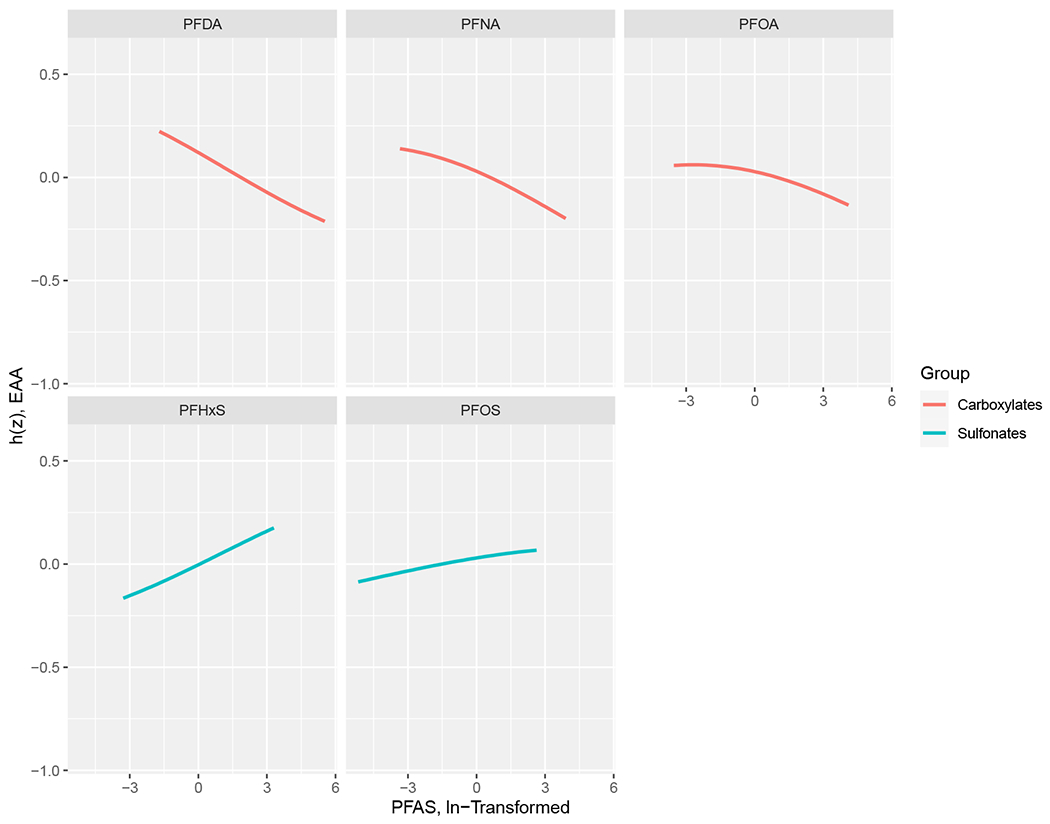
Results: In single pollutant models we observed an inverse relationship between perfluorodecanoate (PFDA) and EAA (-0.148 weeks per log-unit increase, 95% CI: -0.283, -0.013). Mixture analysis with hierarchical selection between perfluoroalkyl carboxylates and sulfonates indicated the carboxylates had the highest group posterior inclusion probability (PIP), or relative importance. Within this group, PFDA had the highest conditional PIP. Univariate predictor-response functions indicated PFDA and perfluorononanoate were inversely associated with EAA, while perfluorohexane sulfonate had a positive association with EAA.
Conclusions: Maternal mid-pregnancy serum concentrations of PFDA were negatively associated with EAA in cord blood, suggesting a pathway by which prenatal PFAS exposures may affect infant development. No significant associations were observed with other PFAS. Mixture models suggested opposite directions of association between perfluoroalkyl sulfonates and carboxylates. Future studies are needed to determine the importance of neonatal EAA for later child health outcomes.
Keywords: Epigenetic aging; Mixtures analysis; Per- and polyfluoroalkyl substances (PFAS); Perfluoroalkyl carboxylates; Perfluoroalkyl sulfonates; Prenatal exposures.
Copyright © 2023 Elsevier Inc. All rights reserved.
Conflict of interest statement
Declaration of competing interest The authors declare that they have no known competing financial interests or personal relationships that could have appeared to influence the work reported in this paper.
Figures
References
-
- Abraham K, Mielke H, Fromme H, Völkel W, Menzel J, Peiser M, Zepp F, Willich SN, Weikert C, 2020. Internal exposure to perfluoroalkyl substances (PFASs) and biological markers in 101 healthy 1-year-old children: associations between levels of perfluorooctanoic acid (PFOA) and vaccine response. Arch. Toxicol 94, 2131–2147. 10.1007/s00204-020-02715-4 - DOI - PMC - PubMed
-
- Bell EM, De Guise S, McCutcheon JR, Lei Y, Levin M, Li B, Rusling JF, Lawrence DA, Cavallari JM, O’Connell C, Javidi B, Wang X, Ryu H, 2021. Exposure, health effects, sensing, and remediation of the emerging PFAS contaminants – Scientific challenges and potential research directions. Sci. Total Environ 780, 146399. 10.1016/j.scitotenv.2021.146399 - DOI - PubMed
Publication types
MeSH terms
Substances
Grants and funding
LinkOut - more resources
Full Text Sources
