Cremastranone-Derived Homoisoflavanes Suppress the Growth of Breast Cancer Cells via Cell Cycle Arrest and Caspase-Independent Cell Death
- PMID: 37226044
- PMCID: PMC10468425
- DOI: 10.4062/biomolther.2023.057
Cremastranone-Derived Homoisoflavanes Suppress the Growth of Breast Cancer Cells via Cell Cycle Arrest and Caspase-Independent Cell Death
Abstract
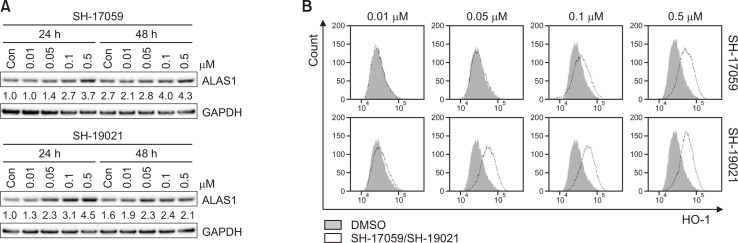
Breast cancer is the most common cancer and a frequent cause of cancer-related deaths among women wordlwide. As therapeutic strategies for breast cancer have limitations, novel chemotherapeutic reagents and treatment strategies are needed. In this study, we investigated the anti-cancer effect of synthetic homoisoflavane derivatives of cremastranone on breast cancer cells. Homoisoflavane derivatives, SH-17059 and SH-19021, reduced cell proliferation through G2/M cell cycle arrest and induced caspase-independent cell death. These compounds increased heme oxygenase-1 (HO-1) and 5-aminolevulinic acid synthase 1 (ALAS1), suggesting downregulation of heme. They also induced reactive oxygen species (ROS) generation and lipid peroxidation. Furthermore, they reduced expression of glutathione peroxidase 4 (GPX4). Therefore, we suggest that the SH-17059 and SH-19021 induced the caspase-independent cell death through the accumulation of iron from heme degradation, and the ferroptosis might be one of the potential candidates for caspase-independent cell death.
Keywords: Anti-cancer; Breast cancer; Caspase-independent cell death; Cell cycle arrest; Cremastranone; Homoisoflavane.
Figures



References
-
- Basavarajappa H. D., Lee B., Lee H., Sulaiman R. S., An H., Magaña C., Shadmand M., Vayl A., Rajashekhar G., Kim E. Y., Suh Y. G., Lee K., Seo S. Y., Corson T. W. Synthesis and biological evaluation of novel homoisoflavonoids for retinal neovascularization. J. Med. Chem. 2015;58:5015–5027. doi: 10.1021/acs.jmedchem.5b00449. - DOI - PMC - PubMed
-
- Basavarajappa H. D., Sulaiman R. S., Qi X., Shetty T., Sheik Pran Babu S., Sishtla K. L., Lee B., Quigley J., Alkhairy S., Briggs C. M., Gupta K., Tang B., Shadmand M., Grant M. B., Boulton M. E., Seo S. Y., Corson T. W. Ferrochelatase is a therapeutic target for ocular neovascularization. EMBO Mol. Med. 2017;9:786–801. doi: 10.15252/emmm.201606561.3e824506a6224c1eb5ab5fcfef835898 - DOI - PMC - PubMed
LinkOut - more resources
Full Text Sources
Research Materials