Clinical Trial
. 2023 May 24;21(1):190.
doi: 10.1186/s12916-023-02900-z.

First-in-human, double-blind, randomized phase 1b study of peptide immunotherapy IMCY-0098 in new-onset type 1 diabetes

Affiliations
Clinical Trial

First-in-human, double-blind, randomized phase 1b study of peptide immunotherapy IMCY-0098 in new-onset type 1 diabetes

Jean Van Rampelbergh et al. BMC Med. .

Abstract

Background: Type 1 diabetes (T1D) is a CD4+ T cell-driven autoimmune disease characterized by the destruction of insulin-producing pancreatic β-cells by CD8+ T cells. Achieving glycemic targets in T1D remains challenging in clinical practice; new treatments aim to halt autoimmunity and prolong β-cell survival. IMCY-0098 is a peptide derived from human proinsulin that contains a thiol-disulfide oxidoreductase motif at the N-terminus and was developed to halt disease progression by promoting the specific elimination of pathogenic T cells.

Methods: This first-in-human, 24-week, double-blind phase 1b study evaluated the safety of three dosages of IMCY-0098 in adults diagnosed with T1D < 6 months before study start. Forty-one participants were randomized to receive four bi-weekly injections of placebo or increasing doses of IMCY-0098 (dose groups A/B/C received 50/150/450 μg for priming followed by three further administrations of 25/75/225 μg, respectively). Multiple T1D-related clinical parameters were also assessed to monitor disease progression and inform future development. Long-term follow-up to 48 weeks was also conducted in a subset of patients.

Results: Treatment with IMCY-0098 was well tolerated with no systemic reactions; a total of 315 adverse events (AEs) were reported in 40 patients (97.6%) and were related to study treatment in 29 patients (68.3%). AEs were generally mild; no AE led to discontinuation of the study or death. No significant decline in C-peptide was noted from baseline to Week 24 for dose A, B, C, or placebo (mean change - 0.108, - 0.041, - 0.040, and - 0.012, respectively), suggesting no disease progression.

Conclusions: Promising safety profile and preliminary clinical response data support the design of a phase 2 study of IMCY-0098 in patients with recent-onset T1D.

Trial registration: IMCY-T1D-001: ClinicalTrials.gov NCT03272269; EudraCT: 2016-003514-27; and IMCY-T1D-002: ClinicalTrials.gov NCT04190693; EudraCT: 2018-003728-35.

Keywords: Beta-cells; Clinical study; Immunotherapy; Safety; T cells; Type 1 diabetes.


Conflict of interest statement

JVR, VC, RRA, EG, NB, LVE, MVM, and PV are employees or contractors of Imcyse S.A., Liège, Belgium, and may hold stock options. RDL’s institution received study funding and materials from Imcyse. RDL received an honorarium from DMRR and took part in advisory boards for Diamyd and Provention. MAA’s institution received study funding and materials from Imcyse. MAA received medical writing and APC support from Imcyse; received grants from EFSD, Wellcome Trust, Cardiff University, Wales Kidney Research Unit, and INNODIA; received honoraria from Sanofi Diabetes, Eli Lilly, Boehringer Ingelheim, Astra Zeneca, MSD, Novo Nordisk and Bayer; received meeting support from Sanofi Diabetes, Eli Lilly, Takeda, Abbott, Merck, Novo Nordisk, NAPP, Miltenyi Biotec and Servier. CD, BK, and CB’s institutions received study funding and materials from Imcyse. CD received consultancy honoraria, medical writing, and APC support from Imcyse. PA and KRO declare no competing interests.

Figures

Fig. 1
Fig. 1
Figure to show summary of IMCY-0098 structure and the HLA class II epitopes it will bind based on previous literature [27] (A), in vitro thioredox data (B), in vitro binding data for DR3 (C), and DR4 (D). IMCY-009 sequence is shown as it overlaps with proinsulin (A). The design was based on previous literature [27]. Thiol-oxidoreductase activity was assessed in vitro on a disulfide-linked tripeptide substrate wherein a fluorescent signal was generated after disulfide bridge reduction using Sensolyte® 520 Thiol Quantification kit. Results are expressed as a relative activity percentage compared to the dithiothreitol (DTT) after 45 min of incubation with the Thiol detection reagent (B). Binding affinities with DR3 and DR4 (C and D, respectively) were confirmed in a classical competition assay with a reference peptide (a high-affinity canonical 1–14 epitope derived from the YAR-B antigen), in which proinsulin-derived high-affinity binders would be identified
Fig. 2
Fig. 2
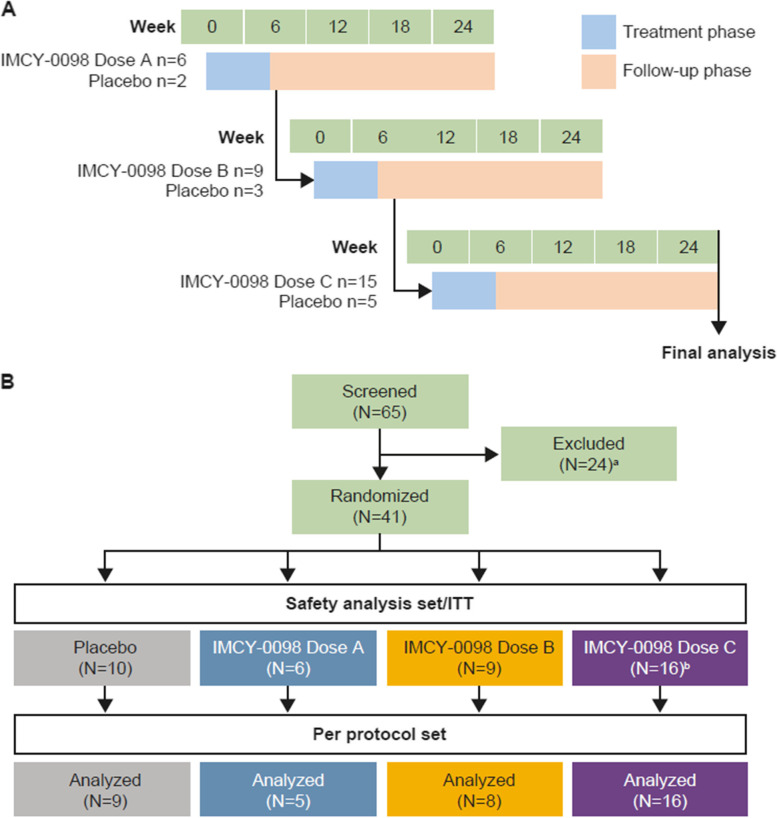
Figure to show the sequential study design (A) and patient disposition (B). Safety analysis set and ITT population were the same in this study. Per protocol set excluded three patients who received the incorrect dose of study medication at one of the four injections (one patient allocated to placebo treatment arm erroneously received IMCY-0098). aPatients were excluded for the following reasons: HLA status (n = 10), withdrawal of consent (n = 7), C-peptide level (n = 3); time post-diagnosis (n = 2), autoantibody status (n = 1) and body-mass index (n = 1). bA total of 15 patients were planned for dose C; however, 16 patients were randomized to receive this dose. dose A: 50 μg at week 0 followed by 3 × 25 μg; dose B: 150 μg at week 0 followed by 3 × 75 μg; dose C: 450 μg at week 0 followed by 3 × 225 μg. ITT, intent-to-treat. N/n refer to patients
Fig. 3
Fig. 3
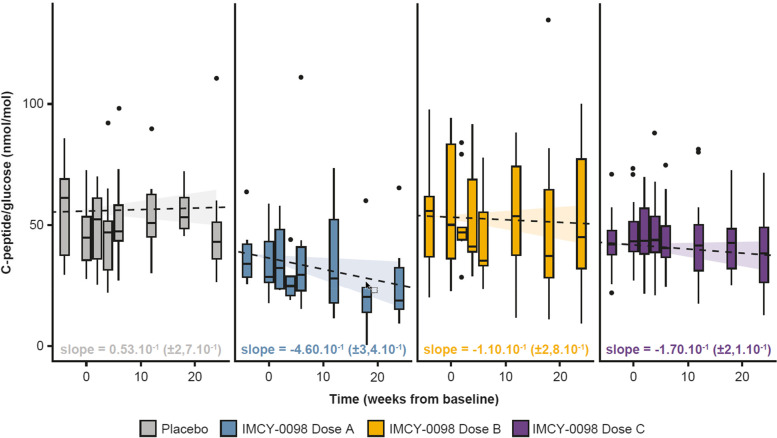
Linear mixed effect model to show C-peptide/glucose progression over time in the intent-to-treat population. Shown is the best of tested linear mixed effect models selected according to the Akaike Information Criterion. The model predicts the progression of C-peptide/glucose over time while taking into account treatment arm, inter-subject variability and fixed effect due to seven additional covariates: C-peptide/glucose at baseline, fasting C-peptide at baseline, glycemia at baseline, HLA-DQ8 status, HLA-DR3/HLA-DQ2 status, HLA-DR4 status, and gender. Regression coefficients were analyzed via Mann–Whitney-Wilcoxon test. Central lines represent median values, boxes represent interquartile range, and whiskers represent upper and lower 1.5 × interquartile range. Shaded bands around the regression lines represent 95% confidence intervals on the fitted values. The ranges displayed in brackets are 95% confidence intervals, which were assessed by computing a likelihood profile and finding the appropriate cutoffs based on the likelihood ratio test. All plotted data are biological replicates. Dose A: 50 μg at week 0 followed by 3 × 25 μg; dose B: 150 μg at week 0 followed by 3 × 75 μg; dose C: 450 μg at week 0 followed by 3 × 225 μg
Fig. 4
Fig. 4
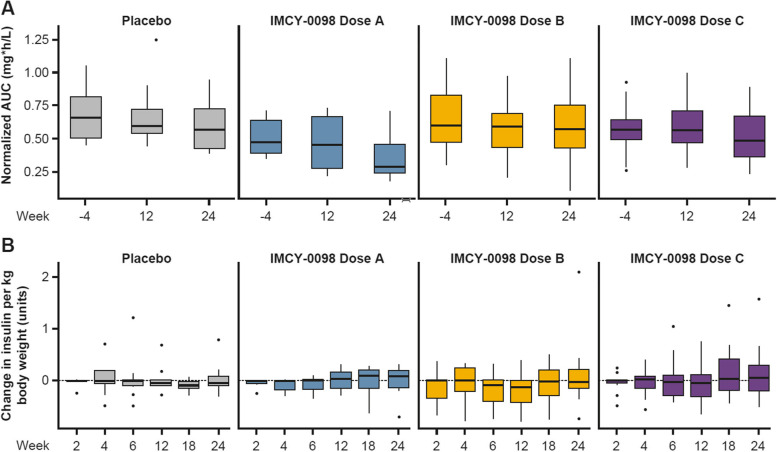
Progression of clinical response measured by AUC C-peptide from MMTT (A) and daily insulin consumption (B). Data are shown for the intent-to-treat population. Central lines represent median values, boxes represent interquartile range, and whiskers represent upper and lower 1.5 × interquartile range, respectively. Dose A: 50 μg at Week 0 followed by 3 × 25 μg; dose B: 150 μg at Week 0 followed by 3 × 75 μg; dose C: 450 μg at Week 0 followed by 3 × 225 μg. Normalized AUC refers to C-peptide normalized to glucose. All plotted data are biological replicates. Points represent subjects. AUC, area under the curve; MMTT, Mixed Meal Tolerance Test
Fig. 5
Fig. 5
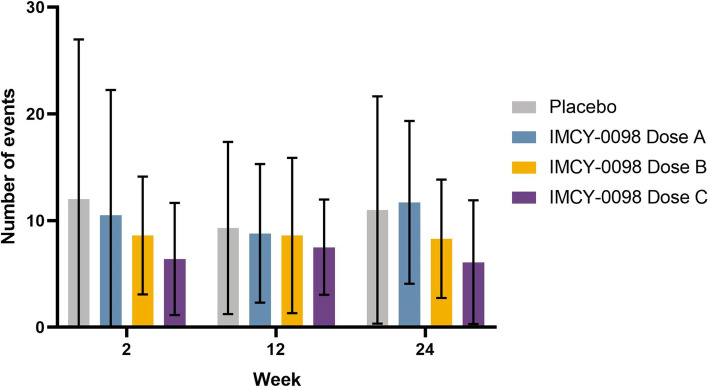
Mean total number of events of low glucose. Mean total number of low glucose events over the past 14 days. Data are shown for the intent-to-treat population. Error bars show standard deviation. Dose A: 50 μg at Week 0 followed by 3 × 25 μg; dose B: 150 μg at Week 0 followed by 3 × 75 μg; dose C: 450 μg at Week 0 followed by 3 × 225 μg. Events of low glucose were defined as being within the hypoglycaemic range (< 3.9 mmol/L or < 70 mg/dl or < 0.7 g/L)

References

    1. Waldron-Lynch F, Herold KC. Immunomodulatory therapy to preserve pancreatic beta-cell function in type 1 diabetes. Nat Rev Drug Discov. 2011;10(6):439–452. doi: 10.1038/nrd3402. - DOI - PubMed
    1. Global report on diabetes. World Health Organization [https://www.who.int/diabetes/global-report/en/].
    1. American Diabetes Association Professional Practice C. Draznin B, Aroda VR, Bakris G, Benson G, Brown FM, Freeman R, Green J, Huang E, et al. 2. Classification and Diagnosis of Diabetes: Standards of Medical Care in Diabetes-2022. Diabetes Care. 2022;45(Supplement_1):S17–S38. doi: 10.2337/dc22-S002. - DOI - PubMed
    1. National Diabetes Statistics Report. Center for disease control and prevention [https://www.cdc.gov/diabetes/data/statistics/statistics-report.html].
    1. Maahs DM, West NA, Lawrence JM, Mayer-Davis EJ. Epidemiology of type 1 diabetes. Endocrinol Metab Clin North Am. 2010;39(3):481–497. doi: 10.1016/j.ecl.2010.05.011. - DOI - PMC - PubMed

Publication types