


The Association of Vaping With Social/Emotional Health and Attitudes Toward COVID-19 Mitigation Measures in Adolescent and Young Adult Cohorts During the COVID-19 Pandemic
- PMID: 37226905
- PMCID: PMC10133863
- DOI: 10.1177/08897077231165860
The Association of Vaping With Social/Emotional Health and Attitudes Toward COVID-19 Mitigation Measures in Adolescent and Young Adult Cohorts During the COVID-19 Pandemic
Erratum in
-
Erratum to Volume 44 Issue 1-2, January-April 2023.Subst Use Addctn J. 2023 Jul 18:8897077231185670. doi: 10.1177/08897077231185670. Online ahead of print. Subst Use Addctn J. 2023. PMID: 37461916 No abstract available.
Abstract
Background: Vaping is a major health risk behavior which often occurs socially. Limited social activity during the COVID-19 pandemic contributed to worsening social and emotional health. We investigated associations among youth vaping, and reports of worsening mental health, loneliness, and relationships with friends and romantic partners (ie, social health), as well as perceived attitudes toward COVID-19 mitigation measures.
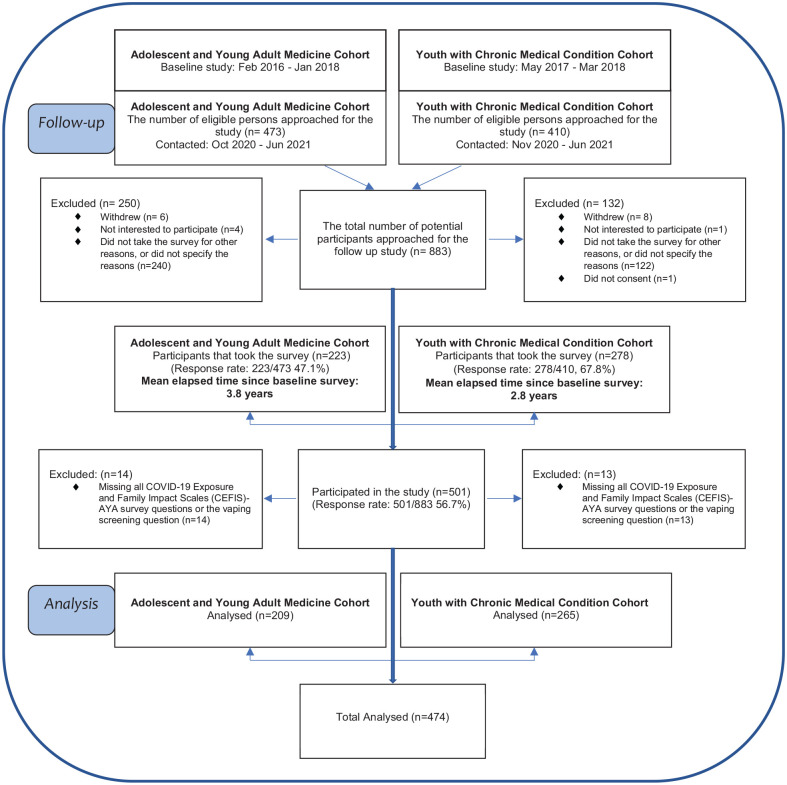
Methods: From October 2020 to May 2021, a clinical convenience sample of adolescents and young adults (AYA) reported on their past-year substance use, including vaping, their mental health, COVID-19 related exposures and impacts, and their attitudes toward non-pharmaceutical COVID-19 mitigation interventions, via a confidential electronic survey. Multivariate logistic regressions were used to estimate associations among vaping and social/emotional health.
Results: Of 474 AYA (mean age = 19.3 (SD = 1.6) years; 68.6% female), 36.9% reported vaping in the prior 12 months. AYA who self-reported vaping were more likely than non-vaping AYA to report worsening: anxiety/worry (81.1%; P = .036), mood (78.9%; P = .028), eating (64.6%; P = .015), sleep (54.3%; P = .019), family discord (56.6%; P = .034), and substance use (54.9%; P < .001). Participants who vaped also reported easy access to nicotine (63.4%; P < .001) and cannabis products (74.9%; P < .001). No difference in perceived change in social wellbeing was seen between the groups. In adjusted models, vaping was associated with symptoms of depression (AOR = 1.86; 95% CI = 1.06-3.29), less social distancing (AOR = 1.82; 95% CI = 1.11-2.98), lower perceived importance of proper mask wearing (AOR = 3.22; 95% CI = 1.50-6.93), and less regular use of masks (AOR = 2.98; 95% CI = 1.29-6.84).
Conclusions: We found evidence that vaping was associated with symptoms of depression and lower compliance with non-pharmaceutical COVID-19 mitigation efforts among AYA during the COVID-19 pandemic.
Keywords: COVID-19; adolescents; cannabis; mental health; nicotine; vaping; young adults.
Conflict of interest statement
The author(s) declared the following potential conflicts of interest with respect to the research, authorship, and/or publication of this article: Dr. Levy serves as an expert for the litigation against JUUL. The other authors have no conflicts of interest to disclose.
Figures
References
-
- Johnston LD, Miech RA, O’Malley PM, Bachman JG, Schulenberg JE, Patrick ME. Monitoring the Future national survey results on drug use, 1975-2020: overview, key findings on adolescent drug use. Institute for Social Research, The University of Michigan; 2021. Accessed October 24, 2022. https://eric.ed.gov/?id=ED611736
-
- Walley SC, Wilson KM, Winickoff JP, Groner J. A public health crisis: electronic cigarettes, vape, and JUUL. Pediatrics. 2019;143(6):e20182741. - PubMed
Publication types
MeSH terms
Grants and funding
LinkOut - more resources
Full Text Sources
Medical
Miscellaneous
