


Web-Based Knowledge Translation Tool About Pediatric Acute Gastroenteritis for Parents: Pilot Randomized Controlled Trial
- PMID: 37227758
- PMCID: PMC10251226
- DOI: 10.2196/45276
Web-Based Knowledge Translation Tool About Pediatric Acute Gastroenteritis for Parents: Pilot Randomized Controlled Trial
Abstract
Background: Acute gastroenteritis (AGE) in children is a leading cause of emergency department (ED) visits, resulting in substantial health care costs and stress for families and caregivers. The majority of pediatric AGE cases are caused by viral infections and can be managed at home using strategies to prevent dehydration. To increase knowledge of, and support health decision-making for, pediatric AGE, we developed a knowledge translation (KT) tool (fully automated web-based whiteboard animation video).
Objective: The aim of this study was to assess the potential effectiveness of the web-based KT tool in terms of knowledge, health care decision-making, use of resources, and perceived benefit and value.
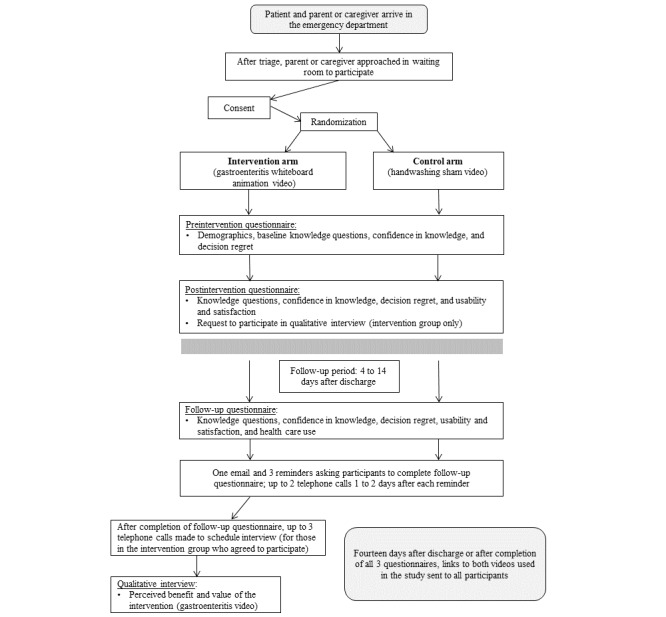
Methods: A convenience sample of parents was recruited between December 18, 2020, and August 10, 2021. Parents were recruited in the ED of a pediatric tertiary care hospital and followed for up to 14 days after the ED visit. The eligibility criteria included parent or legal guardian of a child aged <16 years presenting to the ED with an acute episode of diarrhea or vomiting, ability to communicate in English, and agreeable to follow-up via email. Parents were randomized to receive the web-based KT tool (intervention) about AGE or a sham video (control) during their ED visit. The primary outcome was knowledge assessed before the intervention (baseline), immediately after the intervention, and at follow-up 4 to 14 days after ED discharge. Other outcomes included decision regret, health care use, and KT tool usability and satisfaction. The intervention group participants were invited to participate in a semistructured interview to gather additional feedback about the KT tool.
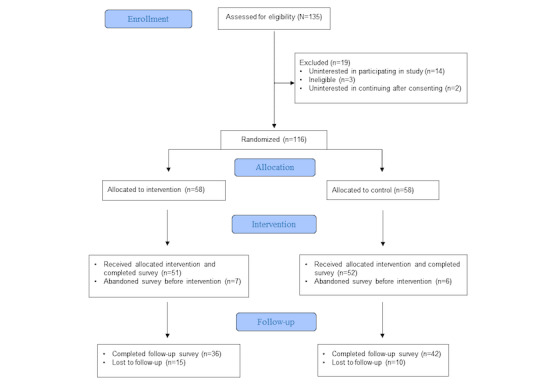
Results: A total of 103 parents (intervention: n=51, 49.5%, and control: n=52, 50.5%) completed the baseline and postintervention assessments. Of these 103 parents, 78 (75.7%; intervention: n=36, 46%, and control: n=42, 54%) completed the follow-up questionnaire. Knowledge scores after the intervention (mean 8.5, SD 2.6 vs mean 6.3, SD 1.7; P<.001) and at follow-up (mean 9.1, SD 2.7 vs mean 6.8, SD 1.6; P<.001) were significantly higher in the intervention group. After the intervention, parents in the intervention group reported greater confidence in knowledge than those in the control group. No significant difference in decision regret was found at any time point. Parents rated the KT tool higher than the sham video across 5 items assessing usability and satisfaction.
Conclusions: The web-based KT tool improved parental knowledge about AGE and confidence in their knowledge, which are important precursors to behavior change. Further research is needed into understanding what information and delivery format as well as other factors influence parents' decision-making regarding their child's health.
Trial registration: ClinicalTrials.gov NCT03234777; https://clinicaltrials.gov/ct2/show/NCT03234777.
International registered report identifier (irrid): RR2-10.1186/s40814-018-0318-0.
Keywords: emergency department; health care decision-making; knowledge translation; multiple methods; pediatric acute gastroenteritis; qualitative interviews; randomized controlled trial; web-based tool.
©Lisa Hartling, Sarah A Elliott, Matthew Munan, Shannon D Scott. Originally published in JMIR Formative Research (https://formative.jmir.org), 25.05.2023.
Conflict of interest statement
Conflicts of Interest: LH and SDS developed the knowledge translation tool that was evaluated in the trial.
Figures
References
-
- Elliott EJ. Acute gastroenteritis in children. BMJ. 2007 Jan 06;334(7583):35–40. doi: 10.1136/bmj.39036.406169.80. https://europepmc.org/abstract/MED/17204802 334/7583/35 - DOI - PMC - PubMed
-
- King CK, Glass R, Bresee JS, Duggan C, Centers for Disease ControlPrevention Managing acute gastroenteritis among children: oral rehydration, maintenance, and nutritional therapy. MMWR Recomm Rep. 2003 Nov 21;52(RR-16):1–16. https://www.cdc.gov/mmwr/preview/mmwrhtml/rr5216a1.htm rr5216a1 - PubMed
Associated data
LinkOut - more resources
Full Text Sources
Medical
Miscellaneous
