


Assessment of severity scoring systems for predicting mortality in critically ill patients receiving continuous renal replacement therapy
- PMID: 37228073
- PMCID: PMC10212150
- DOI: 10.1371/journal.pone.0286246
Assessment of severity scoring systems for predicting mortality in critically ill patients receiving continuous renal replacement therapy
Abstract
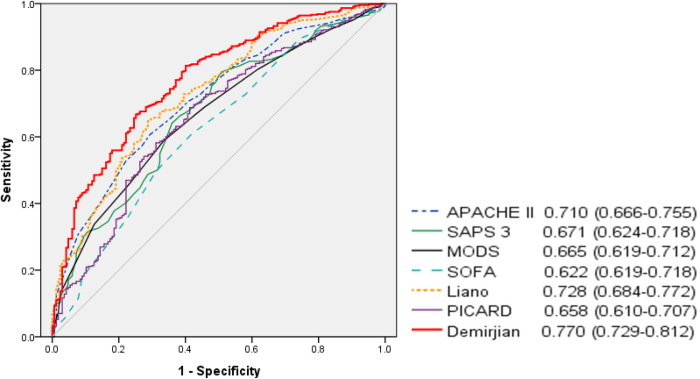
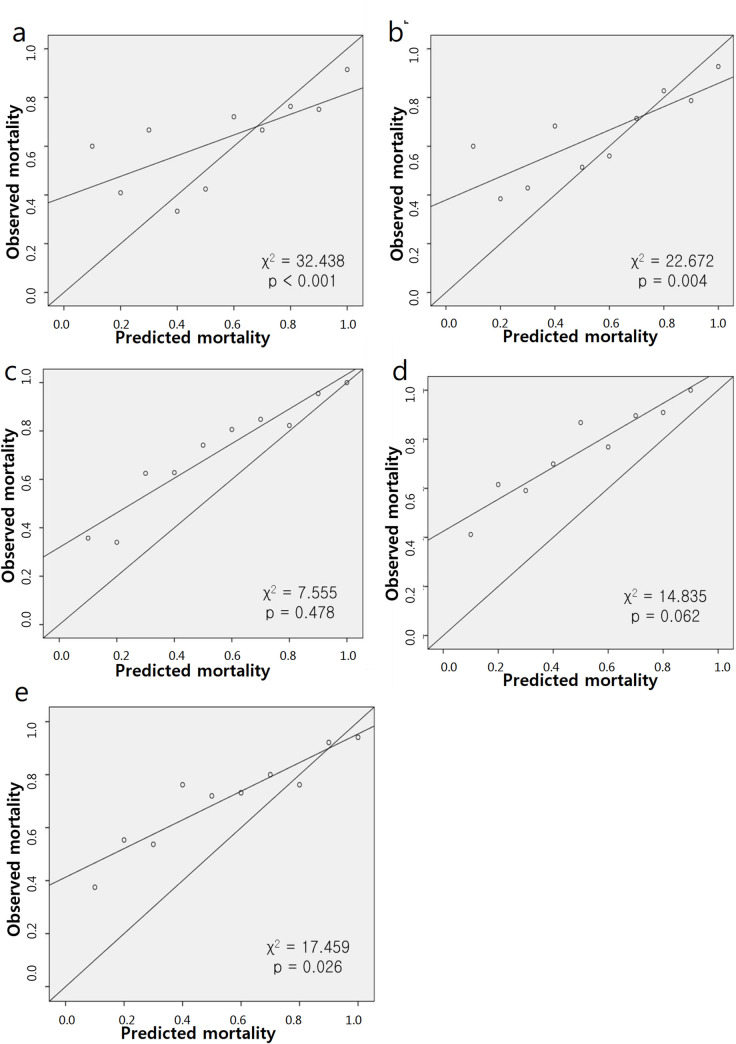
The incidence of acute kidney injury (AKI) is increasing every year and many patients with AKI admitted to the intensive care unit (ICU) require continuous renal replacement therapy (CRRT). This study compared and analyzed severity scoring systems to assess their suitability in predicting mortality in critically ill patients receiving CRRT. Data from 612 patients receiving CRRT in four ICUs of the Korea University Medical Center between January 2016 and November 2018 were retrospectively collected. The mean age of all patients was 67.6 ± 14.8 years, and the proportion of males was 59.6%. The endpoints were in-hospital mortality and 7-day mortality from the day of CRRT initiation to the date of death. The Program to Improve Care in Acute Renal Disease (PICARD), Demirjian's, Acute Physiology and Chronic Health Evaluation (APACHE) II, Simplified Acute Physiology Score (SAPS) 3, Sequential Organ Failure Assessment (SOFA), Multiple Organ Dysfunction Score (MODS), and Liano's scores were used to predict mortality. The in-hospital and 7-day mortality rates in the study population were 72.7% and 45.1%, respectively. The area under the receiver operator characteristic curve (AUROC) revealed the highest discrimination ability for Demirjian's score (0.770), followed by Liano's score (0.728) and APACHE II (0.710). The AUROC curves for the SAPS 3, MODS, and PICARD were 0.671, 0.665, and 0.658, respectively. The AUROC of Demirjian's score was significantly higher than that of the other scores, except for Liano's score. The Hosmer-Lemeshow test on Demirjian's score showed a poor fit in our analysis; however, it was more acceptable than general severity scores. Kidney-specific severity scoring systems showed better performance in predicting mortality in critically ill patients receiving CRRT than general severity scoring systems.
Copyright: © 2023 Park et al. This is an open access article distributed under the terms of the Creative Commons Attribution License, which permits unrestricted use, distribution, and reproduction in any medium, provided the original author and source are credited.
Conflict of interest statement
The authors have declared that no competing interests exist.
Figures
References
MeSH terms
LinkOut - more resources
Full Text Sources
