


Validity and Utility of Early Parameters in TEG6s Platelet Mapping to Assess the Coagulation Status During Cardiovascular Surgery With Cardiopulmonary Bypass
- PMID: 37228566
- PMCID: PMC10208008
- DOI: 10.7759/cureus.38044
Validity and Utility of Early Parameters in TEG6s Platelet Mapping to Assess the Coagulation Status During Cardiovascular Surgery With Cardiopulmonary Bypass
Abstract
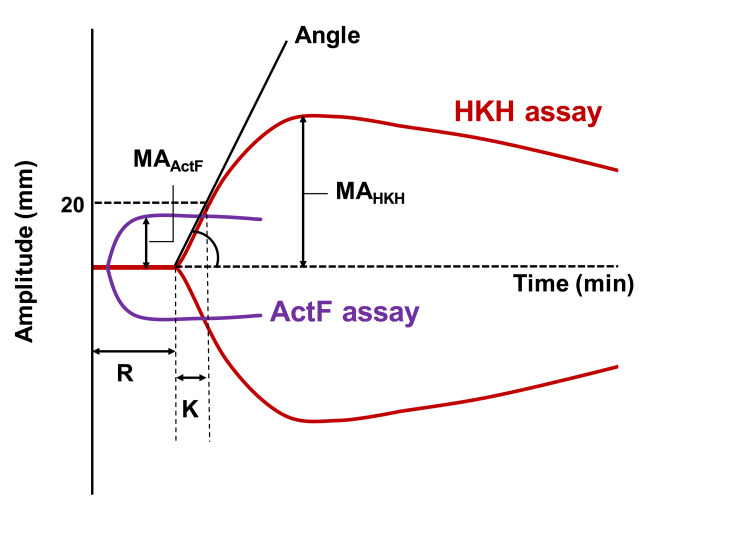
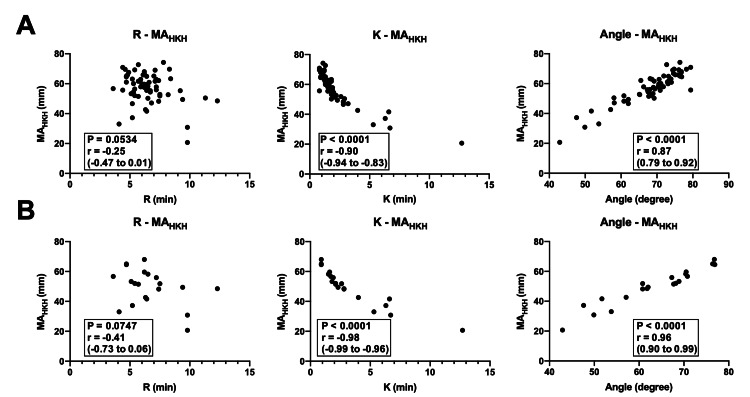
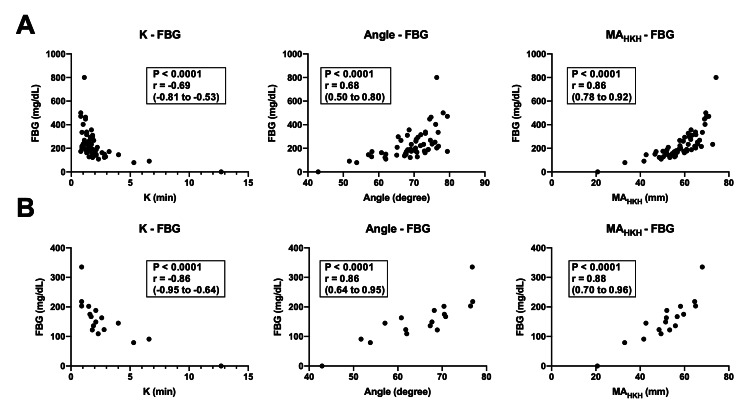
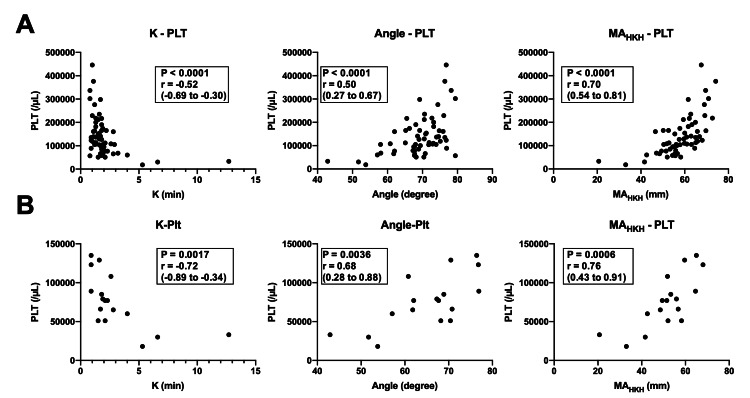
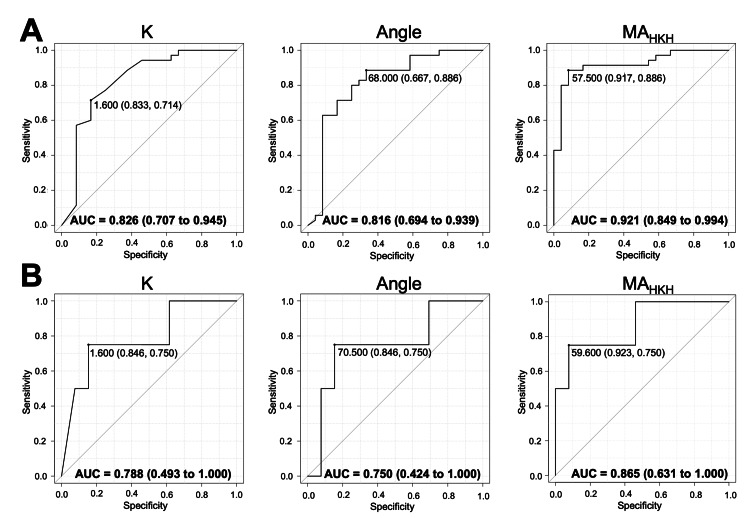
Background The aim of this retrospective observational study was to explore the early predictive parameters for maximum amplitudein the kaolin with heparinase (HKH) assay (MAHKH) of TEG6s Platelet Mapping in cardiovascular surgery including cardiopulmonary bypass (CPB) period. The relationship between each parameter of the assay and laboratory data was also assessed. Methods We included the patients who underwent TEG6s Platelet Mapping during cardiovascular surgery under CPB between November 2021 and May 2022. The correlation between MAHKH and the early parameters was assessed. The association between each parameter of Platelet Mapping and a combination of fibrinogen concentration > 150 mg/dL and platelet count > 100,000µL was also evaluated by the receiver operating characteristic (ROC) curve. Results In 23 patients who underwent TEG6s Platelet Mapping during the study period, 62 HKH assay data including 59 pairs of data (HKH assay and laboratory data) were analyzed. K and angle, but not R, were significantly correlated with MAHKH (r [95% CI]: -0.90 [-0.94, -0.83], p < 0.0001 for K, and 0.87 [0.79, 0.92], p < 0.0001 for angle). Furthermore, ROC curves suggested that these parameters predicted a combination of fibrinogen concentration > 150 mg/dL and platelet count > 100,000/µL with high accuracy. Similar results were confirmed in the heparinized blood samples obtained during CPB. Conclusion These findings suggest that not only MAKHK but also K and angle, which are early parameters in the HKH assay, provide clinically significant information that will facilitate rapid decision-making regarding coagulation strategies during cardiovascular surgery including the CPB period.
Keywords: cardiac surgery; cardiopulmonary bypass; coagulation; platelet mapping; teg6s.
Copyright © 2023, Yoshikawa et al.
Conflict of interest statement
The authors have declared that no competing interests exist.
Figures
References
-
- Activation of the hemostatic system during cardiopulmonary bypass. Sniecinski RM, Chandler WL. Anesth Analg. 2011;113:1319–1333. - PubMed
-
- Managing the coagulopathy associated with cardiopulmonary bypass. Bartoszko J, Karkouti K. J Thromb Haemost. 2021;19:617–632. - PubMed
-
- STS/SCA/AmSECT/SABM update to the clinical practice guidelines on patient blood management. Tibi P, McClure RS, Huang J, et al. Ann Thorac Surg. 2021;112:981–1004. - PubMed
-
- Position of the French Working Group on Perioperative Haemostasis (GIHP) on viscoelastic tests: what role for which indication in bleeding situations? Roullet S, de Maistre E, Ickx B, et al. Anaesth Crit Care Pain Med. 2019;38:539–548. - PubMed
-
- 2017 EACTS/EACTA guidelines on patient blood management for adult cardiac surgery. Boer C, Meesters MI, Milojevic M, et al. J Cardiothorac Vasc Anesth. 2018;32:88–120. - PubMed
LinkOut - more resources
Full Text Sources