Cannabis Consumers' View of Regulated Access to Recreational Cannabis: A Multisite Survey in Switzerland
- PMID: 37231849
- PMCID: PMC10389784
- DOI: 10.1159/000530194
Cannabis Consumers' View of Regulated Access to Recreational Cannabis: A Multisite Survey in Switzerland
Abstract
Introduction: There is considerable effort in legalizing recreational use of cannabis globally. The successful implementation of a program of regulated access to recreational cannabis (PRAC) depends on the consumers' engagement. The aim of this study was to examine the acceptability of twelve different regulatory aspects by cannabis users including those obtaining cannabis from the illicit market and vulnerable populations such as young adults and problematic users.
Methods: The current study is a multisite online survey conducted in Switzerland. A total of 3,132 adult Swiss residents who consumed cannabis within the previous 30 days represented the studied population. Mean age was 30.5 years, 80.5% were men, and 64.2% of the participants stated that they always or often obtain cannabis from the illicit market. We described consumers' acceptability of twelve regulatory aspects concerning THC content control, disclosure of sensitive personal data, security aspects, and follow-up procedures by applying descriptive statistics and multiple regression models.
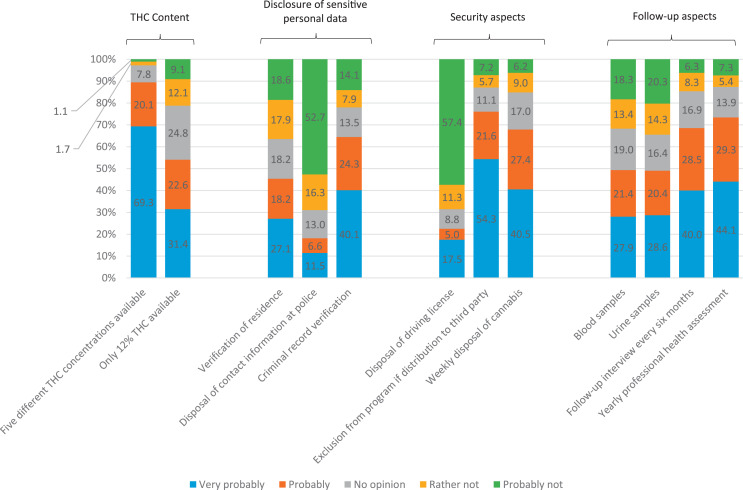
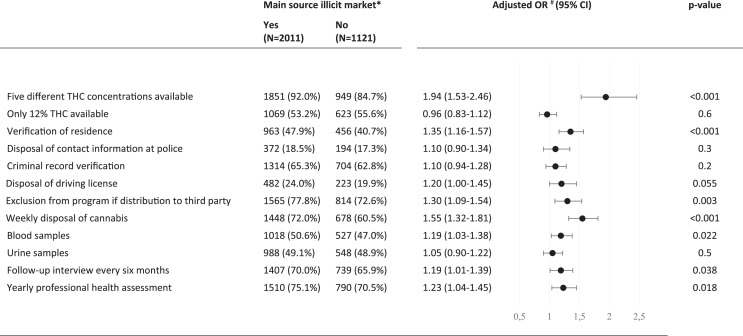
Results: THC content regulation showed most discrepancy with 89.4% of the participants stating to engage in a PRAC if five different THC contents were available as compared to 54% if only 12% THC was available. The least accepted regulatory aspect was disposal of contact details with an acceptability rate of 18.1%. Consumers mainly obtaining cannabis from the illicit market, young adults, and problematic users showed similar acceptability patterns. Participants obtaining cannabis from the illicit market were more likely to engage in a PRAC if five different THC contents were available as compared to participants obtaining cannabis from other sources (OR 1.94, 95% CI: 1.53-2.46).
Conclusion: A carefully designed PRAC that takes into account the consumers' perspective is likely to transfer them to the regulated market and to engage vulnerable populations. We cannot recommend the distribution of cannabis with only 12% THC content as this is unlikely to engage the target population.
Keywords: Cannabis legalization; Cannabis policy; Recreational cannabis; Regulated access to cannabis.
© 2023 The Author(s). Published by S. Karger AG, Basel.
Conflict of interest statement
The authors have no conflicts of interest to declare.
Figures
References
-
- UNODC . Single convention on narcortic drugs. 1961. Available from:https://www.unodc.org/pdf/convention_1961_en.pdf.
-
- UNODC . World Drug Report 2019. 2019. Available from: https://wdr.unodc.org/wdr2019/prelaunch/WDR19_Booklet_5_CANNABIS_HALLUCI....
-
- GBD 2016 Alcohol and Drug Use Collaborators . The global burden of disease attributable to alcohol and drug use in 195 countries and territories, 1990-2016: a systematic analysis for the Global Burden of Disease Study 2016. Lancet Psychiatry. 2018;5(12):987–1012. 10.1016/S2215-0366(18)30337-7. - DOI - PMC - PubMed