


Trimodality Treatment of Superior Sulcus Non-Small Cell Lung Cancer: An Institutional Series of 47 Consecutive Patients
- PMID: 37232802
- PMCID: PMC10217630
- DOI: 10.3390/curroncol30050344
Trimodality Treatment of Superior Sulcus Non-Small Cell Lung Cancer: An Institutional Series of 47 Consecutive Patients
Abstract
Objectives: Treatment of superior sulcus tumors (SST) using concurrent chemoradiation followed by surgery is a current standard. However, due to the rarity of this entity, clinical experience in its treatment remains scarce. Here, we present the results of a large consecutive series of patients treated with concurrent chemoradiation followed by surgery at a single academic institution.
Materials and methods: The study group included 48 patients with pathologically confirmed SST. The treatment schedule consisted of preoperative 6-MV photon-beam radiotherapy (45-66 Gy delivered in 25-33 fractions over 5-6.5 weeks) and concurrent two cycles of platinum-based chemotherapy. Five weeks after completion of chemoradiation, pulmonary and chest wall resection was performed.
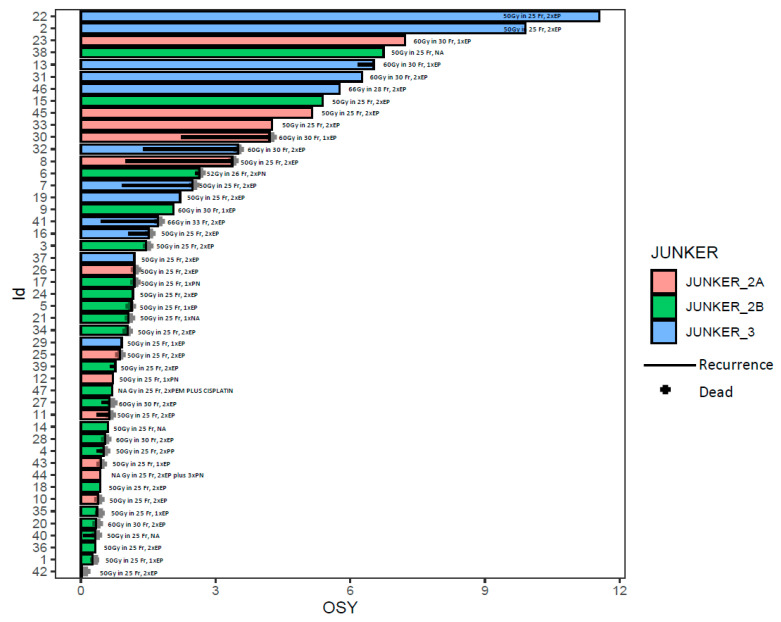
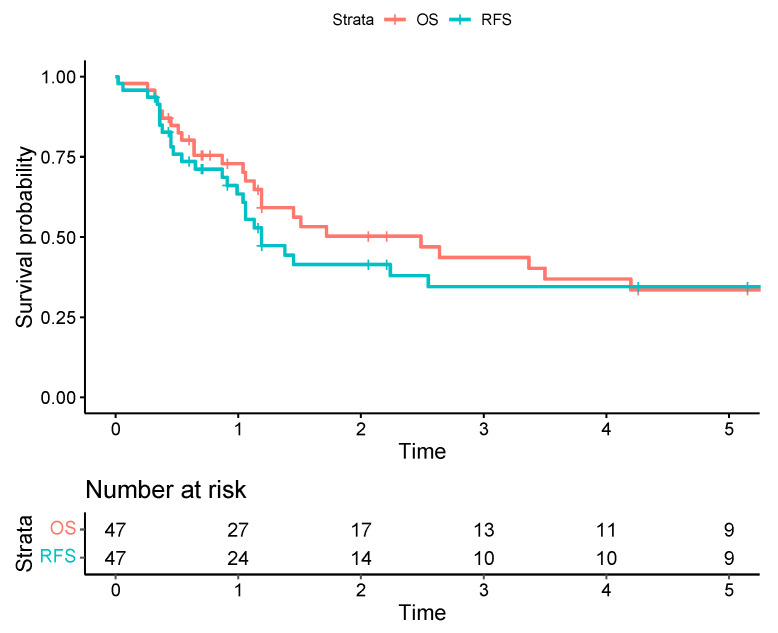
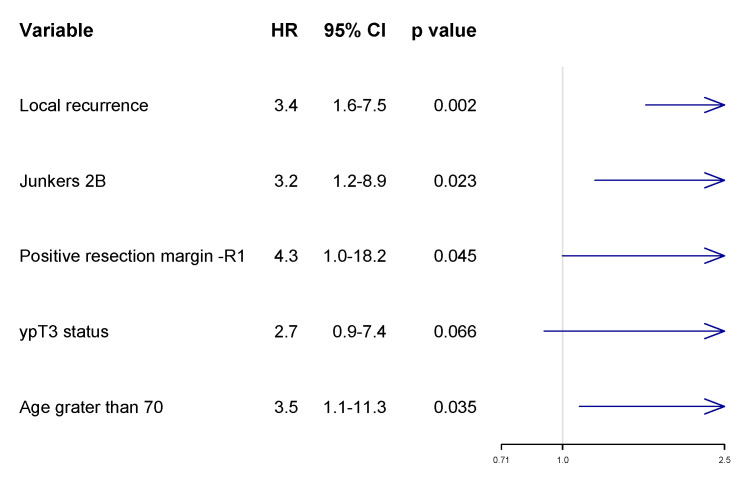
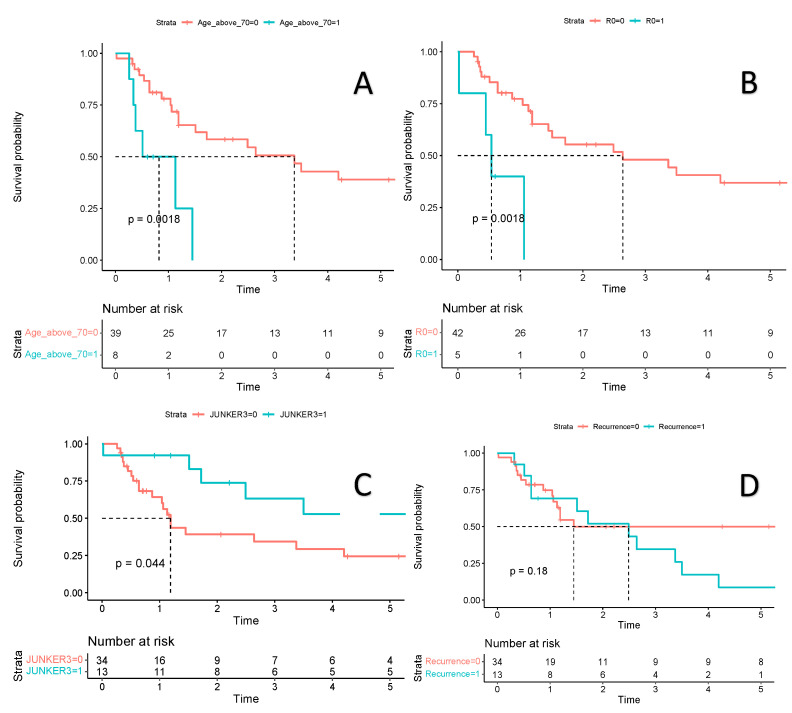
Results: From 2006 to 2018, 47 of 48 consecutive patients meeting protocol criteria underwent two cycles of cisplatin-based chemotherapy and concurrent radiotherapy (45-66 Gy) followed by pulmonary resection. One patient did not undergo surgery due to brain metastases that occurred during induction therapy. The median follow-up was 64.7 months. Chemoradiation was well tolerated, with no toxicity-related deaths. Twenty-one patients (44%) developed grade 3-4 side effects, of which the most common was neutropenia (17 patients; 35.4%). Seventeen patients (36.2%) had postoperative complications, and 90-day mortality was 2.1%. Three- and five-year overall survival (OS) were 43.6% and 33.5%, respectively, and three- and five-year recurrence-free survival were 42.1% and 32.4%, respectively. Thirteen (27.7%) and 22 (46.8%) patients had a complete and major pathological response, respectively. Five-year OS in patients with complete tumor regression was 52.7% (95% CI 29.4-94.5). Predictive factors of long-term survival included age below 70 years, complete resection, pathological stage, and response to induction treatment.
Conclusions: Chemoradiation followed by surgery is a relatively safe method with satisfactory outcomes.
Keywords: multimodality treatment; neoadjuvant chemoradiation; superior sulcus tumors; surgery; survival.
Conflict of interest statement
Rafał Dziadziuszko received honoraria from AstraZeneca, Roche, Novartis, Bristol Myers-Squibb, FoundationMedicine, Karyopharm, and Takeda and Boehringer Ingelheim. Tomasz Marjanski has received payment for consulting fees, lectures, and being an advisory board member of Roche Genentech. The cooperation is not related to the topic of this paper. The other authors have no conflict of interest to declare. The funders had no role in the design of the study; in the collection, analyses, or interpretation of data; in the writing of the manuscript; or in the decision to publish the results.
Figures
References
-
- Walker J. Superior sulcus pulmonary tumor (Pancoast syndrome) J. Med. Assoc. Ga. 1946;35:364. - PubMed
-
- Rusch V., Giroux D., Kraut M., Crowley J., Hazuka M., Winton T., Johnson D., Shulman L., Shepherd F., Deschamps C., et al. Induction chemoradiation and surgical resection for superior sulcus non-small-cell lung carcinomas: Long-term results of Southwest Oncology Group Trial 9416 (Intergroup Trial 0160) J. Clin. Oncol. 2007;25:313–318. doi: 10.1200/JCO.2006.08.2826. - DOI - PubMed
MeSH terms
Substances
LinkOut - more resources
Full Text Sources
Medical
