. 2024 Feb;46(1):897-911.
doi: 10.1007/s11357-023-00824-3. Epub 2023 May 26.

Low circulating adropin concentrations predict increased risk of cognitive decline in community-dwelling older adults

Collaborators, Affiliations

Low circulating adropin concentrations predict increased risk of cognitive decline in community-dwelling older adults

Geetika Aggarwal et al. Geroscience. 2024 Feb.

Abstract

The secreted peptide adropin is highly expressed in human brain tissues and correlates with RNA and proteomic risk indicators for dementia. Here we report that plasma adropin concentrations predict risk for cognitive decline in the Multidomain Alzheimer Preventive Trial (ClinicalTrials.gov Identifier, NCT00672685; mean age 75.8y, SD = 4.5 years, 60.2% female, n = 452). Cognitive ability was evaluated using a composite cognitive score (CCS) that assessed four domains: memory, language, executive function, and orientation. Relationships between plasma adropin concentrations and changes in CCS (∆CCS) were examined using Cox Proportional Hazards Regression, or by grouping into tertiles ranked low to high by adropin values and controlling for age, time between baseline and final visits, baseline CCS, and other risk factors (e.g., education, medication, APOE4 status). Risk of cognitive decline (defined as a ∆CCS of - 0.3 or more) decreased with increasing plasma adropin concentrations (hazard ratio = 0.873, 95% CI 0.780-0.977, P = 0.018). Between adropin tertiles, ∆CCS was significantly different (P = 0.01; estimated marginal mean ± SE for the 1st to 3rd tertile, - 0.317 ± 0.064; - 0.275 ± 0.063; - 0.042 ± 0.071; n = 133,146, and 130, respectively; P < 0.05 for 1st vs. 2nd and 3rd adropin tertiles). Normalized plasma Aß42/40 ratio and plasma neurofilament light chain, indicators of neurodegeneration, were significantly different between adropin tertile. These differences were consistent with reduced risk of cognitive decline with higher plasma adropin levels. Overall, these results suggest cognitive decline is reduced in community-dwelling older adults with higher circulating adropin levels. Further studies are needed to determine the underlying causes of the relationship and whether increasing adropin levels can delay cognitive decline.

Keywords: Adropin; Aging; Cognitive decline; Dementia; Plasma biomarkers.


Conflict of interest statement

The authors declare no competing interests.

Figures
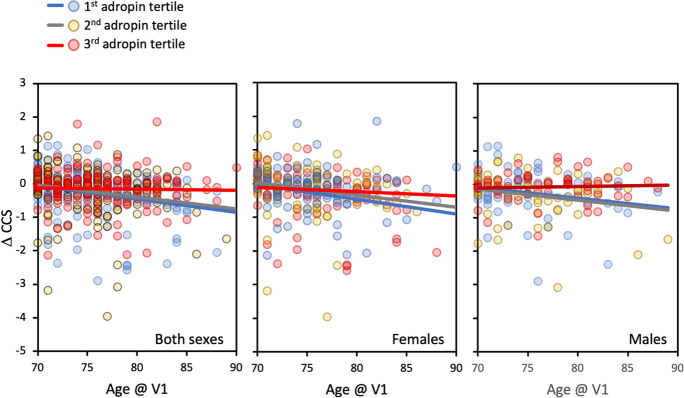
Fig. 1
Fig. 1
Scatterplots showing changes in composite cognitive score (∆CCS) as a function of age on the first visit (V1). For these plots, ∆CCS was calculated using V1 as the baseline. The participants are divided into three groups (adropin tertiles) ranked low (1st) to high (3rd) For the 1st, 2nd, and 3rd adropin tertile, n = 151, 152, and 149, respectively. The three panels show data for both sexes (left), females only (middle), and males only (right). The results from this analysis suggest that ∆CCS declines as a function of age for participants in the 1st and 2nd adropin tertiles, but not for participants in the 3rd adropin tertile
Fig. 2
Fig. 2
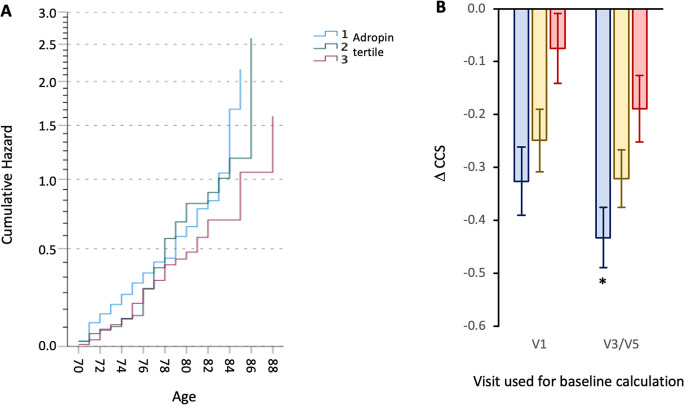
Cumulative hazard as a function of age (A) and comparing ∆CCS between adropin tertiles (B). A Cumulative hazard for exhibiting a decline of CCS of − 0.3 or greater increases with age. The rate of increase is delayed for participants in the 3rd adropin tertile relative to those in the 1st or 2nd adropin tertiles. B Estimated marginal means ± SEM for the ∆CCS for participant grouped into adropin tertiles (reading left to right within V1 or V3/V5, the blue, yellow, or red columns are the 1st, 2nd, and 3rd tertiles). The data are adjusted for age, sex, years between baseline and final measurement, NfL, and Aβ42/40 ratio [37, 39], and APOE4 status. For the data using V1 as baseline, n = 127,140, and 119, respectively; for data using V3/V5 as baseline, n = 124,133, and 104, respectively. Significantly different from the 3rd adropin tertile, *P < 0.05
Fig. 3
Fig. 3
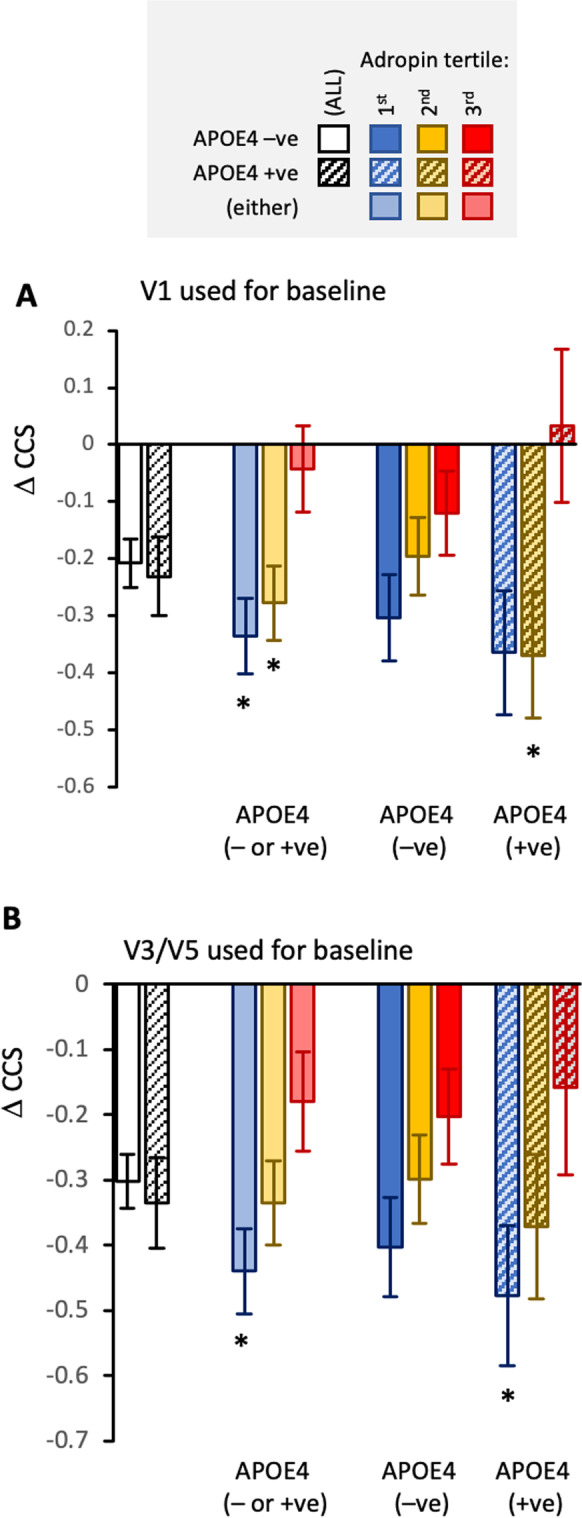
Comparing the differences in ∆CCS between adropin tertile for participants identified by APOE status. The data shown are estimated marginal means and SEM adjusted for age, years between baseline and final measurement, education, and medications. For data using V1 as baseline (A), n = 123, 140, and 119 (APOE4 either negative or positive); n = 95, 105, 100 (APOE4 negative), or n = 42, 41, and 31 (APOE4 positive). For data using V3/5 as baseline (B), n = 130, 139, and 112 (APOE4 either negative or positive); n = 93, 99, or 87 (APOE4 negative or), or n = 41, 40, and 26 (APOE4 positive). Significantly different from the 3rd adropin tertile, *P < 0.05

References

    1. Alzheimer's Association Report. Alzheimer’s disease facts and figures. Alzheimers Dement. 2023;19(4):1598–695. - PubMed
    1. Lutz W, Sanderson W, Scherbov S. The coming acceleration of global population ageing. Nature. 2008;451(7179):716–719. doi: 10.1038/nature06516. - DOI - PubMed
    1. Collaborators GBDDF. Estimation of the global prevalence of dementia in 2019 and forecasted prevalence in 2050: an analysis for the Global Burden of Disease Study 2019. Lancet Public Health. 2022;7(2):e105–e25. - PMC - PubMed
    1. Jack CR, Jr, Bennett DA, Blennow K, Carrillo MC, Dunn B, Haeberlein SB, et al. NIA-AA Research framework: toward a biological definition of Alzheimer’s disease. Alzheimers Dement. 2018;14(4):535–562. doi: 10.1016/j.jalz.2018.02.018. - DOI - PMC - PubMed
    1. Teunissen CE, Verberk IMW, Thijssen EH, Vermunt L, Hansson O, Zetterberg H, et al. Blood-based biomarkers for Alzheimer’s disease: towards clinical implementation. Lancet Neurol. 2022;21(1):66–77. doi: 10.1016/S1474-4422(21)00361-6. - DOI - PubMed

Publication types

Associated data