. 2023 May 11;9(5):e16195.
doi: 10.1016/j.heliyon.2023.e16195. eCollection 2023 May.

Curcumin protects against rotenone-induced Parkinson's disease in mice by inhibiting microglial NLRP3 inflammasome activation and alleviating mitochondrial dysfunction

Affiliations

Curcumin protects against rotenone-induced Parkinson's disease in mice by inhibiting microglial NLRP3 inflammasome activation and alleviating mitochondrial dysfunction

Long Xu et al. Heliyon. .

Abstract

Parkinson's disease (PD) is a common neurodegenerative disorder worldwide. Currently, treatment options can only relieve symptoms but cannot prevent, slow, or halt the neurodegenerative process of PD. Much evidence has suggested that microglia-mediated neuroinflammation is involved in the pathophysiology of PD. As an anti-inflammatory agent, curcumin may exert a neuroprotective effect on PD. However, its mechanism has yet to be demonstrated clearly. Our results indicated that curcumin alleviated rotenone-induced behavioral defects, dopamine neuron loss, and microglial activation. Besides, the NF-κB signaling pathway, the NLRP3 inflammasome, and pro-inflammatory cytokines, including IL-18 and IL-1β, contributed to the microglia-mediated neuroinflammation in PD. Furthermore, Drp1-mediated mitochondrial fission causing mitochondrial dysfunction also had an etiological role in the process. This study suggests that curcumin protects against rotenone-induced PD by inhibiting microglial NLRP3 inflammasome activation and alleviating mitochondrial dysfunction in mice. Thus, curcumin may be a neuroprotective drug with promising prospects in PD.

Keywords: Curcumin; Dopaminergic neuron; Microglia; Mitochondrial dysfunction; NLRP3 inflammasome; Parkinson's disease.


Conflict of interest statement

The authors declare that they have no known competing financial interests or personal relationships that could have appeared to influence the work reported in this paper.

Figures

Fig. 1
Fig. 1
Curcumin treatment reversed rotenone-induced behavioral defects in mice. A, Experimental procedure. B, Behavior trace of mice in the open field test. C, The total distance of mice in the open field test. D, The rotarod performance time of mice in the rotarod test. N = 10/group. All data are shown as mean ± S.E.M. *P < 0.05, **P < 0.01, ***P < 0.001.
Fig. 2
Fig. 2
Curcumin treatment alleviated the rotenone-induced reduction of dopamine neurons in SN in mice. A, Representative immunohistochemistry staining for TH in the SN. Scale bar is 50 μm. B, Quantitative analysis of the relative number of TH-positive cells in the SN. N = 5/group. All data are shown as mean ± S.E.M. **P < 0.01, ***P < 0.001.
Fig. 3
Fig. 3
Curcumin treatment inhibited microglial activation in SN induced by rotenone in mice. A, Representative immunohistochemistry staining for Iba-1 in the SN. Scale bar is 50 μm. B, Quantitative analysis of the relative number of Iba-1-positive cells in the SN. C, Representative western blots for Iba-1 in the SN. D, Quantification of the relative intensity of Iba-1 in the SN. N = 5/group. All data are shown as mean ± S.E.M. *P < 0.05, ***P < 0.001.
Fig. 4
Fig. 4
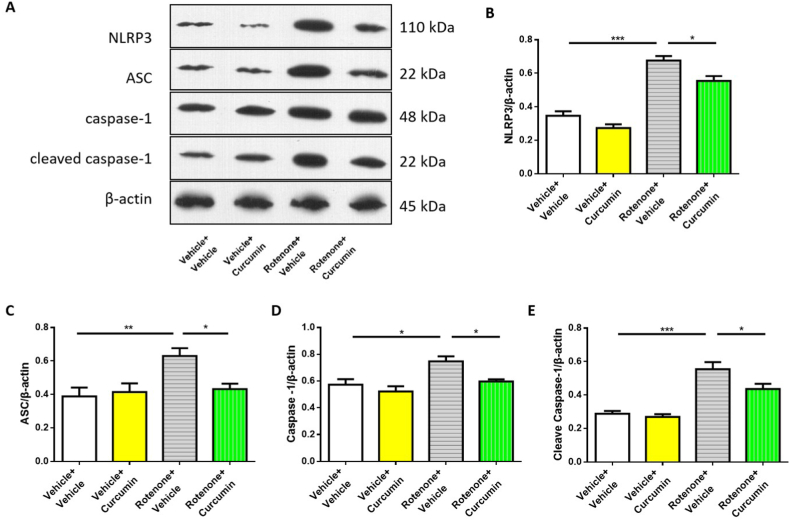
Curcumin treatment inhibited the activation of NLRP3 inflammasome in SN induced by rotenone in mice. A, Representative western blots for NLRP3, ASC, caspase-1, and cleaved caspase-1. B, Quantification of the relative intensities of NLRP3. C, Quantification of the relative intensities of ASC. D, Quantification of the relative intensities of caspase-1. E, Quantification of the relative intensities of cleaved caspase-1. N = 5/group. All data are shown as mean ± S.E.M. *P < 0.05, **P < 0.01, ***P < 0.001.
Fig. 5
Fig. 5
Curcumin treatment inhibited the overexpression of cytokines and the activation of the NF-κB signaling pathway in SN induced by rotenone in mice. A, IL-18 content. B, IL-1β content. C, Representative western blots for p–NF–κB and NF-κB. D, Quantification of the relative intensities of p–NF–κB/NF-κB. N = 5/group. All data are shown as mean ± S.E.M. *P < 0.05, **P < 0.01, ***P < 0.001.
Fig. 6
Fig. 6
Curcumin treatment inhibited the excessive mitochondrial fission in SN induced by rotenone in mice. A, Representative western blots for mitochondrial Drp1. B, Quantification of the relative intensities of mitochondrial Drp1. C, Representative western blots for cytosolic Drp1. D, Quantification of the relative intensities of cytosolic Drp1. N = 5/group. All data are shown as mean ± S.E.M. *P < 0.05, **P < 0.01, ***P < 0.001.

References

    1. Eusebi P., et al. Incidence and prevalence of Parkinson's disease in the Italian region of Umbria: a population-based study using healthcare administrative databases. Neurol. Sci. 2019;40(8):1709–1712. - PubMed
    1. Hirsch L., et al. The incidence of Parkinson's disease: a systematic review and meta-analysis. Neuroepidemiology. 2016;46(4):292–300. - PubMed
    1. Reich S.G., Savitt J.M. Parkinson's disease. Med. Clin. 2019;103(2):337–350. - PubMed
    1. Bouça‐Machado R., et al. Measurement instruments to assess functional mobility in Parkinson's disease: a systematic review. Movement disorders clinical practice. 2020;7(2):129–139. - PMC - PubMed
    1. Schwab A.D., et al. Immunotherapy for Parkinson's disease. Neurobiol. Dis. 2020;137 - PMC - PubMed