


Can MSH3 lowering stop HTT repeat expansion in its CAG tract?
- PMID: 37236185
- PMCID: PMC10277920
- DOI: 10.1016/j.ymthe.2023.05.010
Can MSH3 lowering stop HTT repeat expansion in its CAG tract?
Conflict of interest statement
Declaration of interests In the past year, through the offices of UCL Consultants Ltd, a wholly owned subsidiary of University College London, S.J.T. has undertaken consultancy services for Alnylam Pharmaceuticals, Annexon, Ascidian Therapeutics, Arrowhead Pharmaceuticals, Atalanta Therapeutics, Design Therapeutics, F. Hoffman-La Roche, HCD Economics, IQVIA, Iris Medicine, Latus Bio, LifeEdit, Novartis Pharma, Pfizer, Prilenia Neurotherapeutics, PTC Therapeutics, Rgenta Therapeutics, Takeda Pharmaceuticals, UniQure Biopharma, and Vertex Pharmaceuticals. In the past 12 months, University College London Hospitals NHS Foundation Trust, S.J.T.’s host clinical institution, received funding to run clinical trials for F. Hoffman-La Roche, Novartis Pharma, PTC Therapeutics, and UniQure Biopharma.
Figures
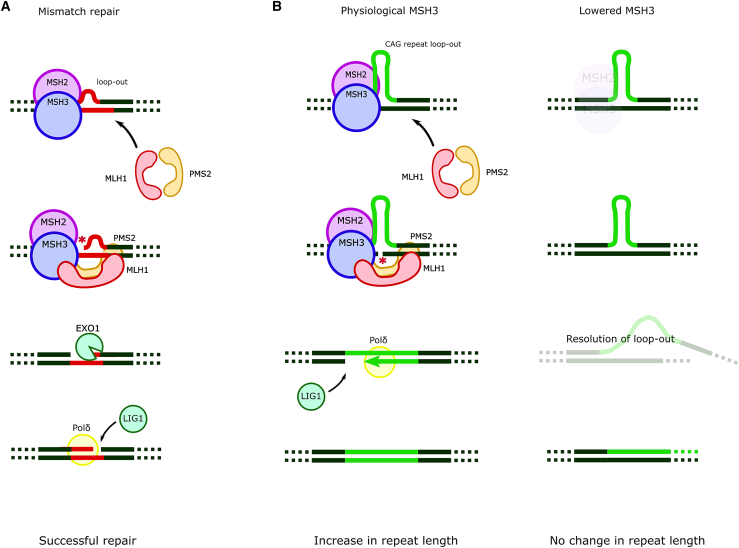
Comment on
-
Di-valent siRNA-mediated silencing of MSH3 blocks somatic repeat expansion in mouse models of Huntington's disease.Mol Ther. 2023 Jun 7;31(6):1661-1674. doi: 10.1016/j.ymthe.2023.05.006. Epub 2023 May 12. Mol Ther. 2023. PMID: 37177784 Free PMC article.
References
-
- Moss D.J.H., Pardiñas A.F., Langbehn D., Lo K., Leavitt B.R., Roos R., Durr A., Mead S., TRACK-HD investigators, REGISTRY investigators, et al. Identification of genetic variants associated with Huntington’s disease progression: a genome-wide association study. Lancet Neurol. 2017;16:701–711. - PubMed
-
- O'Reilly D., Belgrad J., Ferguson C., Summers A., Sapp E., McHugh C., Mathews E., Boudi A., Buchwald J., Ly S., et al. Di-valent siRNA mediated silencing of MSH3 blocks somatic repeat expansion in mouse models of Huntington’s disease. Mol. Ther. 2023 doi: 10.1016/j.ymthe.2023.05.006. - DOI - PMC - PubMed
-
- Alterman J.F., Godinho B.M.D.C., Hassler M.R., Ferguson C.M., Echeverria D., Sapp E., Haraszti R.A., Coles A.H., Conroy F., Miller R., et al. A divalent siRNA chemical scaffold for potent and sustained modulation of gene expression throughout the central nervous system. Nat. Biotechnol. 2019;37:884–894. - PMC - PubMed
Publication types
MeSH terms
Substances
LinkOut - more resources
Full Text Sources
Other Literature Sources
Medical
