. 2023 May 26;14(1):3033.
doi: 10.1038/s41467-023-38762-5.

Reconciling scaling of the optical conductivity of cuprate superconductors with Planckian resistivity and specific heat

Affiliations

Reconciling scaling of the optical conductivity of cuprate superconductors with Planckian resistivity and specific heat

Bastien Michon et al. Nat Commun. .

Abstract

Materials tuned to a quantum critical point display universal scaling properties as a function of temperature T and frequency ω. A long-standing puzzle regarding cuprate superconductors has been the observed power-law dependence of optical conductivity with an exponent smaller than one, in contrast to T-linear dependence of the resistivity and ω-linear dependence of the optical scattering rate. Here, we present and analyze resistivity and optical conductivity of La2-xSrxCuO4 with x = 0.24. We demonstrate ℏω/kBT scaling of the optical data over a wide range of frequency and temperature, T-linear resistivity, and optical effective mass proportional to [Formula: see text] corroborating previous specific heat experiments. We show that a T, ω-linear scaling Ansatz for the inelastic scattering rate leads to a unified theoretical description of the experimental data, including the power-law of the optical conductivity. This theoretical framework provides new opportunities for describing the unique properties of quantum critical matter.


Conflict of interest statement

The authors declare no competing interests.

Figures

Fig. 1
Fig. 1. Optical data of La2−xSrxCuO4 at p = 0.24.
a Real and b imaginary part of the optical conductivity σ deduced from the dielectric function ϵ (Supplementary Fig. 1), using Eq. (14) and the value ϵ = 2.76. c Scattering rate and d effective mass deduced from Eqs. (16) and (17) using K = 211 meV. The values of ϵ and K are discussed and justified in the text. Inset: Temperature dependence of m*/m at ω = 5kBT (see dots in d). In each panel errorbars are indicated for three representative frequencies and pertain to the upper curve, i.e., the lowest temperature for σ(ω), m*(ω)/m and the highest temperature for /τ(ω). They represent the uncertainty arising from reflectivity calibration using in-situ gold evaporation, and have been estimated by repeating the Kramers--Kronig analysis after multiplying the reflectivity curves by 1 ± 0.002.
Fig. 2
Fig. 2. Scaling of scattering rate and mass enhancement.
a Temperature-dependent resistivity measured in zero field (black) and at 16 teslas (red). The inset emphasizes the linearity of the 16 T data at low temperature. The dashed line shows ρ0 + AT with ρ0 = 12.2 μΩcm and A = 0.63 μΩcm/K. b Scattering rate divided by temperature plotted versus ω/T; the collapse of the curves indicates a behavior 1/τ ~ Tfτ(ω/T). c Effective quasiparticle mass (in units of the indicated band mass m) deduced from the low-temperature electronic specific heat [mCp*=(3/π)(2dc/kB2)(C/T)] and zero-frequency optical mass enhancement; the dashed lines indicate lnT behavior. d Optical mass minus the zero-frequency mass shown in c plotted versus ω/T; the collapse of the curves indicates a behavior m*(ω) − m*(0) ~ fm(ω/T). The data between 0.22 and 0.4 eV are shown as dotted lines. ϵ = 2.76 was used here as in Fig. 1.
Fig. 3
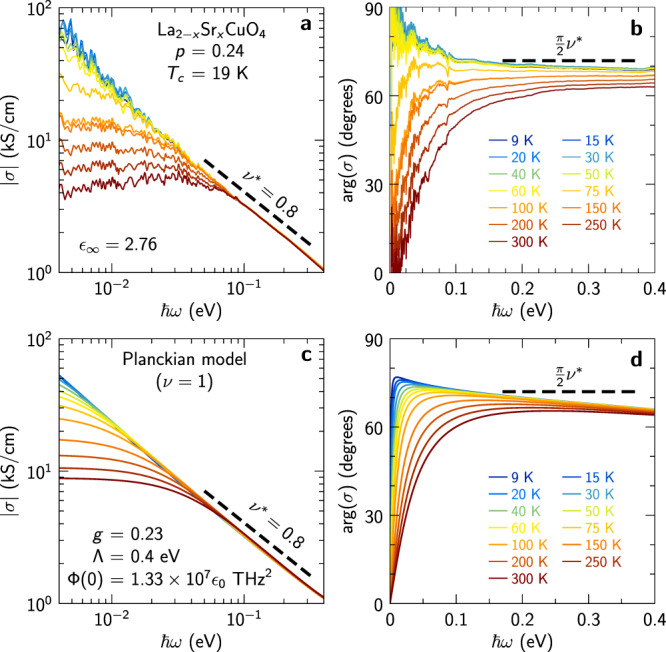
Fig. 3. Sub-linear power law at intermediate frequencies.
a Modulus and b phase of the complex conductivity shown in Fig. 1a and b; the modulus decays with an exponent ν* ≈ 0.8 and the phase approaches a value slightly lower than (π/2)ν*. c and d: same quantities calculated using a Planckian model with linear-in-energy scattering rate, Eqs. (7) and (10). The model and parameters are discussed in the text.
Fig. 4
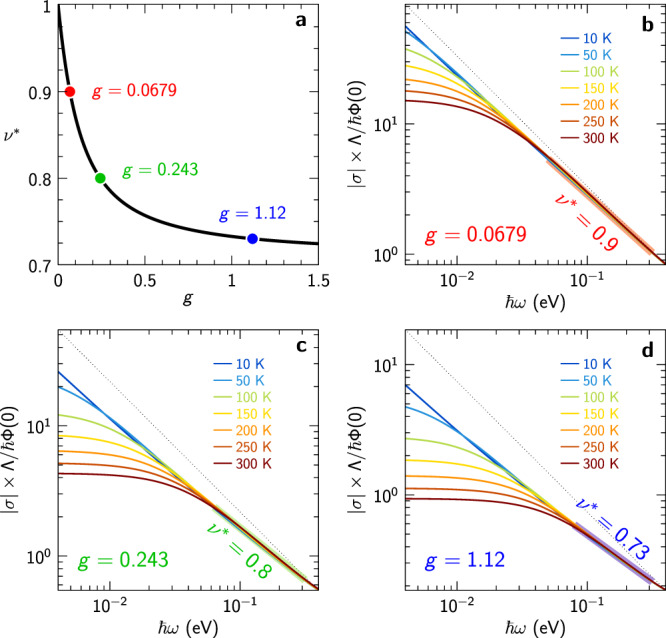
Fig. 4. Effective exponent.
Emergence of an apparent sub-linear power-law in a pure Planckian model. a Apparent exponent given by Eq. (12) versus interaction strength g. bd Modulus of the optical conductivity on a log-log scale showing the apparent power law at energies between kBT and the cutoff Λ = 0.4 eV. Data are shown for three values of g (dots in a) and a range of temperatures. Both horizontal and vertical axes cover exactly two decades, such that a 1/ω behavior would correspond to a slope of − 1 (dotted line).
Fig. 5
Fig. 5. Frequency-temperature scaling.
a Approximate collapse of the theoretical scattering rate and b mass enhancement; the dashed lines show 2πgS(x/2) in a and Eq. (S16) in b. c Same data as in Fig. 2b. d Same data as in Fig. 2d on a logarithmic scale (not displayed here because of excessive noise: ω/kBT < 10 for T < Tc); the dashed line is Eq. (S16).

References

    1. Hussey NE. Phenomenology of the normal state in-plane transport properties of high-Tc cuprates. J. Phys.: Condens. Matt. 2008;20:123201.
    1. Proust C, Taillefer L. The remarkable underlying ground states of cuprate superconductors. Annu. Rev. Conden. Mater. P. 2019;10:409. doi: 10.1146/annurev-conmatphys-031218-013210. - DOI
    1. Varma CM. Colloquium: Linear in temperature resistivity and associated mysteries including high temperature superconductivity. Rev. Mod. Phys. 2020;92:031001. doi: 10.1103/RevModPhys.92.031001. - DOI
    1. Varma CM, Nussinov Z, van Saarloos W. Singular or non-Fermi liquids. Phys. Rep. 2002;361:267. doi: 10.1016/S0370-1573(01)00060-6. - DOI
    1. Martin S, Fiory AT, Fleming RM, Schneemeyer LF, Waszczak JV. Normal-state transport properties of Bi2+xSr2−yCuO6±δ crystals. Phys. Rev. B. 1990;41:846. doi: 10.1103/PhysRevB.41.846. - DOI - PubMed