Review
. 2023 May 26;11(1):84.
doi: 10.1186/s40337-023-00806-y.

Eating disorder symptomatology among transgender individuals: a systematic review and meta-analysis

Affiliations
Review

Eating disorder symptomatology among transgender individuals: a systematic review and meta-analysis

Sofie M Rasmussen et al. J Eat Disord. .

Abstract

Objective: The purpose of this systematic review and meta-analysis was to synthesize the literature on eating disorders and eating disorder symptomatology among transgender individuals and to summarize the existing literature on gender-affirming treatment and the prevalence of eating disorder symptomatology.

Method: The literature search for this systematic review and meta-analysis was performed in PubMed, Embase.com, and Ovid APA PsycInfo. We searched for "eating disorders" and "transgender" using both controlled vocabularies and natural language terms for their synonyms. The PRISMA statement guidelines were followed. Quantitative data from studies on transgender individuals and eating disorders assessed with relevant assessment tools was included.

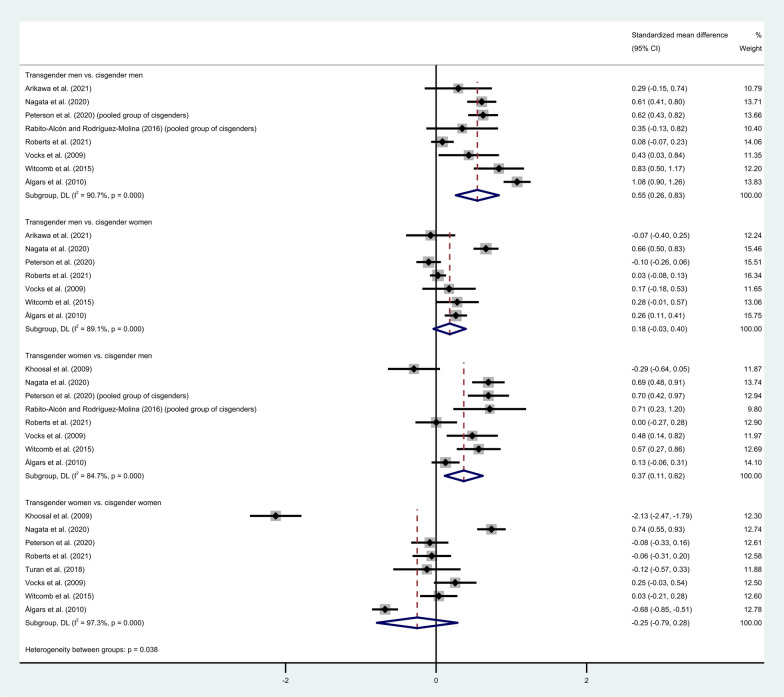
Results: Twenty-four studies were included for the qualitative synthesis, and 14 studies were included in the meta-analysis. The results revealed higher levels of eating disorder symptomatology among transgender individuals compared with cisgender individuals, especially cisgender men. Transgender men tend to display higher levels of eating disorder symptomatology than transgender women; however, transgender women seem to have higher levels of eating disorder symptomatology than cisgender men and, interestingly, this study also noted a trend toward transgender men having higher levels of eating disorders than cisgender women. Gender-affirming treatment seems to alleviate the presence of eating disorder symptomatology in transgender individuals.

Discussion: The body of research on this subject is extremely limited, and transgender individuals are underrepresented in the eating disorder literature. More research investigating eating disorders and eating disorder symptomatology in transgender individuals and the relationship between gender-affirming treatment and eating disorder symptomatology is needed.

Keywords: Anorexia nervosa; Bulimia nervosa; Eating disorder; Gender identity; Gender-affirming treatment; Transgender.


Conflict of interest statement

All authors declare that they have no competing interests.

Figures
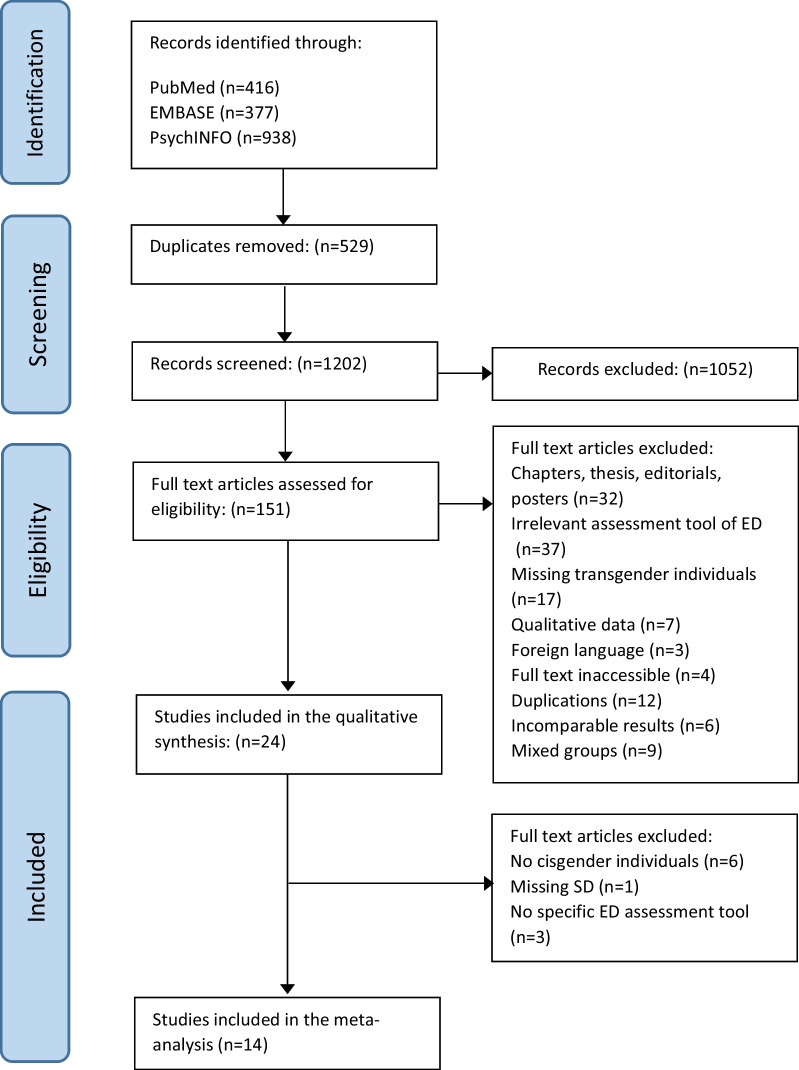
Fig. 1
Fig. 1
Flow diagram. Results of literature search with exclusion criteria as well as the numbers of studies included and excluded
Fig. 2
Fig. 2
Meta-analysis on eating disorder symptomatology in transgender men and women versus. cisgender men and women. Forest plots on transgender men and transgender women versus cisgender men and women. The pooled estimates have been computed with a random-effects model because of the levels of heterogeneity. The global scores for Khoosal et al. [6], Roberts et al. [51], Vocks et al. [48], and Witcomb et al. [21] were computed with the upper bound for the variance given that only subscales are reported. Note that Rabito-Alcón and Rodríguez-Molina [7] and Peterson et al. [45] reported results only for pooled groups of cisgender individuals. The instruments used in these studies are the EAT-26, EAT-40, EDE-Q, EDI (with the same three subscales), and EPSI
Fig. 3
Fig. 3
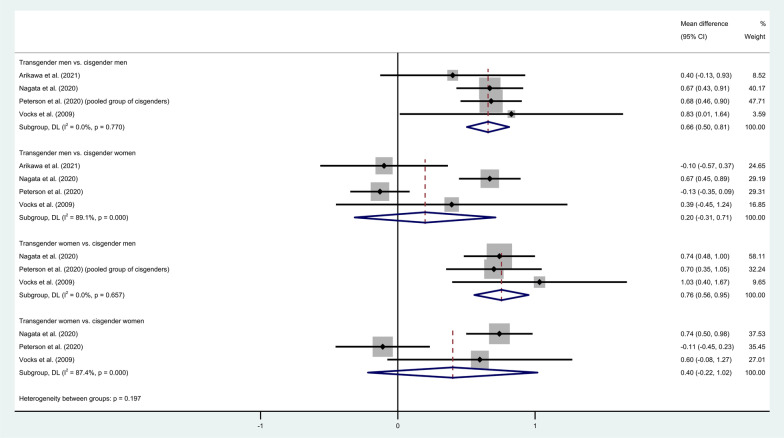
Meta-analysis on Eating Disorder Examination Questionnaire (EDE-Q) in transgender men and women versus cisgender men and women. Legend: Forest plots on transgender men and women vs. cisgender men and cisgender women with only the studies that reported EDE-Q scores. The pooled estimates have been computed with a random-effects model (because the fixed-effects and random-effects models are equivalent in the case of no heterogeneity). The global scores for Vocks et al. [48] were computed with the upper bound for the variance because only subscales are reported. Note that Peterson et al. [45] reported results only for pooled groups of cisgender individuals. The meta-analysis was conducted based on EDE-Q as the EDE-Q has a 28-day time frame which enables the instrument to identify the frequency of key ED behaviors opposite to other self-report instruments of ED (e.g. EAT and EDI; 30, 32)
Fig. 4
Fig. 4
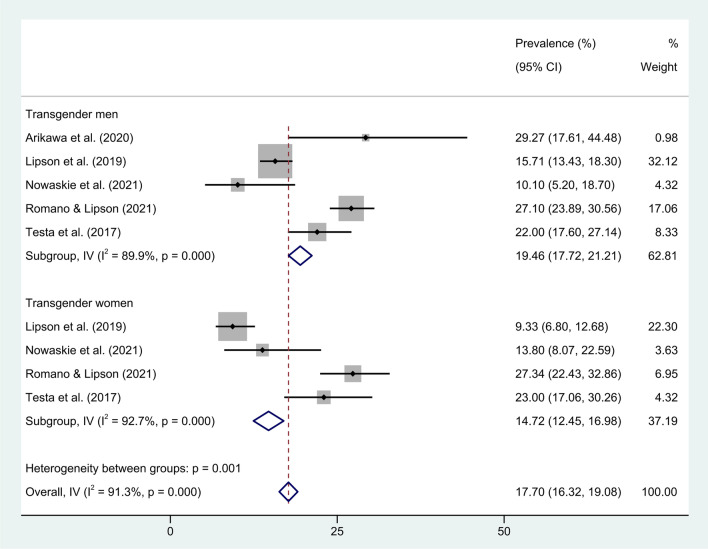
Meta-analysis on the prevalence of eating disorders in transgender individuals. Forest plots on the prevalences of eating disorders in transgender men and women. The pooled estimates have been computed with a fixed-effects model because of the considerable sizes of the studies by Lipson et al. [59] and Romano and Lipson [56], which would have smaller weights in a random-effects model. The instruments used in the studies were the Eating Attitudes Test (26-item version), SCOFF, and Eating Disorders Examination Questionnaire

References

    1. Diemer EW, Grant JD, Munn-Chernoff MA, Patterson DA, Duncan AE. Gender identity, sexual orientation, and eating-related pathology in a national sample of college students. J Adolesc Health. 2015;57:144–149. doi: 10.1016/j.jadohealth.2015.03.003. - DOI - PMC - PubMed
    1. Duffy ME, Henkel KE, Joiner TE. Prevalence of self-injurious thoughts and behaviors in transgender individuals with eating disorders: a national study. J Adolesc Health. 2019;64(4):461–466. doi: 10.1016/j.jadohealth.2018.07.016. - DOI - PubMed
    1. Feder S, Isserlin L, Seale E, Hammond N, Norris ML. Exploring the association between eating disorders and gender dysphoria in youth. Eat Disord. 2017;25(4):310–317. doi: 10.1080/10640266.2017.1297112. - DOI - PubMed
    1. Ålgars M, Santtila P, Sandnabba NK. Conflicted gender identity, body dissatisfaction, and disordered eating in adult men and women. Sex Roles: J Res. 2010;63(1–2):118–125. doi: 10.1007/s11199-010-9758-6. - DOI
    1. Gordon AR, Moore LB, Guss C. Eating disorders among transgender and gender non-binary people. In: Eating disorders in boys and men. Springer; 2021. p. 265–81.

LinkOut - more resources