. 2023 May 26;24(1):62.
doi: 10.1186/s10194-023-01598-x.

Estrogen modulation of cortical spreading depression

Affiliations

Estrogen modulation of cortical spreading depression

Chiho Kudo et al. J Headache Pain. .

Abstract

Background and aims: Cortical spreading depression (CSD), a transient neuronal and glial depolarization that propagates slowly across the cerebral cortex, is the putative electrophysiological event underlying migraine aura and a headache trigger. Migraine is three times more prevalent in women than men, linked to circulating female hormones. High estrogen levels or estrogen withdrawal may be a migraine trigger for many women. We, therefore, aimed to examine whether sex, gonadectomy, and female hormone supplementation and withdrawal affect the susceptibility to CSD.

Methods: To determine CSD susceptibility, we recorded the frequency of CSDs triggered during 2-h topical KCl application in intact or gonadectomized female and male rats, without or with estradiol or progesterone supplementation via daily intraperitoneal injections. Estrogen or progesterone treatment followed by withdrawal was studied in a separate cohort. To take the first step towards identifying potential mechanisms, we studied glutamate and GABAA receptor binding using autoradiography.

Results: The CSD frequency in intact female rats was higher than intact male and ovariectomized rats. We did not detect a change in CSD frequency during different stages of the estrous cycle in intact females. Daily estrogen injections for three weeks did not change CSD frequency. However, one-week estrogen withdrawal after two weeks of treatment significantly increased CSD frequency compared with the vehicle group in gonadectomized females. The same protocol of estrogen treatment and withdrawal was ineffective in gonadectomized males. In contrast to estrogen, daily progesterone injections for three weeks elevated CSD susceptibility, and one-week withdrawal after two weeks of treatment partially normalized this effect. Autoradiography did not reveal significant changes in glutamate or GABAA receptor binding density after estrogen treatment and withdrawal.

Conclusions: These data suggest that females are more susceptible to CSD, and sexual dimorphism is abrogated by gonadectomy. Moreover, estrogen withdrawal after prolonged daily treatment enhances CSD susceptibility. These findings may have implications for estrogen-withdrawal migraine, although the latter tends to be without aura.

Keywords: Aura; Cortical spreading depression; Estrogen replacement; Gonadal hormones; Migraine.


Conflict of interest statement

The authors declare no competing interests.

Figures
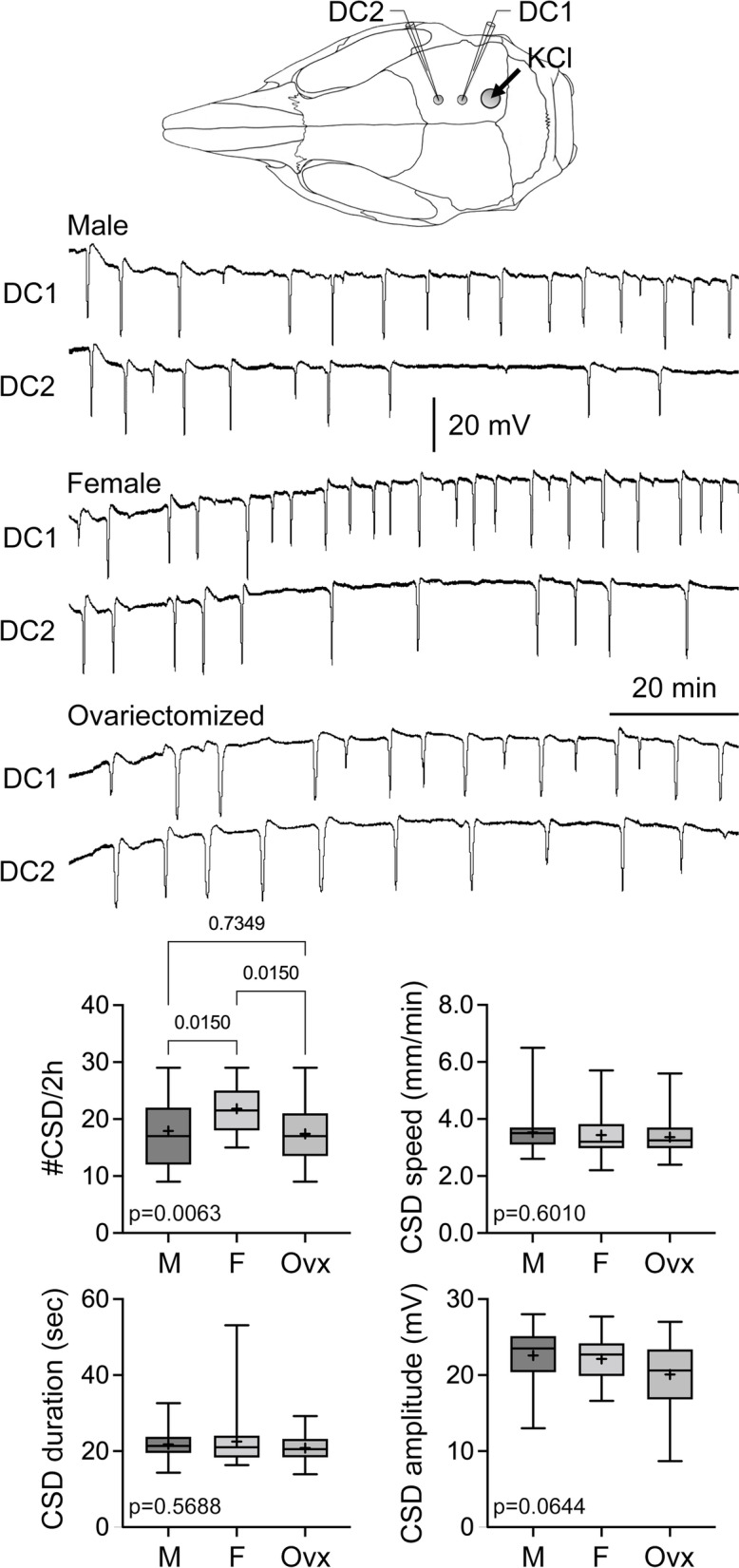
Fig. 1
Fig. 1
Effect of female sex and ovariectomy on CSD susceptibility. Representative DC potentials from DC1 and DC2 recording sites show recurrent CSDs triggered by topical 1 M KCl application onto the occipital cortex. CSD frequency, speed, duration, and amplitude are shown for male (n = 29), female (n = 26) and ovariectomized females (n = 21)
Fig. 2
Fig. 2
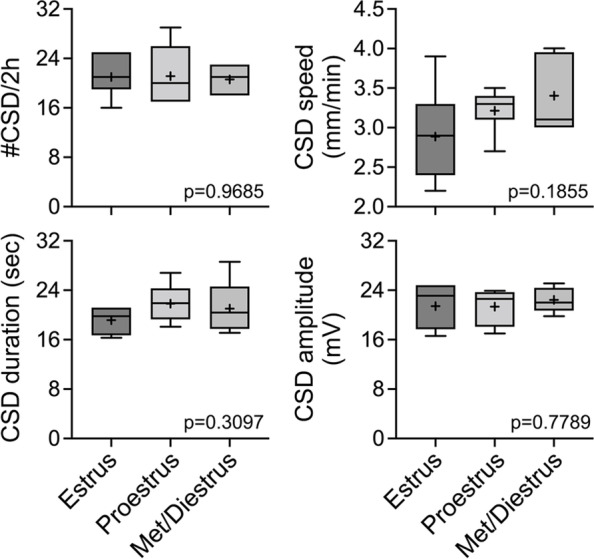
The estrous cycle stages did not differ in CSD susceptibility. There was no difference among the estrus (n = 7), proestrus (n = 7), and metestrus/diestrus (n = 5) stages in CSD frequency, speed, duration, or amplitude triggered by topical 1 M KCl as shown in Fig. 1. Data shown here are from the female group in Fig. 1
Fig. 3
Fig. 3
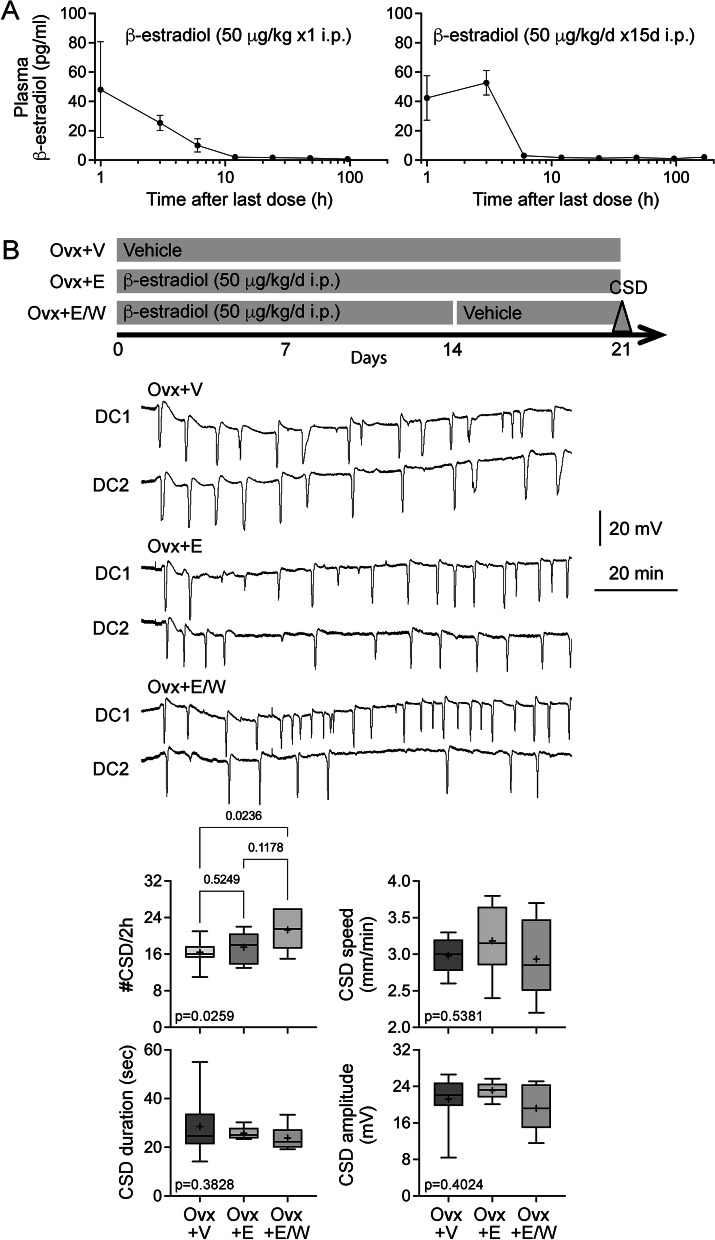
Effects of estradiol replacement and withdrawal in ovariectomized rats on CSD susceptibility. A Plasma concentrations of β-estradiol after a single intraperitoneal injection (left panel) and once-daily intraperitoneal injection (right panel) of 50 μg/kg/day β-estradiol-3-benzoate. Samples were collected at indicated times after the last dose. B Experimental timeline shows the treatment protocol with once-daily intraperitoneal injections in ovariectomized rats. Representative DC potentials from DC1 and DC2 recording sites show recurrent CSDs triggered by topical 1 M KCl application onto the occipital cortex, as shown in Fig. 1. CSD frequency, speed, duration, and amplitude are shown for ovariectomized rats after 3 weeks of vehicle treatment (Ovx + V, n = 12), ovariectomized rats after 3 weeks of 50 μg/kg/day β-estradiol-3-benzoate treatment (Ovx + E, n = 6) and ovariectomized rats treated with 50 μg/kg/day β-estradiol-3-benzoate for 2 weeks followed by withdrawal (Ovx + E/W, n = 6)
Fig. 4
Fig. 4
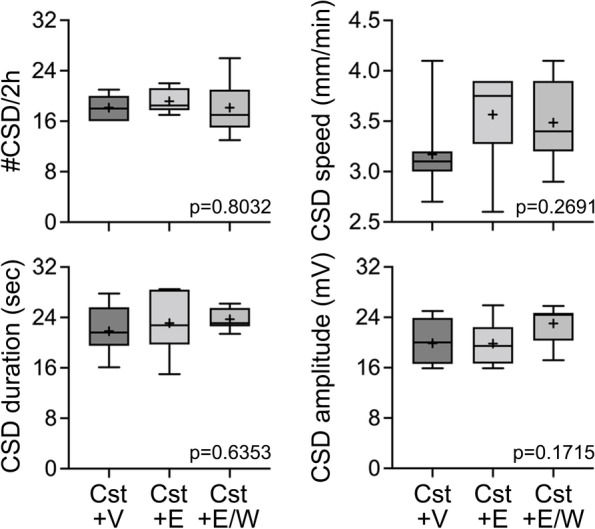
Effects of estradiol replacement and withdrawal in castrated rats on CSD susceptibility. CSD frequency, speed, duration, and amplitude are shown for castrated rats after 3 weeks of vehicle treatment (Cst + V, n = 7), castrated rats after 3 weeks of 50 μg/kg/day β-estradiol-3-benzoate treatment (Cst + E, n = 6) and castrated rats treated with 50 μg/kg/day β-estradiol-3-benzoate for 2 weeks followed by withdrawal (Cst + E/W, n = 7)
Fig. 5
Fig. 5
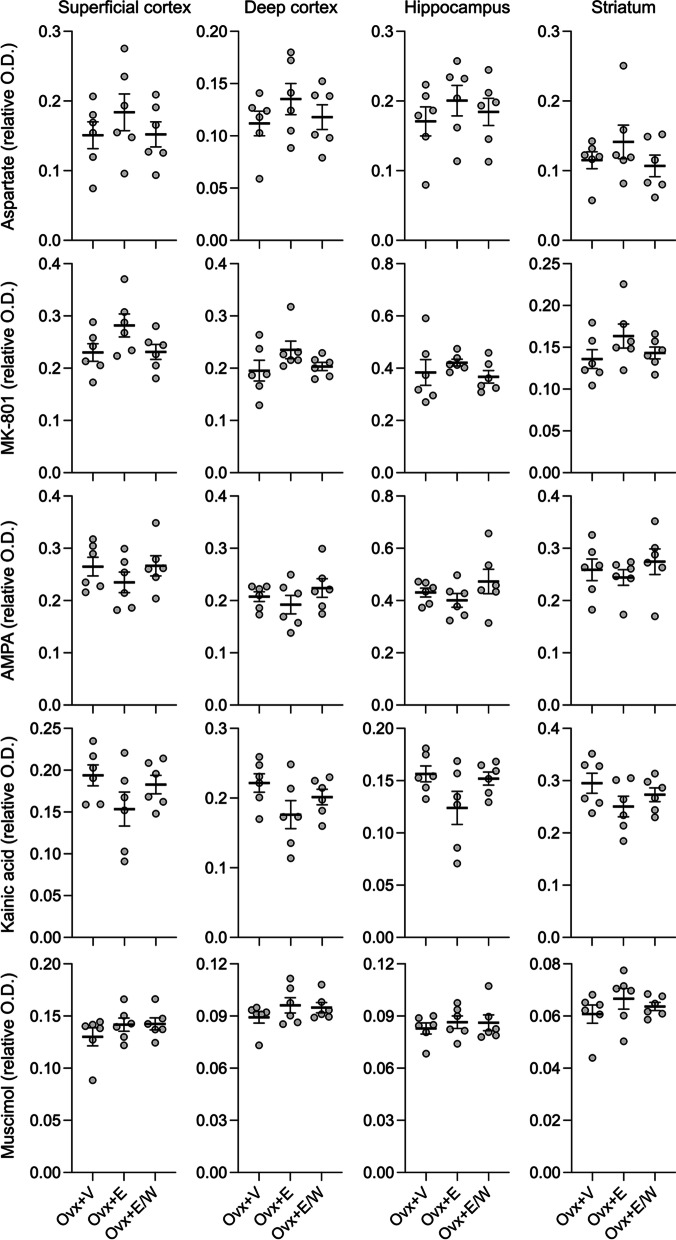
Receptor autoradiography after estrogen treatment or withdrawal. Aspartate, AMPA, kainate, NMDA, and GABAA binding sites were visualized by quantitative in vitro receptor autoradiography using D-[3H]aspartate, [3H]kainate, [3H]AMPA, [3H]MK-801 and [.3H]muscimol in frozen sections from ovariectomized female rats treated with vehicle (Ovx + V), with β-estradiol-3-benzoate (Ovx + E), or with β-estradiol-3-benzoate followed by withdrawal (Ovx + E/W). Specific radioligand binding in selected brain regions (superficial and deep cortical layers, in the striatum and in hippocampus (CA1, CA2, CA3) was assessed by measuring the optical density of the autoradiograms using a computerized image analysis system (Imaging Research, St. Catharines, Ontario, Canada). No significant treatment effect was noted for any of the radioligands. Individual values for each rat (expressed as Relative Optical Densities) are shown, together with group means and SEMs (n = 6 per treatment group)

References

    1. Jensen R, Stovner LJ. Epidemiology and comorbidity of headache. Lancet Neurol. 2008;7(4):354–361. doi: 10.1016/S1474-4422(08)70062-0. - DOI - PubMed
    1. Sakai F, Igarashi H. Prevalence of migraine in Japan: a nationwide survey. Cephalalgia. 1997;17(1):15–22. doi: 10.1046/j.1468-2982.1997.1701015.x. - DOI - PubMed
    1. Gupta S, Mehrotra S, Villalon CM, Perusquia M, Saxena PR, MaassenVanDenBrink A. Potential role of female sex hormones in the pathophysiology of migraine. Pharmacol Ther. 2007;113(2):321–340. doi: 10.1016/j.pharmthera.2006.08.009. - DOI - PubMed
    1. Martin VT, Behbehani M. Ovarian hormones and migraine headache: understanding mechanisms and pathogenesis–part 2. Headache. 2006;46(3):365–386. doi: 10.1111/j.1526-4610.2006.00370.x. - DOI - PubMed
    1. Martin VT, Behbehani M. Ovarian hormones and migraine headache: understanding mechanisms and pathogenesis–part I. Headache. 2006;46(1):3–23. doi: 10.1111/j.1526-4610.2006.00309.x. - DOI - PubMed