


Loss of Consciousness and Righting Reflex Following Traumatic Brain Injury: Predictors of Post-Injury Symptom Development (A Narrative Review)
- PMID: 37239222
- PMCID: PMC10216326
- DOI: 10.3390/brainsci13050750
Loss of Consciousness and Righting Reflex Following Traumatic Brain Injury: Predictors of Post-Injury Symptom Development (A Narrative Review)
Abstract
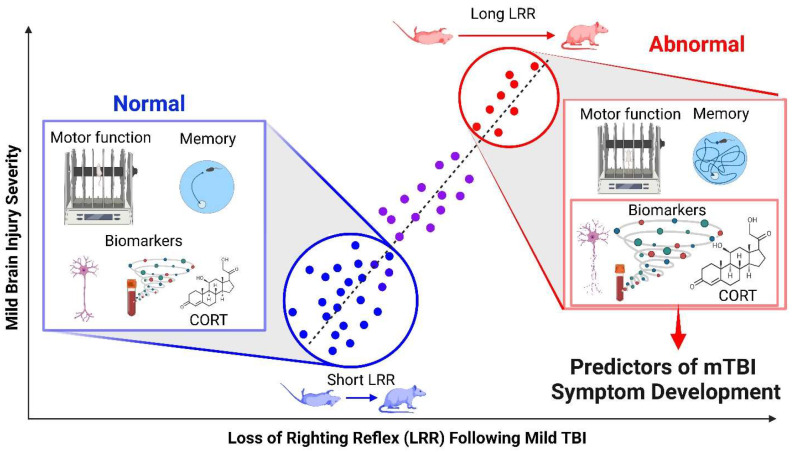
Identifying predictors for individuals vulnerable to the adverse effects of traumatic brain injury (TBI) remains an ongoing research pursuit. This is especially important for patients with mild TBI (mTBI), whose condition is often overlooked. TBI severity in humans is determined by several criteria, including the duration of loss of consciousness (LOC): LOC < 30 min for mTBI and LOC > 30 min for moderate-to-severe TBI. However, in experimental TBI models, there is no standard guideline for assessing the severity of TBI. One commonly used metric is the loss of righting reflex (LRR), a rodent analogue of LOC. However, LRR is highly variable across studies and rodents, making strict numeric cutoffs difficult to define. Instead, LRR may best be used as predictor of symptom development and severity. This review summarizes the current knowledge on the associations between LOC and outcomes after mTBI in humans and between LRR and outcomes after experimental TBI in rodents. In clinical literature, LOC following mTBI is associated with various adverse outcome measures, such as cognitive and memory deficits; psychiatric disorders; physical symptoms; and brain abnormalities associated with the aforementioned impairments. In preclinical studies, longer LRR following TBI is associated with greater motor and sensorimotor impairments; cognitive and memory impairments; peripheral and neuropathology; and physiologic abnormalities. Because of the similarities in associations, LRR in experimental TBI models may serve as a useful proxy for LOC to contribute to the ongoing development of evidence-based personalized treatment strategies for patients sustaining head trauma. Analysis of highly symptomatic rodents may shed light on the biological underpinnings of symptom development after rodent TBI, which may translate to therapeutic targets for mTBI in humans.
Keywords: injury severity; loss of consciousness; mild traumatic brain injury; prognosis; righting reflex.
Conflict of interest statement
The authors declare no conflict of interest.
Figures
References
-
- CDC . Traumatic Brain Injury in the United States: Epidemiology and Rehabilitation. National Center for Injury Prevention and Control, Division of Unintentional Injury Prevention; Atlanta, GA, USA: 2015.
-
- Washington, DC, USA: 2021. [(accessed on 25 March 2023)]. VA/DoD Clinical Practice Guideline for the Management and Rehabilitation of Post-Acute Mild Traumatic Brain Injury. Available online: https://pubmed.ncbi.nlm.nih.gov/20108447/
-
- Cnossen M.C., Winkler E.A., Yue J.K., Okonkwo D.O., Valadka A.B., Steyerberg E.W., Lingsma H.F., Manley G.T., Investigators T.-T. Development of a Prediction Model for Post-Concussive Symptoms following Mild Traumatic Brain Injury: A TRACK-TBI Pilot Study. J. Neurotrauma. 2017;34:2396–2409. doi: 10.1089/neu.2016.4819. - DOI - PMC - PubMed
Publication types
LinkOut - more resources
Full Text Sources
