


Assessment of Microhardness of Conventional and Bulk-Fill Resin Composites Using Different Light-Curing Intensity
- PMID: 37242825
- PMCID: PMC10224105
- DOI: 10.3390/polym15102250
Assessment of Microhardness of Conventional and Bulk-Fill Resin Composites Using Different Light-Curing Intensity
Abstract
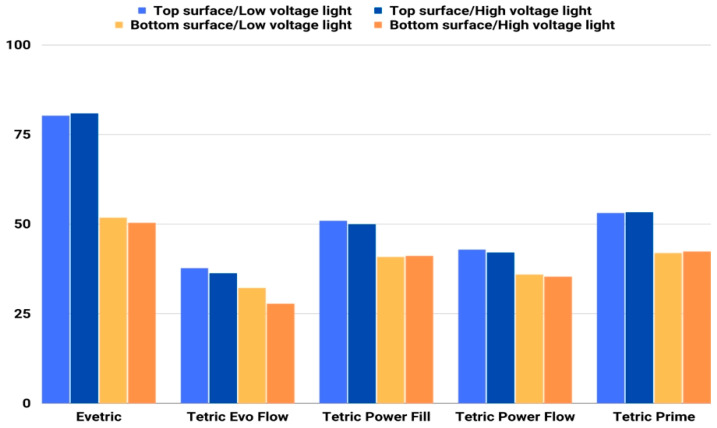
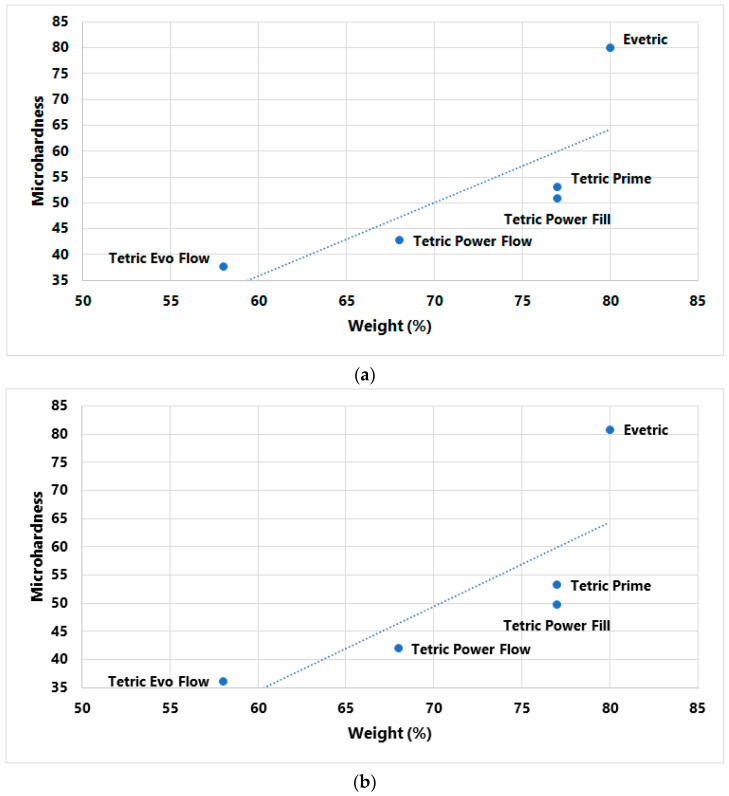
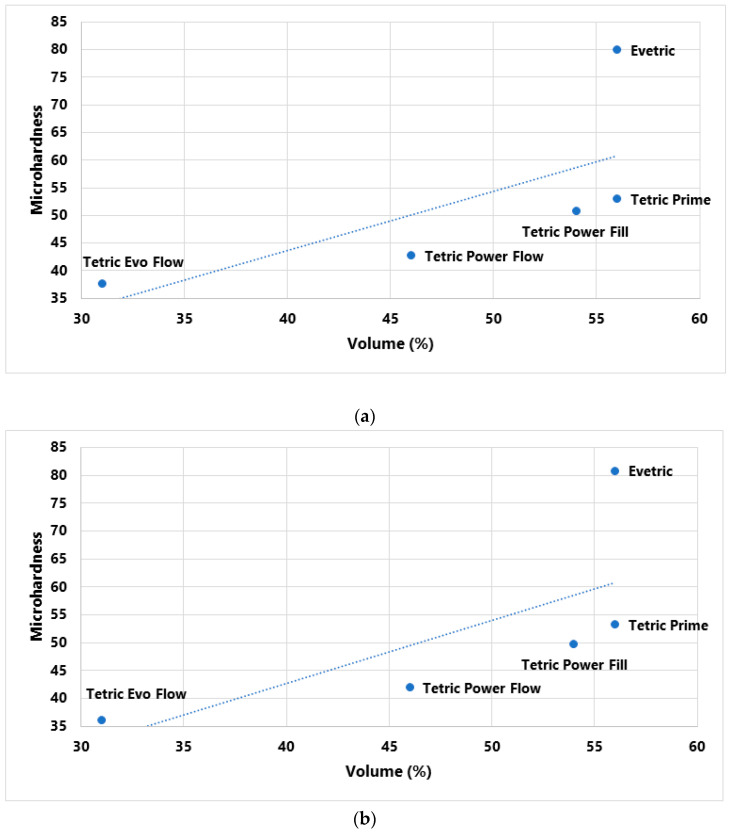
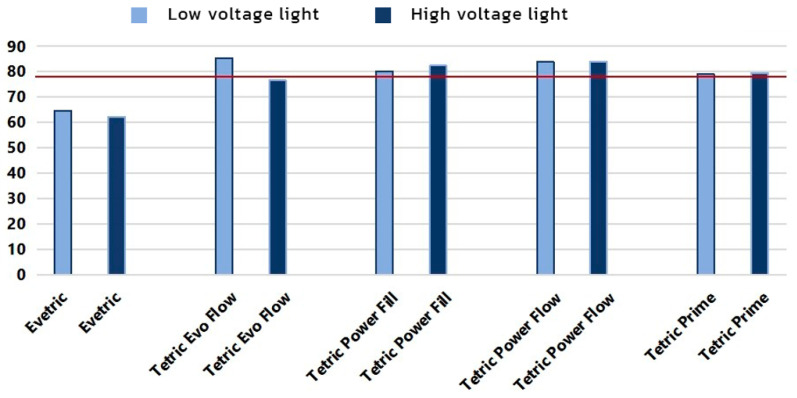
(1) Background: This study evaluates the effect of a conventional/low-voltage light-curing protocol (LV protocol) (10 s with 1340 mW/cm2) and high-voltage light-curing protocol (HV protocol) (3 s with 3440 mW/cm2) on the microhardness (MH) of dental resin-based composites (RBCs). Five resin composites were tested: conventional Evetric (EVT), Tetric Prime (TP), Tetric Evo Flow (TEF), bulk-fill Tetric Power Fill (PFL), and Tetric Power Flow (PFW). (2) Materials and Methods: Two tested composites (PFW and PFL) were designed for high-intensity light curing. The samples were made in the laboratory in specially designed cylindrical molds; diameter = 6 mm and height = 2 or 4 mm, depending on the type of composite. Initial MH was measured on the top and bottom surfaces of composite specimens 24 h after light curing using a digital microhardness tester (QNESS 60 M EVO, ATM Qness GmbH, Mammelzen, Germany). The correlation between the filler content (wt%, vol%) and the MH of the RBCs was tested. For the calculation of depth-dependent curing effectiveness, the bottom/top ratio for initial MH was used. (3) Conclusions: MH of RBCs is more dependent on material composition than on light-curing protocol. Filler wt% has a greater influence on MH values compared to filler vol%. The bottom/top ratio showed values over 80% for bulk composites, while for conventional sculptable composites, borderline or suboptimal values were measured for both curing protocols.
Keywords: bulk-fill composites; filler content; high-intensity curing; microhardness; resin composites.
Conflict of interest statement
The authors declare no conflict of interest.
Figures
References
-
- Yeşil Acar Z., Tunç Koçyiğit M., Asiltürk M. Investigation of the Effect of Matrix-Interface Formed with Silane-Based Coupling Agents on Physico-Chemical Behavior and Flow Distance of Dental Composites. J. Mol. Liq. 2023;378:121600. doi: 10.1016/j.molliq.2023.121600. - DOI
-
- Cho K., Rajan G., Farrar P., Prentice L., Prusty B.G. Dental Resin Composites: A Review on Materials to Product Realizations. Compos. Part B Eng. 2022;230:109495. doi: 10.1016/j.compositesb.2021.109495. - DOI
-
- Georgiev G., Dikova T. Hardness Investigation of Conventional, Bulk Fill and Flowable Dental Composites. J. Achiev. Mater. Manuf. Eng. 2021;109:68–77. doi: 10.5604/01.3001.0015.6261. - DOI
-
- Anusavice K. Chapter 18—Dental Ceramics. In: Anusavice K.J., Shen C., Rawls H.R., editors. Phillips’ Science of Dental Materials. Saunders; St. Louis, MO, USA: 2013. pp. 418–473.
-
- Sherwood I. Materials in Restorative Dentistry. Jaypee Brothers; New Delhi, India: 2010. Introduction to Dental Materials.
Grants and funding
LinkOut - more resources
Full Text Sources
Research Materials
Miscellaneous
