. 2023 Apr 25;15(5):1054.
doi: 10.3390/v15051054.

Electrostatic Screening, Acidic pH and Macromolecular Crowding Increase the Self-Assembly Efficiency of the Minute Virus of Mice Capsid In Vitro

Affiliations

Electrostatic Screening, Acidic pH and Macromolecular Crowding Increase the Self-Assembly Efficiency of the Minute Virus of Mice Capsid In Vitro

Miguel Angel Fuertes et al. Viruses. .

Abstract

The hollow protein capsids from a number of different viruses are being considered for multiple biomedical or nanotechnological applications. In order to improve the applied potential of a given viral capsid as a nanocarrier or nanocontainer, specific conditions must be found for achieving its faithful and efficient assembly in vitro. The small size, adequate physical properties and specialized biological functions of the capsids of parvoviruses such as the minute virus of mice (MVM) make them excellent choices as nanocarriers and nanocontainers. In this study we analyzed the effects of protein concentration, macromolecular crowding, temperature, pH, ionic strength, or a combination of some of those variables on the fidelity and efficiency of self-assembly of the MVM capsid in vitro. The results revealed that the in vitro reassembly of the MVM capsid is an efficient and faithful process. Under some conditions, up to ~40% of the starting virus capsids were reassembled in vitro as free, non aggregated, correctly assembled particles. These results open up the possibility of encapsidating different compounds in VP2-only capsids of MVM during its reassembly in vitro, and encourage the use of virus-like particles of MVM as nanocontainers.

Keywords: assembly efficiency; capsid; macromolecular crowding; nanocontainer; self-assembly; virus; virus-like particle.


Conflict of interest statement

The authors declare no conflict of interest.

Figures

Figure 1
Figure 1
Scheme and structure of the MVM capsid. (A) Scheme of the icosahedral MVM capsid. (B) Surface representation of the atomic structure of the MVM capsid. The surface is color coded from blue to red as a function of the particle radius. In (A,B), the contour of a VP2 trimer (capsid building block) is indicated by a yellow triangle.
Figure 2
Figure 2
Disassembly and reassembly of MVM VLPs. Representative TEM images taken at the same magnification and total capsid protein concentration during a representative disassembly and reassembly experiment. (A) Purified VLPs prior to disassembly. (B) Viral capsid protein after the VLPs in the original sample were disassembled. (C) VLPs reassembled at 25 °C in PBS pH = 7.6. The scale bar corresponds to 50 nm.
Figure 3
Figure 3
VLP reassembly efficiency as a function of protein concentration. Reassembly of VLPs was performed at 25 °C in PBS pH = 7.6, using different protein concentrations. Efficiency values were obtained as indicated in Methods by averaging the results of counting many EM grid fields. Vertical bars represent standard deviations. tf = 140 min. (A) Total number of reassembled VLPs. (B) Absolute reassembly efficiency. (C) Reassembly efficiency relative to the highest efficiency achieved (at 0.056 mg/mL).
Figure 4
Figure 4
VLP aggregates formed during the reassembly reaction. Representative TEM images showing free recombinant VLPs purified from cells and kept at room temperature (A), free VLPs after in vitro disassembly and reassembly for 20 min (B), and a mixture of free and aggregated VLPs after disassembly, reassembly, and further incubation for a total of 3.3 h (C). Scale bars correspond to 100 nm.
Figure 5
Figure 5
VLP reassembly efficiency as a function of time in the presence or absence of macromolecular crowding conditions. Reassembly of VLPs was performed at 25 °C in PBS pH = 7.6 using a protein concentration of 0.35 mg/mL, either in the absence (black circles) or presence (red squares) of 50 gr/L Ficoll-70. Relative reassembly efficiency values are given, using as a reference (100%) the efficiency obtained at the end of the reaction (t = 80 min) in the absence of Ficoll-70. Vertical bars represent standard deviations. The data were fitted to exponential curves (continuous lines).
Figure 6
Figure 6
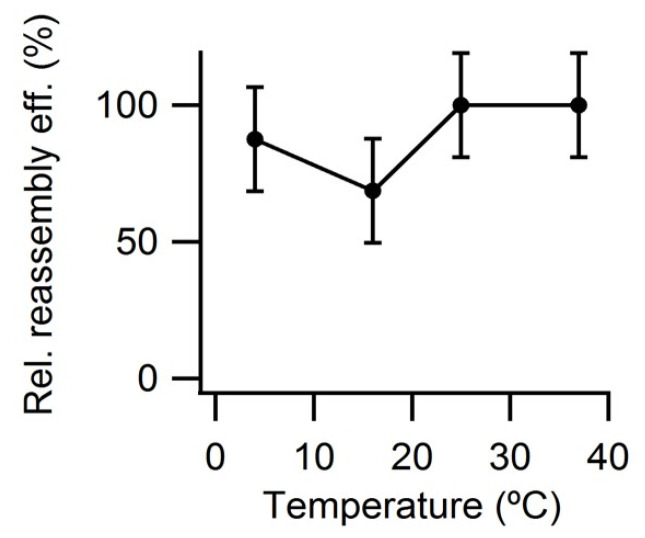
VLP reassembly efficiency as a function of temperature. Reassembly of VLPs was performed at 25 °C in PBS pH = 7.6, using a protein concentration of 0.6 mg/mL. Relative reassembly efficiency values after the reaction was complete (t = 2.5 h) are given, using as a reference (100%) the efficiency obtained at 25 °C. Vertical bars represent standard deviations.
Figure 7
Figure 7
VLP reassembly efficiency as a function of ionic strength. (A) Reassembly of VLPs was performed at 25 °C in PBS pH = 7.6, using a protein concentration of 0.65 mg/mL and increasing amounts of NaCl, from 0.15 M to 2 M. Relative reassembly efficiency values after the reaction was complete (t = 80 min) are given, using as a reference (100%) the efficiency obtained at physiological ionic strength (0.15 M NaCl). Vertical bars represent standard deviations. (B) Calculated electrostatic potentials represented on the MVM capsid trimer surface as a function of ionic strength. The value of the electrostatic potential is expressed in kBT units (where kB is the Boltzmann constant and T the temperature) and color coded from red (negative) to blue (positive) in the trimer structure viewed from the side.
Figure 8
Figure 8
VLP reassembly efficiency as a function of pH. (A) Reassembly of VLPs was performed at 25 °C in PBS using a protein concentration of 0.6 mg/mL at different pH from 6.0 to 8.0). Relative reassembly efficiency values after the reaction was complete (t = 6 h) are given, using as a reference (100%) the efficiency obtained at pH = 7.6. Vertical bars represent standard deviations. (B) Calculated electrostatic potentials represented on the MVM capsid trimer surface as a function of pH. The value of the electrostatic potential is expressed in kBT units (where kB is the Boltzmann constant and T the temperature) and color coded from red (negative) to blue (positive) in the trimer structure viewed from the side.
Figure 9
Figure 9
VLP stability as a function of pH. VLPs at a final concentration of 0.05 mg/mL were disassembled at 25 °C using GdmHCl at a final concentration of 3.75 M. (A,B) Electron micrographs of a VLPs before starting the experiment (A) or after complete dissociation using GdmHCl (B). Scale bars in A and B correspond to 100 nm. (C) Average percent VLPs remaining after incubation for different times in different buffers: (i) 150 mM Tris-HCl, 650 mM NaCl at pH = 7.6 (blue triangles) or pH = 6.8 (green inverted triangles); (ii) PBS at pH = 6.2 (black squares) or pH = 5.5 (red circles). Vertical bars represent standard deviations. The values were fitted to simple exponential decays (continuous lines) that correspond to the dissociation of the VLPs into their constituent subunits.
Figure 10
Figure 10
Combined effects of ionic strength and pH on VLP reassembly efficiency. Reassembly of VLPs was performed in PBS at 25 °C using a protein concentration of 0.05 mg/mL and the following pH and ionic strengths: pH = 7.6, 0.15 M NaCl (black bar); pH 7.6, 0.5 M NaCl (white bar); pH 6.6, 0.15 M NaCl (light grey bar); and pH 6.6, 0.5 M NaCl (dark grey bar). Relative reassembly efficiency values after the reaction was complete (t = 3 h) are given, using as a reference (100%) the efficiency obtained at pH = 7.6 and 0.15 M NaCl. Error bars represent propagated errors.

References

    1. Cuervo A., Daudén M.I., Carrascosa J.L. Nucleic acid packaging in viruses. Subcell. Biochem. 2013;68:361–394. - PubMed
    1. Mateu M.G. Assembly, stability and dynamics of virus capsids. Arch. Biochem. Biophys. 2013;531:65–79. doi: 10.1016/j.abb.2012.10.015. - DOI - PubMed
    1. Twarock R., Stockley P.G. RNA-Mediated Virus Assembly: Mechanisms and Consequences for Viral Evolution and Therapy. Annu. Rev. Biophys. 2019;48:495–514. doi: 10.1146/annurev-biophys-052118-115611. - DOI - PMC - PubMed
    1. Bancroft J.B., Hiebert E., Bracker C.E. The effects of various polyanions on shell formation of some spherical viruses. Virology. 1969;39:924–930. doi: 10.1016/0042-6822(69)90029-4. - DOI - PubMed
    1. Adolph K.W., Butler P.J. Studies on the assembly of a spherical plant virus. I. States of aggregation of the isolated protein. J. Mol. Biol. 1974;88:327–341. doi: 10.1016/0022-2836(74)90485-9. - DOI - PubMed

Publication types

Substances

LinkOut - more resources