. 2023 May 27;10(1):332.
doi: 10.1038/s41597-023-02222-y.

A compendium of bacterial and archaeal single-cell amplified genomes from oxygen deficient marine waters

Affiliations

A compendium of bacterial and archaeal single-cell amplified genomes from oxygen deficient marine waters

Julia Anstett et al. Sci Data. .

Abstract

Oxygen-deficient marine waters referred to as oxygen minimum zones (OMZs) or anoxic marine zones (AMZs) are common oceanographic features. They host both cosmopolitan and endemic microorganisms adapted to low oxygen conditions. Microbial metabolic interactions within OMZs and AMZs drive coupled biogeochemical cycles resulting in nitrogen loss and climate active trace gas production and consumption. Global warming is causing oxygen-deficient waters to expand and intensify. Therefore, studies focused on microbial communities inhabiting oxygen-deficient regions are necessary to both monitor and model the impacts of climate change on marine ecosystem functions and services. Here we present a compendium of 5,129 single-cell amplified genomes (SAGs) from marine environments encompassing representative OMZ and AMZ geochemical profiles. Of these, 3,570 SAGs have been sequenced to different levels of completion, providing a strain-resolved perspective on the genomic content and potential metabolic interactions within OMZ and AMZ microbiomes. Hierarchical clustering confirmed that samples from similar oxygen concentrations and geographic regions also had analogous taxonomic compositions, providing a coherent framework for comparative community analysis.


Conflict of interest statement

S.J.H is a co-founder of Koonkie Inc., a bioinformatics consulting company that designs and provides scalable algorithmic and data analytics solutions in the cloud.

Figures
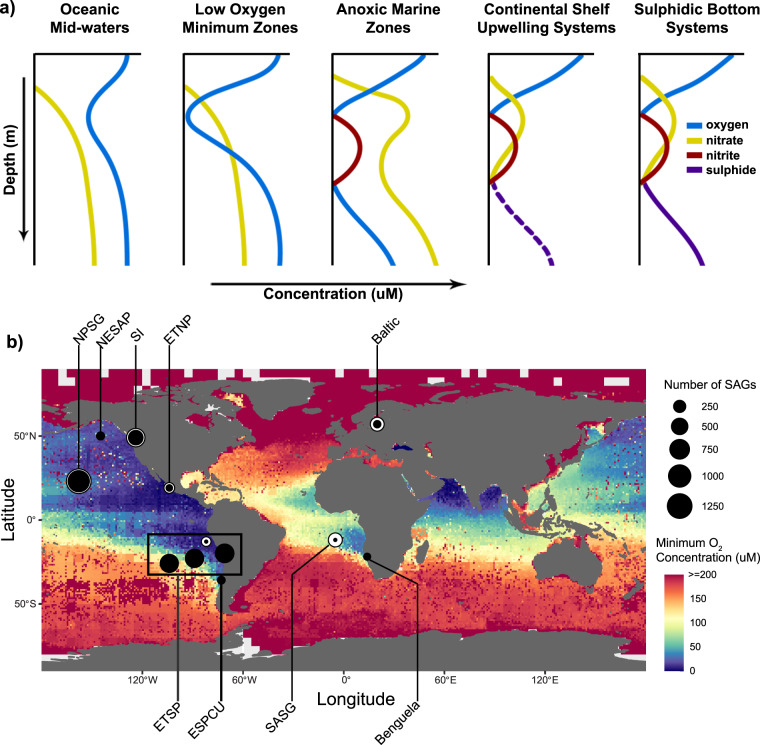
Fig. 1
Fig. 1
Oxygen minimum zone (OMZ) and anoxic marine zone (AMZ) geochemical profiles and global map of sampling locations. (a) The different geochemical profiles of oxygen-deficient marine waters are schematized (modified from Ulloa et al., 2012). Solid lines represent observed data, while the dashed line represent a sporadic accumulation event. (b) OMZ and AMZ sampling locations for single-cell amplified genomes (SAGs) are indicated. The total number (white) and sequenced (black) SAGs obtained from each location are denoted with a circle proportional to the corresponding number of samples in the dataset. The Ocean is coloured according to the lowest mean statistical value for the oxygen concentration reported for each 1° and 5° grid in the 2018 annual NOAA World Ocean Atlas, with white grids indicating locations where oxygen concentration data was unavailable. Sampling sites from oceanic midwaters include the North Pacific Subtropical Gyre (NPSG) and the South Atlantic Subtropical Gyre (SASG). Sample sites from low oxygen OMZs include the Northeastern Subarctic Pacific (NESAP). Sample sites from AMZs include the Eastern Tropical North Pacific Gyre (ETNP) and Eastern Tropical South Pacific Gyre (ETSP). Sites from coastal upwelling systems with ephemerally sulfidic bottoms include the Eastern South Pacific Coastal Upwelling (ESPCU) and Benguela coastal upwelling (Benguela). Sampling sites from sulfidic bottom basins include Saanich Inlet (SI) and the Baltic Sea. Geolocalization coordinates and the number of samples for each location are detailed in Table 1.
Fig. 2
Fig. 2
Overview of the workflow for processing and generating microbial Single-cell Amplified Genomes (SAGs). A more detailed scheme is presented in the supplementary information (Supplemental Figure S1-S3) (modified from Rinke et al., 2013).
Fig. 3
Fig. 3
A SAG-based assessment of microbial composition across OMZs. The dot-plot presents the taxonomic designation and proportion of anonymously sorted SAGs sequenced (colored dot) in each taxa at the phylum level and Proteobacteria at the class level from each location. Underlying grey dots represent SAGs collected and taxonomically screened, but not currently sequenced. Taxonomy was determined by SSU rRNA gene amplicon sequences as defined by SILVA v138.1. Dot colour represents environmental oxygen concentrations at time of sampling. Sampling locations were clustered according to the similarity of the SAG taxonomic composition collected at each location. Clustering scale represents the Bray-Curtis dissimilarity among the microbial diversity from each location based on SAG sequence information. Annotation bars denote DNA amplification mentod and OMZ type. Location information is colour encoded as shown for DNA amplification method, OMZ or AMZ type, and oxygen concentration at time of sampling. Sampling location names, on the tips of the dendrogram, are denoted as ‘location_depth (m)_collection month and/or year’. Location acronyms correspond to: Saanich Inlet (SI), Northeastern Subarctic Pacific (NESAP), North Pacific Subtropical Gyre (NPSG), Eastern Tropical North Pacific (ETNP), Eastern Tropical South Pacific (ETSP), Eastern South Pacific Coastal Upwelling (ESPCU), Benguela coastal upwelling (Benguela), South Atlantic Subtropical Gyre (SASG), and the Baltic Sea (Baltic).
Fig. 4
Fig. 4
CheckM completeness and contamination estimates of sequenced SAGs for all sequenced SAGs with the point size representing the assembly length in Megabase Pairs (MBP). Of these, the solid line represents the estimated completeness and contamination threshold for medium quality SAGs (> = 50% Completeness, <10% Contamination) and the dashed line represents the threshold for high quality SAGs (>90% Completeness, <5% Contamination). Plots are coloured based on (a) region, (b) OMZ ecotype, (c) depth, (d) environmental oxygen concentration level, (e) DNA amplification method, and (f) taxonomic group (class level for Proteobacteria, phylum level for other taxa) as defined by SILVA v138.1. Note that SAGs >5% estimated contamination have been excluded from this figure.

References

    1. Revsbech, N. P. et al. Determination of ultra-low oxygen concentrations in oxygen minimum zones by the STOX sensor. Limnol. Oceanogr.: Methods.7, 371-381. (2009).
    1. Wright JJ, Konwar KM, Hallam SJ. Microbial ecology of expanding oxygen minimum zones. Nat. Rev. Microbiol. 2012;10:381–394. doi: 10.1038/nrmicro2778. - DOI - PubMed
    1. Jürgens, K. & Taylor, G. T. Microbial ecology and biogeochemistry of oxygen-deficient water columns in Microbial Ecology of the Oceans (eds. Gasol, J. M. & Kirchman, D. L.) 231–288 (John Wiley & Sons, 2018).
    1. Ulloa O, Canfield DE, DeLong EF, Letelier RM, Stewart FJ. Microbial oceanography of anoxic oxygen minimum zones. Proc. Natl. Acad. Sci. USA. 2012;109:15996–16003. doi: 10.1073/pnas.1205009109. - DOI - PMC - PubMed
    1. Thamdrup, B., Dalsgaard, T. & Revsbech, N. P. Widespread functional anoxia in the oxygen minimum zone of the Eastern South Pacific. Deep-Sea Res. Pt. I.65, 36–45 (2012).
