


Study of Immune Response and Malondialdehyde Levels in Irradiated Rats Supplemented with Curcuma xanthorriza Roxb Extract
- PMID: 37247293
- PMCID: PMC10495877
- DOI: 10.31557/APJCP.2023.24.5.1717
Study of Immune Response and Malondialdehyde Levels in Irradiated Rats Supplemented with Curcuma xanthorriza Roxb Extract
Abstract
Objective: The purpose of this study was to assess the immune response and malondialdehyde levels in irradiated rats supplemented with Curcuma xanthorriza Roxb extract as a candidate for mitigating radiation exposure.
Methods: Twenty-four male Wistar rats were grouped into eight treatment groups, then Curcuma xanthorrhiza Roxb extract was administered orally and irradiated at 6 Gy. Measurement of rats IL-6 and INF-γ was performed using a sandwich ELISA Kit, while the MDA concentration was quantified according to the method of Wills (1971). The statistical test is determined by one way ANOVA test. P-value <0.05 was considered statistically significant.
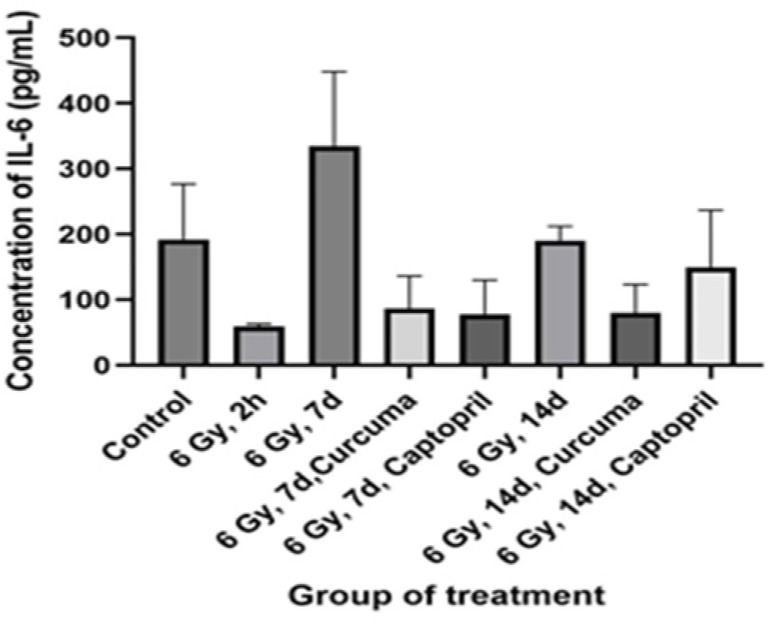
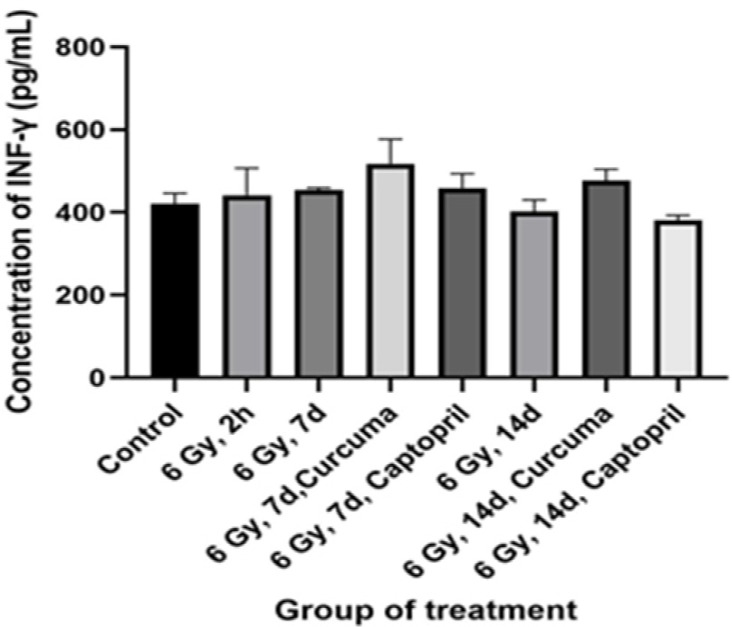
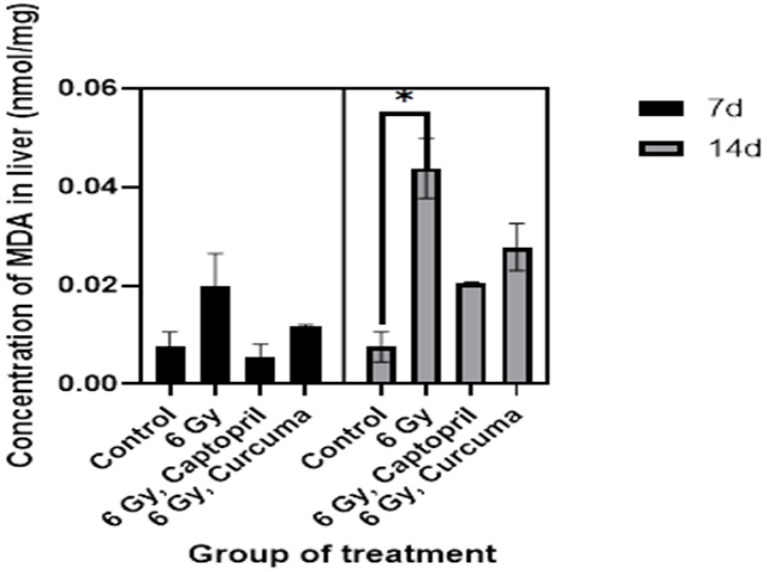
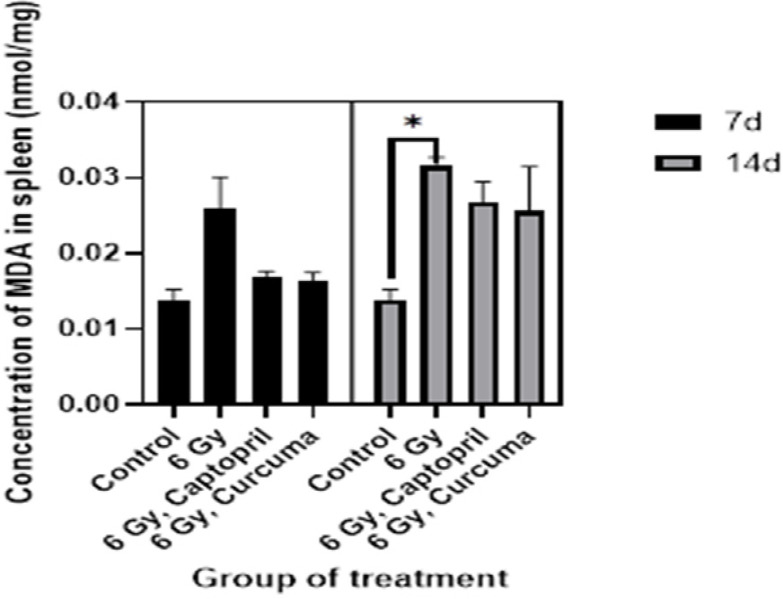
Result: The concentration of IL-6 in all groups showed no statistically significant difference (P=0.18). There was an increase in the concentration of IL-6 in the group of rats irradiated with 6 Gy for 7 days and 14 days. Meanwhile, the INF-γ concentration also showed no significant results in all treatment groups (P=0.28). The average of MDA concentration showed a significant difference in the liver and spleen of irradiated rats at 6 Gy for 14 days compared to the control (0.044 nmol/mg vs 0.008 nmol/mg, P=0.03 and 0.032 nmol/mg vs 0.014 nmol/mg, P=0.05, respectively).
Conclusion: The administration of Curcuma xanthorriza Xorb extract was able to reduce MDA concentrations in the liver and spleen although not statistically significant. In addition, exposure to ionizing radiation at a dose of 6 Gy significantly increased lipid peroxidation in the liver and spleen by 5.5 times and 2.3 times, respectively.
Keywords: Curcuma xanthorriza Roxb extract; Interferon-gamma; Interleukin-6; Malondialdehyde levels; radiation exposure.
Conflict of interest statement
All of authors state that this study was conducted without any financial relationship construed as a potential conflict of interest.
Figures
References
-
- Akarchariya N, Sirilun S, Julsrigival J, Chansakaowa S. Chemical profiling and antimicrobial activity of essential oil from Curcuma aeruginosa Roxb Curcuma glans K Larsen & J Mood and Curcuma cf xanthorrhiza Roxb collected in Thailand. Asian Pac J Trop Biomed. 2017;7:881–5.
-
- Alkadi H. A Review on free radicals and antioxidants. Infect Disord Drug Targets. 2020;20:16–26. - PubMed
-
- Angel GR, Menon N, Vimala B, Nambisan B. Essential oil composition of eight starchy Curcuma species. Ind Crops Prod. 2014;60:233–8.
-
- Aranda-Rivera AK, Cruz-Gregorio A, Arancibia-Hernandez YL, Hernandez-Cruz EY, Pedraza-Chaverri J. RONS and oxidative stress: An overview of basic concepts. Oxygen. 2020;2:437–78.
