


Effect of Different Nonstarter Compensatory Strategies on Training Load in Female Soccer Players: A Pilot Study
- PMID: 37249238
- PMCID: PMC10606965
- DOI: 10.1177/19417381231176555
Effect of Different Nonstarter Compensatory Strategies on Training Load in Female Soccer Players: A Pilot Study
Abstract
Background: In soccer, the day of the week with the highest external load is match day (MD), with starters (>60 minutes per match) showing higher levels of physical fitness and seasonal high-intensity loading. It is necessary, therefore, to determine training strategies to reduce the differences between starters and nonstarters. The aim of this study was to analyze and compare the external load of different training compensatory strategies with match external load in female nonstarters.
Hypothesis: A strategy combining small-sided games (SSG) and running-based drills (RBD) would reproduce match demands, with RBD leading to greater high-intensity running and SSG leading to a greater number of accelerations and decelerations.
Study design: Descriptive and comparative study.
Level of evidence: Level 4.
Methods: The training and match external load of 14 female players belonging to the same reserve squad of a Spanish First Division Club (Liga Reto Iberdrola) was registered. In the first session after the match (MD+1), nonstarters (<60 minutes in the match) performed 1 of 3 different compensatory strategies: RBD, SSG, or a mixed intervention combining the previous strategies (RBD+SSG). Starters carried out a recovery session.
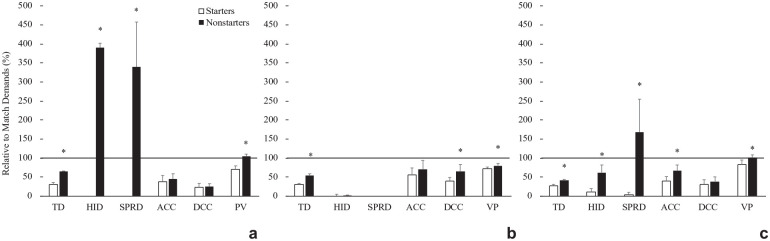
Results: A marked difference in load was observed between the compensatory training strategies and MD. In comparison with MD, RBD showed greater high-intensity and sprint distances and lower acceleration, SSG showed less high-intensity running and sprint distances, lower peak velocity, and greater acceleration, and RBD+SSG registered lower accelerations. In addition, nonstarters covered greater high-intensity running and sprint distances in RBD and achieved higher accelerations in SSG.
Conclusion: RBD and SSG compensatory strategies could be recommended to nonstarter female soccer players in MD+1 to compensate for match external load deficits.
Clinical relevance: This study provides comprehensive information on the compensatory exercises of female soccer players, which can be useful for strength and conditioning coaches when developing recovery strategies during a microcycle.
Keywords: compensatory training; football; load; women.
Conflict of interest statement
The authors report no potential conflicts of interest in the development and publication of this article.
Figures
References
-
- Ade JD, Harley JA, Bradley PS. Physiological response, time-motion characteristics, and reproducibility of various speed-endurance drills in elite youth soccer players: small-sided games versus generic running. Int J Sport Physiol Perform. 2014;9(3):471-479. - PubMed
-
- Anderson L, Orme P, Di Michele R, et al. Quantification of seasonal-long physical load in soccer players with different starting status from the English premier league: implications for maintaining squad physical fitness. Int J Sports Physiol Perform. 2016;11(8):1038-1046. - PubMed
-
- Anderson L, Orme P, Di Michele R, et al. Quantification of training load during one-, two- and three-game week schedules in professional soccer players from the English Premier League: implications for carbohydrate periodisation. J Sports Sci. 2016;34(13):1250-1259. - PubMed
-
- Bastida Castillo A, Gomez Carmona CD, De la Cruz Sanchez E, Pino Ortega J. Accuracy, intra- and inter-unit reliability, and comparison between GPS and UWB-based position-tracking systems used for time-motion analyses in soccer. Eur J Sport Sci. 2018;18(4):450-457. - PubMed
MeSH terms
LinkOut - more resources
Full Text Sources
Research Materials
