


Microbial Pathogenesis in the Era of Spatial Omics
- PMID: 37255461
- PMCID: PMC10353406
- DOI: 10.1128/iai.00442-22
Microbial Pathogenesis in the Era of Spatial Omics
Abstract
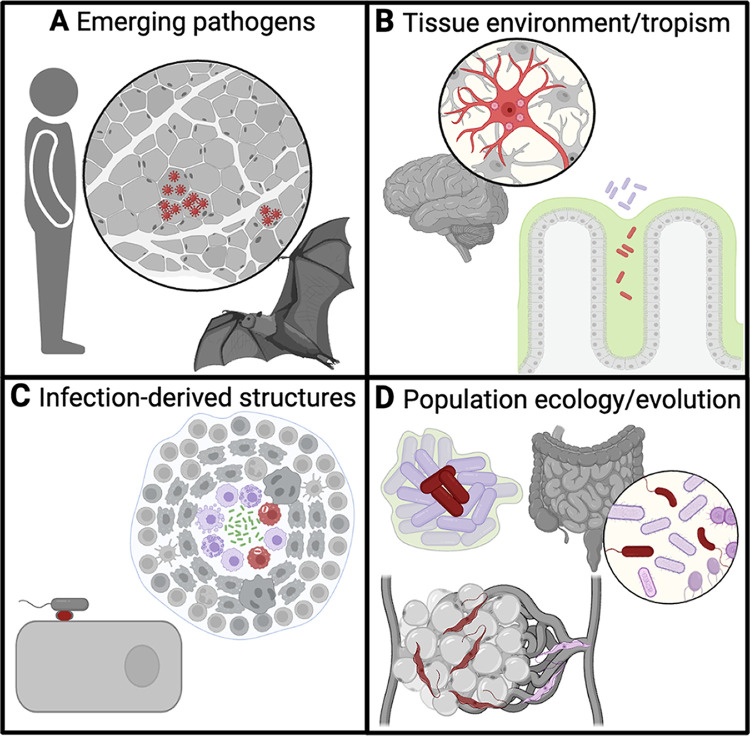
The biology of a cell, whether it is a unicellular organism or part of a multicellular network, is influenced by cell type, temporal changes in cell state, and the cell's environment. Spatial cues play a critical role in the regulation of microbial pathogenesis strategies. Information about where the pathogen is-in a tissue or in proximity to a host cell-regulates gene expression and the compartmentalization of gene products in the microbe and the host. Our understanding of host and pathogen identity has bloomed with the accessibility of transcriptomics and proteomics techniques. A missing piece of the puzzle has been our ability to evaluate global transcript and protein expression in the context of the subcellular niche, primary cell, or native tissue environment during infection. This barrier is now lower with the advent of new spatial omics techniques to understand how location regulates cellular functions. This review will discuss how recent advances in spatial proteomics and transcriptomics approaches can address outstanding questions in microbial pathogenesis.
Keywords: host-pathogen interactions; microbial pathogenesis; spatial proteomics; spatial transcriptomics.
Conflict of interest statement
The authors declare no conflict of interest.
Figures
References
-
- Gouin E, Gantelet H, Egile C, Lasa I, Ohayon H, Villiers V, Gounon P, Sansonetti PJ, Cossart P. 1999. A comparative study of the actin-based motilities of the pathogenic bacteria Listeria monocytogenes, Shigella flexneri and Rickettsia conorii. J Cell Sci 112:1697–1708. doi: 10.1242/jcs.112.11.1697. - DOI - PubMed
Publication types
MeSH terms
Grants and funding
LinkOut - more resources
Full Text Sources
