Review
. 2023 Jul;113(1):68-82.
doi: 10.1007/s00223-023-01100-4. Epub 2023 May 31.

"Bone-SASP" in Skeletal Aging

Affiliations
Review

"Bone-SASP" in Skeletal Aging

Ching-Lien Fang et al. Calcif Tissue Int. 2023 Jul.

Abstract

Senescence is a complex cell state characterized by stable cell cycle arrest and a unique secretory pattern known as the senescence-associated secretory phenotype (SASP). The SASP factors, which are heterogeneous and tissue specific, normally include chemokines, cytokines, growth factors, adhesion molecules, and lipid components that can lead to multiple age-associated disorders by eliciting local and systemic consequences. The skeleton is a highly dynamic organ that changes constantly in shape and composition. Senescent cells in bone and bone marrow produce diverse SASP factors that induce alterations of the skeleton through paracrine effects. Herein, we refer to bone cell-associated SASP as "bone-SASP." In this review, we describe current knowledge of cellular senescence and SASP, focusing on the role of senescent cells in mediating bone pathologies during natural aging and premature aging syndromes. We also summarize the role of cellular senescence and the bone-SASP in glucocorticoids-induced bone damage. In addition, we discuss the role of bone-SASP in the development of osteoarthritis, highlighting the mechanisms by which bone-SASP drives subchondral bone changes in metabolic syndrome-associated osteoarthritis.

Keywords: Bone-SASP; Cellular senescence; Osteoarthritis; Osteoporosis; Premature aging syndromes; Progeria syndrome; Senescence-associated secretory phenotype (SASP); Skeletal aging.


Figures

Fig. 1
Fig. 1
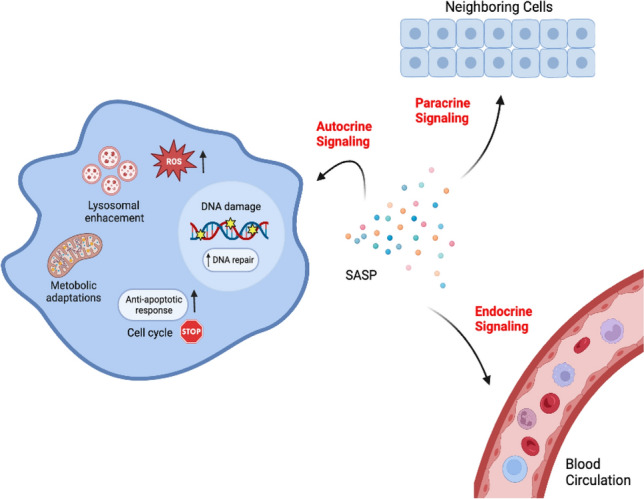
Different types of action of SASP. Stress stimuli can trigger normal cells to enter senescence-associated cell cycle arrest, which is characterized by enlarged and flattened cell shape, lysosomal enhancement, metabolic adaptations, elevated anti-apoptotic response, increasing ROS, and the secretion of SASP. The SASP can have an autocrine effect to reinforce the senescent phenotype and also function in a paracine manner to trigger cellular senescence or regulate the activities of neighboring cells. Endocrine effects of SASP on remote tissues/organs have also been proposed
Fig. 2
Fig. 2
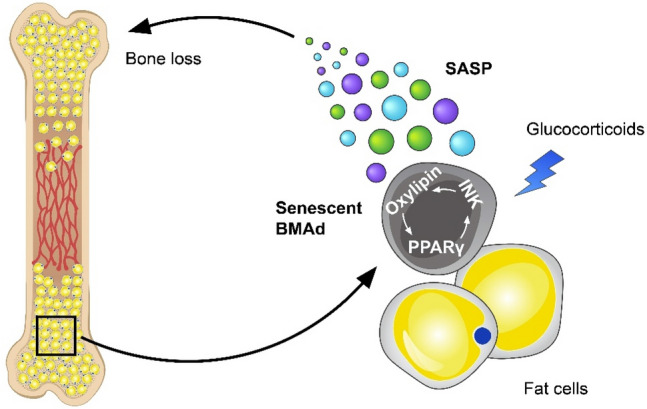
Involvement of senescent BMAds and the SASP in glucocorticoid-induced bone loss. Glucocorticoid treatment induces primary senescence of BMAds through a positive interacting feedback loop of 15d-PGJ2-PPARγ-INK signaling. The senescent BMAds spread senescence to other bone and bone marrow cells, leading to an accumulation of senescent cells for bone impairment
Fig. 3
Fig. 3
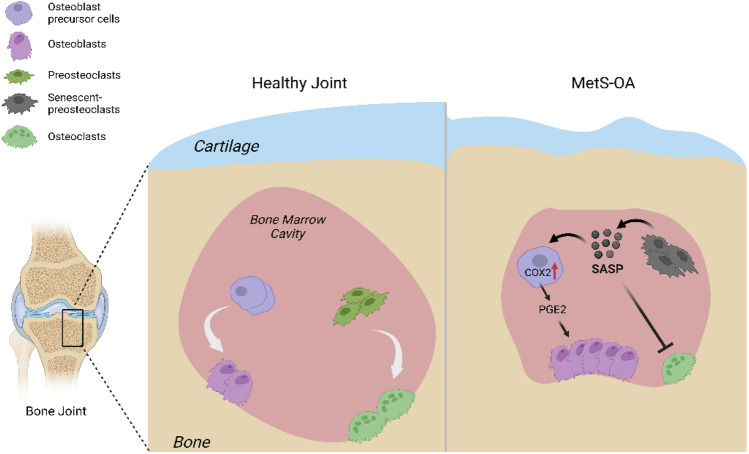
Involvement of preosteoclast-secreted SASP factors in MetS-OA. In normal physiological conditions, the balanced osteoblast and osteoclast differentiation maintain subchondral bone homeostasis and normal subchondral microarchitecture. Under MetS, preosteoclasts in subchondral bone marrow undergo cellular senescence and secrete SASP factors. The SASP acts on both osteoclast precursors to suppress osteoclast differentiation and osteoblast precursors to activate COX2-PGE2 signaling to promote osteoblast differentiation for bone formation, leading to rapid subchondral plate and trabecular bone thickening

References

    1. von Zglinicki T, Petrie J, Kirkwood TB. Telomere-driven replicative senescence is a stress response. Nat Biotechnol. 2003;21(3):229–230. doi: 10.1038/nbt0303-229b. - DOI - PubMed
    1. Bodnar AG, et al. Extension of life-span by introduction of telomerase into normal human cells. Science. 1998;279(5349):349–352. doi: 10.1126/science.279.5349.349. - DOI - PubMed
    1. Robles SJ, Adami GR. Agents that cause DNA double strand breaks lead to p16INK4a enrichment and the premature senescence of normal fibroblasts. Oncogene. 1998;16(9):1113–1123. doi: 10.1038/sj.onc.1201862. - DOI - PubMed
    1. d’Adda di Fagagna F. Living on a break: cellular senescence as a DNA-damage response. Nat Rev Cancer. 2008;8(7):512–22. doi: 10.1038/nrc2440. - DOI - PubMed
    1. Wang C, et al. DNA damage response and cellular senescence in tissues of aging mice. Aging Cell. 2009;8(3):311–323. doi: 10.1111/j.1474-9726.2009.00481.x. - DOI - PubMed

Publication types

LinkOut - more resources