


Assessing Behavioral Risk Factors Driving Zoonotic Spillover Among High-risk Populations in Myanmar
- PMID: 37256491
- PMCID: PMC10230129
- DOI: 10.1007/s10393-023-01636-9
Assessing Behavioral Risk Factors Driving Zoonotic Spillover Among High-risk Populations in Myanmar
Abstract
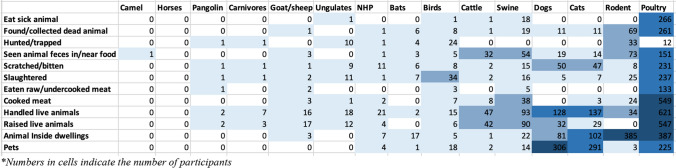
The increasing global emergence of zoonoses warrants improved awareness of activities that predispose vulnerable communities to greater risk of disease. Zoonotic disease outbreaks regularly occur within Myanmar and at its borders partly due to insufficient knowledge of behavioral risks, hindering participatory surveillance and reporting. This study employed a behavioral surveillance strategy among high-risk populations to understand the behavioral risks for zoonotic disease transmission in an effort to identify risk factors for pathogen spillover. To explore behavioral mechanisms of spillover in Myanmar, we aimed to: (1) evaluate the details around animal contact and types of interaction, (2) assess the association between self-reported unusual symptoms (i.e., any illness or sickness that is not known or recognized in the community or diagnosed by medical providers) and animal contact activities and (3) identify the potential risk factors including behavioral practices of self-reported illness. Participants were enrolled at two community sites: Hpa-An and Hmawbi in Southern Myanmar. A behavioral questionnaire was administered to understand participants' animal exposures, behaviors and self-reported illnesses. From these responses, associations between (1) animal contact activities and self-reported unusual illnesses, and (2) potential risk factors and self-reported unusual illness were tested. Contact with poultry seemed to be very frequent (91.1%) and many participants reported raising, handling and having poultry in their houses as well as slaughtering or being scratched/bitten by them, followed by contact with rodents (57.8%) and swine (17.9%). Compared to participants who did not have any unusual symptoms, participants who had unusual symptoms in the past year were more likely to have sold dead animals (OR = 13.6, 95% CI 6.8-27.2), slaughtered (OR = 2.4, 95% CI 1.7-3.3), raised (OR = 3.4, 95% CI 2.3-5.0) or handled animals (OR = 2.1, 95% CI 1.2-3.6), and had eaten sick (OR = 4.4, 95% CI 3.0-6.4) and/or dead animals (OR = 6.0, 95% CI 4.1-8.8) in the same year. Odds of having reported unusual symptoms was higher among those involved in animal production business (OR = 3.4, 95% CI 1.9-6.2) and animal-involved livelihoods (OR = 3.3, 95% CI 1.5-7.2) compared to other livelihoods. The results suggest that there is a high level of interaction between humans, livestock and wild animals in communities we investigated in Myanmar. The study highlights the specific high-risk behaviors as they relate to animal contact and demographic risk factors for zoonotic spillover. Our findings contribute to human behavioral data needed to develop targeted interventions to prevent zoonotic disease transmission at human-animal interfaces.
Keywords: Behavioral risk; Community; Infectious disease transmission; Myanmar; Risk factors; Zoonoses.
© 2023. EcoHealth Alliance.
Figures
References
-
- Belton B, Cho A, Payongayong E, Mahrt K, Abaidoo E. Commercial poultry and pig farming in Yangon’s peri-urban zone. Food Security Policy Project (FSPP)
-
- Blacksell SD, Myint KSA, Khounsy S, Phruaravanh M, Mammen MP, Day NPJ, Newton PN. Prevalence of hepatitis E virus antibodies in pigs: implications for human infections in village-based subsistence pig farming in the Lao PDR. Transactions of the Royal Society of Tropical Medicine and Hygiene. 2007;101:305–307. doi: 10.1016/j.trstmh.2006.05.003. - DOI - PMC - PubMed
Publication types
MeSH terms
Grants and funding
LinkOut - more resources
Full Text Sources
Medical
Miscellaneous
