Effect of Perioperative Palliative Care on Health-Related Quality of Life Among Patients Undergoing Surgery for Cancer: A Randomized Clinical Trial
- PMID: 37256623
- PMCID: PMC10233417
- DOI: 10.1001/jamanetworkopen.2023.14660
Effect of Perioperative Palliative Care on Health-Related Quality of Life Among Patients Undergoing Surgery for Cancer: A Randomized Clinical Trial
Abstract
Importance: Involvement of palliative care specialists in the care of medical oncology patients has been repeatedly observed to improve patient-reported outcomes, but there is no analogous research in surgical oncology populations.
Objective: To determine whether surgeon-palliative care team comanagement, compared with surgeon team alone management, improves patient-reported perioperative outcomes among patients pursuing curative-intent surgery for high morbidity and mortality upper gastrointestinal (GI) cancers.
Design, setting, and participants: From October 20, 2018, to March 31, 2022, a patient-randomized clinical trial was conducted with patients and clinicians nonblinded but the analysis team blinded to allocation. The trial was conducted in 5 geographically diverse academic medical centers in the US. Individuals pursuing curative-intent surgery for an upper GI cancer who had received no previous specialist palliative care were eligible. Surgeons were encouraged to offer participation to all eligible patients.
Intervention: Surgeon-palliative care comanagement patients met with palliative care either in person or via telephone before surgery, 1 week after surgery, and 1, 2, and 3 months after surgery. For patients in the surgeon-alone group, surgeons were encouraged to follow National Comprehensive Cancer Network-recommended triggers for palliative care consultation.
Main outcomes and measures: The primary outcome of the trial was patient-reported health-related quality of life at 3 months following the operation. Secondary outcomes were patient-reported mental and physical distress. Intention-to-treat analysis was performed.
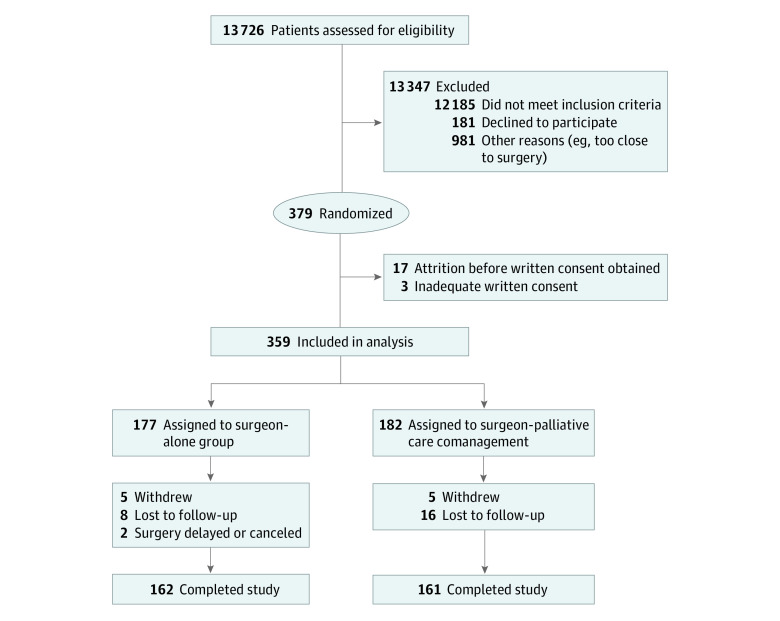
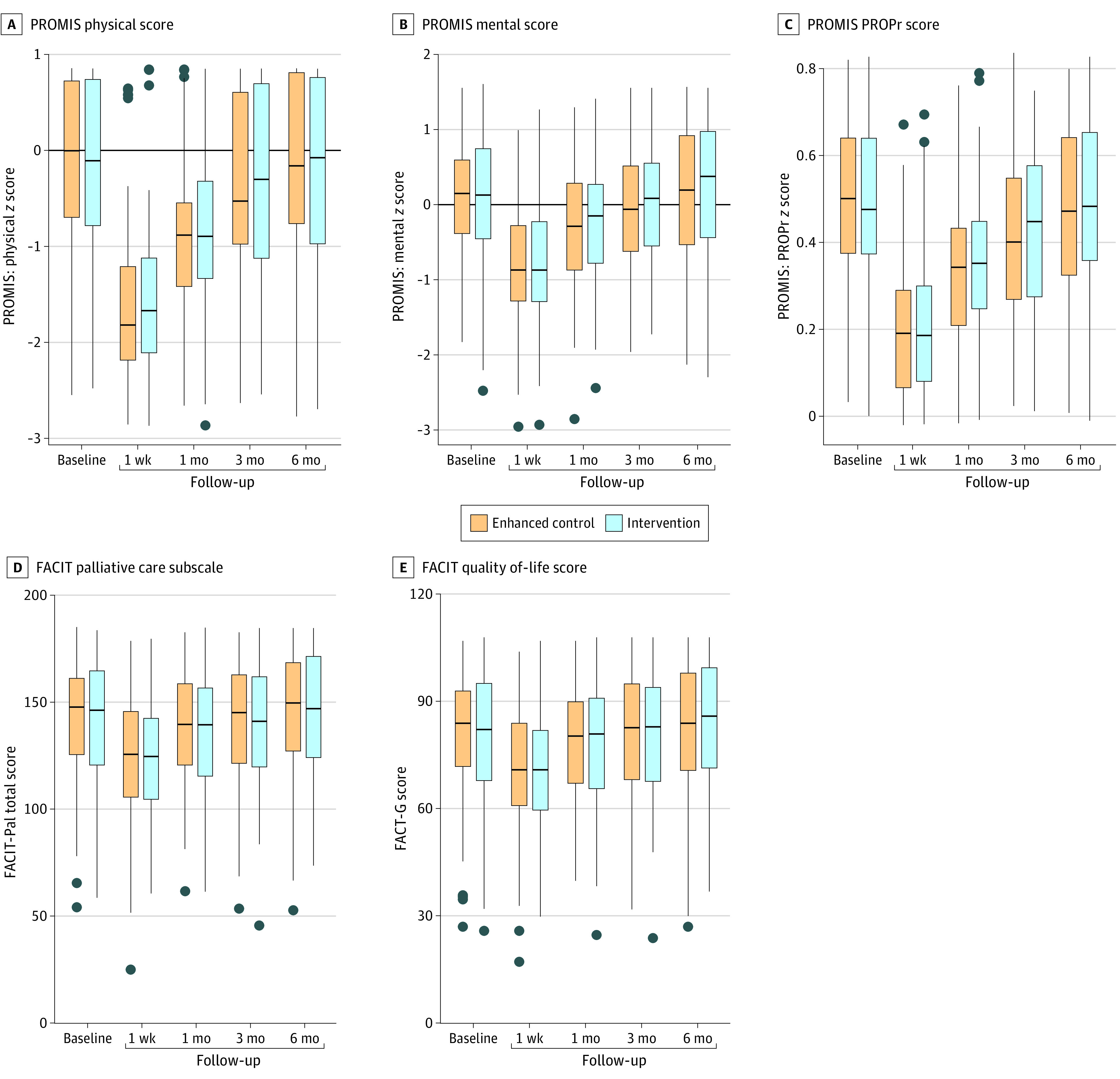
Results: In total, 359 patients (175 [48.7%] men; mean [SD] age, 64.6 [10.7] years) were randomized to surgeon-alone (n = 177) or surgeon-palliative care comanagement (n = 182), with most patients (206 [57.4%]) undergoing pancreatic cancer surgery. No adverse events were associated with the intervention, and 11% of patients in the surgeon-alone and 90% in the surgeon-palliative care comanagement groups received palliative care consultation. There was no significant difference between study arms in outcomes at 3 months following the operation in patient-reported health-related quality of life (mean [SD], 138.54 [28.28] vs 136.90 [28.96]; P = .62), mental health (mean [SD], -0.07 [0.87] vs -0.07 [0.84]; P = .98), or overall number of deaths (6 [3.7%] vs 7 [4.1%]; P > .99).
Conclusions and relevance: To date, this is the first multisite randomized clinical trial to evaluate perioperative palliative care and the earliest integration of palliative care into cancer care. Unlike in medical oncology practice, the data from this trial do not suggest palliative care-associated improvements in patient-reported outcomes among patients pursuing curative-intent surgeries for upper GI cancers.
Trial registration: ClinicalTrials.gov Identifier: NCT03611309.
Conflict of interest statement
Figures
Comment in
-
Early Palliative Care Consultation Before High-risk Surgery.JAMA Netw Open. 2023 May 1;6(5):e2314627. doi: 10.1001/jamanetworkopen.2023.14627. JAMA Netw Open. 2023. PMID: 37256628 No abstract available.
-
Palliative Care for Patients Undergoing Surgery.JAMA Surg. 2024 Feb 1;159(2):229. doi: 10.1001/jamasurg.2023.4514. JAMA Surg. 2024. PMID: 37755823 No abstract available.
References
Publication types
MeSH terms
Associated data
Grants and funding
LinkOut - more resources
Full Text Sources
Medical
Miscellaneous