


Timing and burden of persistent critical illnessin UK intensive care units: An observational cohort study
- PMID: 37260430
- PMCID: PMC10227892
- DOI: 10.1177/17511437211047180
Timing and burden of persistent critical illnessin UK intensive care units: An observational cohort study
Abstract
Background: Persistent critical illness is a recognisable clinical syndrome defined conceptually as when the patient's reason for being in the intensive care unit (ICU) is more related to their ongoing critical illness than their original reason for admission. Our objectives were: (1) to assess the day in ICU on which chronic factors (e.g., age, gender and comorbidities) were more predictive of survival than acute factors (e.g. admission diagnosis, physiological derangements) measured on the day of admission; (2) to assess the consistency of this finding across major patient subgroups and over time and (3) to compare case mix characteristics and outcomes for patients determined to develop persistent critical illness (based on ICU length of stay) with other patients.
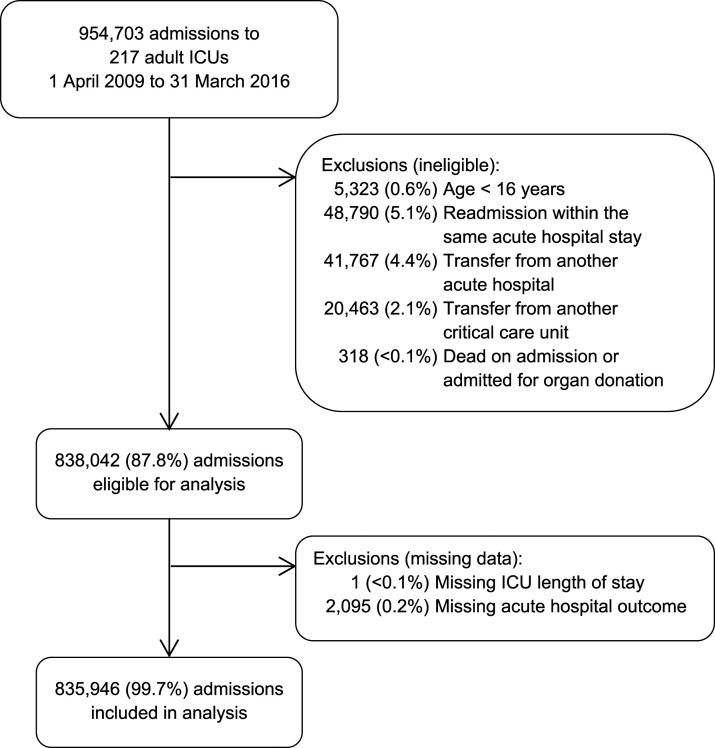
Methods: Observational cohort study using a high-quality clinical database from the national clinical audit of adult critical care. 217 adult ICUs in England, Wales and Northern Ireland. 835,946 adult patients admitted to participating ICUs between 1 April 2009 and 31 March 2016. The main outcome measure was mortality at discharge from acute hospital.
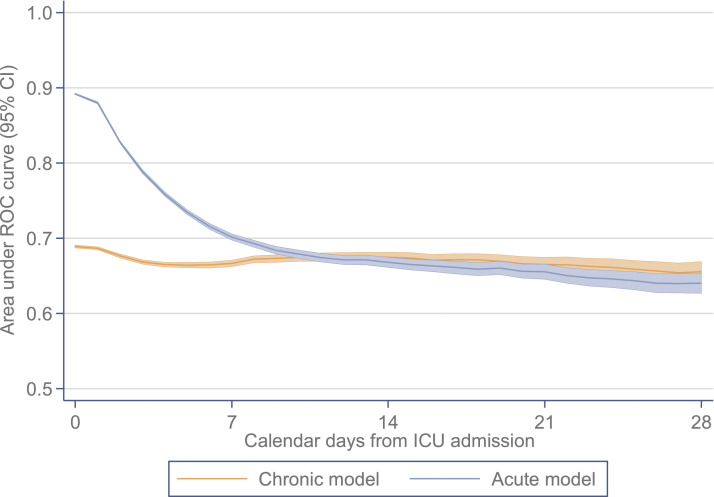
Results: We fitted two statistical models ('chronic' and 'acute') and updated these based upon patients with an ICU length of stay of at least 1, 2, etc., up to 28 days. The discrimination of the chronic model first exceeded that of the acute model on day 11. Patients with longer stays (>10 days) comprised 9% of admissions but used 45% of ICU bed-days. After a mean ICU length of stay of 22 days and a subsequent 28 days in hospital, 30% died.
Conclusions: Persistent critical illness is commonly encountered in clinical practice and is associated with increased healthcare utilisation and adverse outcomes. Improvements in our understanding of the longer term outcomes and in the development of tools to aid prognostication are urgently required - for humane as well as health economic reasons.
Keywords: Prognosis; artificial; critical care; critical illness; hospital mortality; respiration.
© The Intensive Care Society 2021.
Conflict of interest statement
The author(s) declared no potential conflicts of interest with respect to the research, authorship, and/or publication of this article.
Figures
References
-
- Intensive Care National Audit & Research Centre (ICNARC) . Key statistics from the case mix programme-adult, general critical care units. 1 april 2017 to 31 march 2018. London, UK: ICNARC, 2018.
-
- Iwashyna TJ, Hodgson CL, Pilcher D, et al.Towards defining persistent critical illness and other varieties of chronic critical illness. Crit Care Resusc 2015; 17: 215–218. - PubMed
LinkOut - more resources
Full Text Sources
Miscellaneous